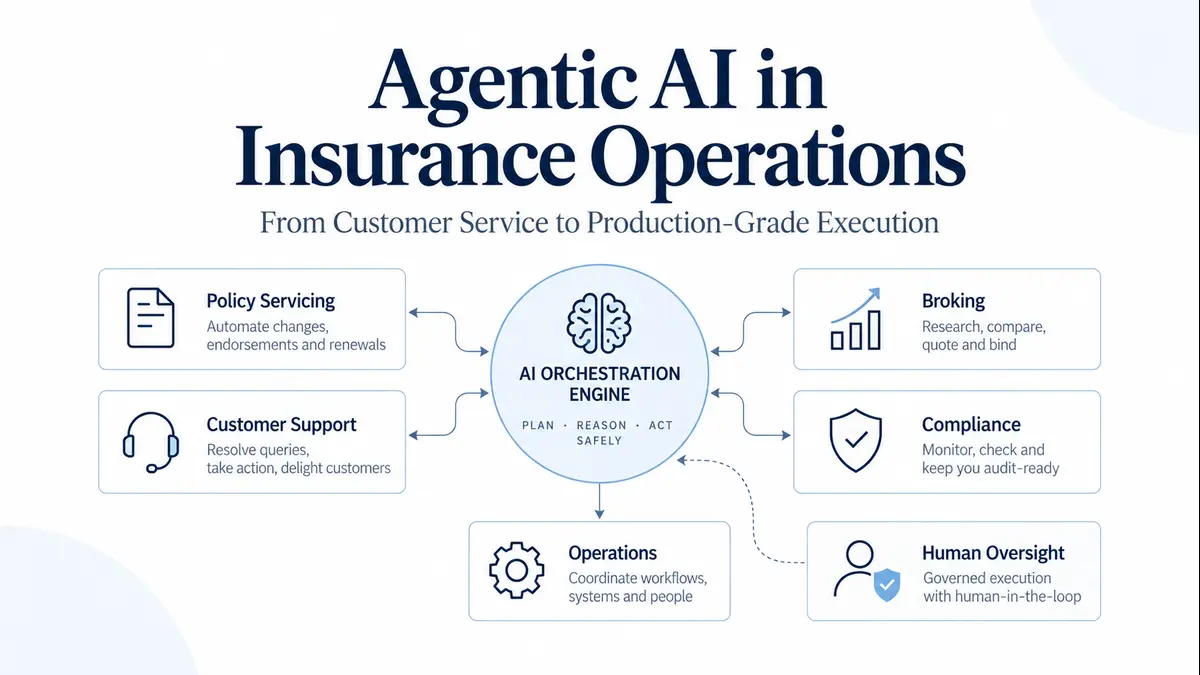
Agentic AI in insurance operations is moving beyond information retrieval and copilots towards controlled execution across servicing, distribution, compliance and back-office workflows.
In Part 1 of this series, we examined how agentic AI is emerging across claims, underwriting and fraud. Those functions reveal both the potential of coordinated AI workflows and the limits of delegating consequential insurance decisions.
The wider operational opportunity extends well beyond them.
Policy servicing, customer support, distribution, broking, compliance and back-office operations contain thousands of repetitive but variable workflows. These are areas where AI agents can gather information, coordinate tasks, manage exceptions and prepare approved actions without immediately taking over the most sensitive decisions affecting customers or capital.
This second part examines how that transition is unfolding, the data and governance foundations it requires, how insurers should measure economic value, and which insurance agents are most likely to reach production next.

Policy Servicing: Where Chatbots Begin to Become Agents
Policy servicing is one of the clearest areas where conversational AI can evolve into controlled execution.
A typical workflow is:
Customer request → identity and authority verification → policy retrieval → eligibility check → calculation or document preparation → approval → policy-system update → confirmation
A chatbot generally answers questions near the beginning of this process. An agent can go further by collecting the required information, checking servicing rules, preparing a transaction and, for selected low-risk requests, initiating an approved system update.
Servicing can include contact-detail changes, payment-method updates, certificate generation, coverage amendments, reinstatement, cancellation, beneficiary changes and renewal preparation. These transactions do not carry the same level of risk. Updating an email address is fundamentally different from changing a beneficiary, reducing coverage or cancelling a policy.
Lemonade: Servicing Within an Integrated Platform
Lemonade reports that CX.AI handles more than half of customer enquiries without human intervention.
The system answers coverage questions and supports activities such as adding a spouse, changing payment methods, updating coverage amounts and adding newly purchased items. This moves beyond a knowledge-only chatbot because the system supports actual policy-servicing activity.
Its effectiveness is closely connected to Lemonade’s integrated customer and policy environment. Instead of reconstructing the customer’s position from unrelated legacy records, the system can interact with connected servicing workflows.
Generali Switzerland: Multilingual Customer Assistance
Generali Switzerland’s Chatty provides multilingual support for policy selection, customer questions and claims assistance.
The public evidence demonstrates conversational and process support, but not independent authority over consequential policy or claims decisions.
That distinction matters. Helping a customer understand insurance is not the same as altering the customer’s contractual position.
What the Policy-Servicing Evidence Suggests
Insurers should define authority at the level of the individual transaction rather than treating policy servicing as one universal automation category.
An agent may be permitted to answer policy questions, gather information, pre-populate requests, generate certificates or prepare a transaction for approval.
Stronger authentication, formal approval or human review may remain necessary for beneficiary changes, cancellation, reinstatement, reductions in coverage or changes affecting premium obligations.
The strongest near-term model is therefore graduated servicing authority: agents complete clearly defined and lower-risk actions, while higher-impact changes remain subject to stronger verification and accountable approval.
Customer Support: Copilots First, Transaction Agents Later
Customer support is one of the fastest-moving areas of insurance AI because many enquiries are repetitive, information-heavy and suitable for structured escalation.
A typical workflow is:
Understand the enquiry → verify the customer and policy → retrieve information → explain or resolve → transfer or initiate an approved action → document the interaction
Most early deployments have focused on copilots rather than autonomous agents. These systems help employees retrieve information, prepare responses and summarise interactions without immediately granting AI authority to alter policies or make consequential decisions.
AIA: Improving Employee Productivity
AIA has reported more than 50 generative-AI use cases.
Its customer-service copilot helps representatives answer enquiries and summarise interactions, reducing post-call wrap-up time by approximately 50%. AIA has also used generative AI to analyse medical documents, reporting time savings of up to 55% for claims assessors and underwriters.
These are meaningful productivity gains, but the systems remain primarily assistive. Employees continue to own the customer interaction and execute the relevant insurance action.
Ping An: Customer Service at Industrial Scale
Ping An reported approximately 1.84 billion interactions through AI smart voice agents during 2024, representing around 80% of its customer-service volume.
The number illustrates the scale at which AI-supported service can operate. This however, should nevertheless be interpreted carefully: an interaction handled by AI may involve routing, information retrieval, question answering or transaction support, and public disclosures do not separate every interaction according to its degree of autonomy.
The case demonstrates scale, but not necessarily unrestricted decision-making.
From Knowledge Support to Controlled Execution
Customer-support AI is likely to progress through three broad stages.
Knowledge support retrieves policy information, procedures and product guidance.
Case preparation understands the issue, collects information, identifies missing details and prepares the next action.
Controlled execution completes an approved transaction when identity, authority, rules and system permissions can be reliably verified.
The first stage is common today. The second is becoming more practical. The third requires significantly stronger integration, authentication, monitoring, permissions and exception handling.
The objective should therefore not be to eliminate human contact. It should be to resolve routine enquiries faster while ensuring that complex, emotional or high-impact cases reach a professional with the relevant context already assembled.

Distribution and Broking: AI as a Professional Enablement Layer
Insurance distribution involves far more than lead generation or answering product questions.
A simplified workflow is:
Client need identified → exposure or needs assessment → product and market analysis → application or submission preparation → quotation → advice and negotiation → renewal
In personal insurance, conversational systems can guide customers through relatively standardised quotation and onboarding processes.
Commercial and specialty insurance is more complex. Brokers must organise corporate-risk information, identify appropriate markets, compare quotations and explain differences in limits, deductibles, exclusions and insurer appetite.
AIA and Lemonade: Two Distribution Models
AIA uses an AI-driven training system that simulates customer interactions for insurance advisors. The company reported a ten-point improvement in assessment scores among agents using the system.
This represents AI as a professional-development tool: strengthening advisor capability rather than replacing the advisor.
Lemonade demonstrates a more automated direct-distribution model. The company reports that AI Maya and its APIs sell 98% of its policies. Maya collects information, adapts questions, personalises coverage options, generates quotations and supports payment.
That model is particularly suited to standardised retail products inside an integrated digital insurer. It is less directly transferable to complex commercial risks that require negotiation, bespoke wordings and interaction with multiple insurance markets.
Aon and the Intermediary Opportunity
Brokers and risk advisers occupy a different position in the value chain.
An insurer principally evaluates whether a risk should be accepted, on what terms and at what price. A broker must also determine how the client’s risk should be presented, which insurers may be appropriate, how quotations differ and what recommendation should ultimately be made.
Aon’s disclosed AI-related capabilities include pricing technology, claims and litigation analytics, and insurance-market research. Its Pricing Platform supports underwriting teams through richer data capture, configurability and workflow integration, but it is better understood as decision infrastructure rather than an autonomous underwriter.
Aon’s LAMBDA capability similarly applies AI-derived insights to litigation risk, attorney performance and claim resolution. These tools strengthen professional analysis without transferring final advisory or claims authority to the system.
What the Distribution Evidence Suggests
One of the strongest commercial-insurance opportunities is a submission and placement-preparation agent.
Such a system could organise exposure information, identify missing schedules, create consistent risk summaries, prepare insurer-specific submission packs, track clarification requests, compare quotations and exclusions, and support renewal preparation.
The broker would retain responsibility for market strategy, negotiation, recommendation and the client relationship.
AI is therefore more likely to strengthen professional broking than eliminate it. Its value lies in removing administrative friction and improving the quality of information available for judgment, negotiation and client advice.
Operations, Compliance and Data Readiness
Some of the most practical insurance agents may emerge first in back-office operations rather than in highly visible decisions such as claim denial or underwriting acceptance.
A typical operational workflow is:
Email or document received → content classified → information extracted → work item created → case routed → records reconciled → exception identified → quality checked → reporting updated
Potential applications include document classification, inbound-email triage, premium reconciliation, bordereaux processing, work allocation, catastrophe-surge handling, exception management and operational reporting.
These processes are repetitive and measurable, while generally carrying less direct customer-decision risk than pricing, coverage or settlement.
From Task Automation to Exception Management
Traditional automation works best when inputs follow predictable structures.
Insurance operations rarely remain perfectly predictable.
Documents arrive in different formats. Information can be missing. Transactions fail reconciliation. Cases become stalled because the next action depends on context spread across emails, policy systems and work queues.
An operational agent can potentially recognise when a case has deviated from the expected process, collect the relevant context and either initiate an approved corrective action or route the exception to the appropriate professional.
The ability to manage variability—not merely repeat a predefined action—is where agentic systems can create substantial operational value.
Compliance as Monitoring and Evidence Preparation
AI can also support compliance workflows such as:
Regulatory change identified → applicability assessed → affected products and controls mapped → amendments prepared → implementation tracked → evidence collected → testing and reporting
Other applications include policy-wording comparison, complaint-pattern analysis, sales-conduct monitoring, call-quality review, sanctions support, control testing and audit-evidence preparation.
Public evidence of fully autonomous compliance agents remains limited. The more credible near-term role is to monitor developments, compare documents, identify possible gaps and assemble evidence for accountable legal and compliance professionals.
Existing deployments already point in this direction. Allianz’s Project Nemo includes an audit agent that documents the workflow before human approval. Lemonade’s internal Cooper system performs operational activities including processing paper checks and supporting regulatory-filing preparation. AIA has used generative AI to reduce document-analysis time.
Data Readiness Is the Real Constraint
An insurance agent can act reliably only when it receives the correct information, in the correct version, with known provenance and appropriate permissions.
The precise information varies by function. Claims requires policy wordings, endorsements, evidence and loss information. Underwriting requires exposure data, loss runs, appetite rules and historical decisions. Fraud depends on identity, behavioural and relationship information. Servicing needs customer authority, policy status and transaction history. Broking depends on exposures, programme structures, quotations and insurer appetite. Compliance and operations require regulations, controls, work queues, correspondence and audit evidence.
Four disciplines are particularly important.
Version control: the system must know which policy wording, endorsement, underwriting manual or regulation applied at the relevant time.
Provenance: the organisation must know where information came from and whether it has been verified.
Historical quality: previous decisions may contain inconsistencies, outdated practices or bias. Automating history can reproduce those weaknesses at greater scale.
Permissions and purpose: access to sensitive health, identity, behavioural and financial information must be limited according to the agent’s role and legitimate purpose.
The practical bottleneck is therefore rarely the language model alone.
A production insurance agent also requires reliable integrations, document and policy versioning, role-based permissions, traceable source evidence, exception handling, workflow ownership and explicit limits on execution authority.
Without these foundations, insurers may build impressive conversational interfaces that remain unable to complete real insurance work safely.

Risks, Governance and Human Accountability
Insurance agents introduce risks beyond ordinary software failure because their outputs can influence coverage, pricing, claims, customer treatment and access to financial protection.
One risk is incorrect policy interpretation. A system may retrieve the correct base wording but fail to account for an endorsement, exclusion, definition, limit, deductible, effective date or jurisdictional rule that changes the answer.
Another is unfair discrimination. Historical insurance data may contain inconsistent treatment or variables that act as proxies for protected characteristics. Automating those outcomes can reproduce their weaknesses at greater speed and scale.
European supervisory guidance expects insurers to apply proportionate controls around fairness, data governance, documentation, explainability, human oversight, accuracy, robustness and cybersecurity.
Human Review Must Be Meaningful
Adding a human approval step does not automatically make a system safe.
Automation bias can lead employees to accept a recommendation because it appears detailed, consistent or confident.
Human oversight is meaningful only when reviewers have sufficient time to examine the case, access to supporting evidence, authority to reject or modify the recommendation, and training to understand the system’s limitations.
Authority should therefore be defined at workflow level. The organisation must specify what an agent may retrieve, recommend, initiate and complete—and which actions always require professional approval.
Privacy, Cybersecurity and Third-Party Risk
Insurance workflows frequently involve sensitive medical, financial, identity, behavioural and location information.
Agents can create privacy risk through excessive retrieval, weak permissions, inappropriate reuse or accidental disclosure.
They also introduce new cybersecurity concerns. Submitted documents may contain malicious instructions. Images may be synthetic. Attackers may attempt to manipulate the agent, its tools or the information sources it relies upon.
Third-party dependence adds another layer of risk. Insurers remain accountable for vendor-supplied AI and therefore require appropriate due diligence, monitoring, contractual protections and visibility into system limitations and governance.
Explanation, Redress and Regulatory Accountability
Customers affected by material decisions should be able to understand the role AI played and seek human review.
This becomes particularly important for claim denial, fraud referral, underwriting decisions, cancellation and material pricing.
In the European Union, AI used for risk assessment and pricing concerning individuals in life and health insurance is classified as high-risk under the EU AI Act. In the United States, the NAIC has similarly emphasised that insurance decisions supported by AI remain subject to existing requirements concerning fairness, accuracy and unfair discrimination.
The governing principle is straightforward:
The greater the authority delegated to an agent, the stronger the required evidence, testing, supervision and customer recourse.

Measuring ROI: From Time Saved to Insurance Value
The return on agentic AI should not be reduced to employee hours saved.
A more complete model is:
Economic value = capacity released + leakage prevented + recoveries identified + conversion or retention improvement + rework avoided − implementation and control costs
The strongest insurance use cases may create value by preventing loss, identifying recovery opportunities or accelerating sound decisions—not simply by reducing administrative effort.
Because production economics must be assessed across the full insurance value chain, the measurement framework also includes claims, underwriting and fraud, which were examined in Part 1.
Claims
Relevant measures include FNOL-to-triage time, settlement cycle time, human touches per claim, cost per claim, reopening rates, leakage, recovery and subrogation yield, fraud-alert precision, complaints and customer satisfaction.
Allianz demonstrates the cycle-time opportunity, while Swiss Re shows how AI can create value through possible fraud identification and previously missed recovery opportunities.
Underwriting
Useful measures include submission completeness, submission-to-quote time, review effort, clarification cycles, referral rates, quote-to-bind conversion, post-bind corrections, appetite adherence and subsequent portfolio performance.
The objective should not be to generate more quotations indiscriminately. It should be to improve the speed and consistency of sound underwriting decisions.
Fraud
Fraud systems should be assessed through alert precision, false-positive rates, prevented loss, application fraud stopped, investigator capacity, evidence-assembly time and the number of genuine customers unnecessarily delayed.
A system that produces more alerts but creates excessive customer friction may destroy rather than create value.
Servicing, Distribution and Operations
Policy servicing and customer support can be measured through handling time, first-contact resolution, transfer rates, repeat enquiries, transaction accuracy, turnaround time and complaints.
For distribution and broking, value may appear through improved submission quality, fewer clarification cycles, faster placement, stronger quote comparison, better renewal preparation and greater broker capacity.
Compliance and operational systems can be measured through review time, evidence completeness, exception rates, rework, control failures, repeat audit findings and regulatory-response time.
Every deployment should establish a baseline before implementation. Otherwise, an organisation may know that an agent is active without knowing whether it is creating economic value.
Market Gaps and the Practical Agents Likely to Emerge Next
Despite visible progress, the insurance industry has not solved several foundational problems.
The Gap Between Copilots and Execution
Many systems can summarise documents, answer questions or generate recommendations.
Far fewer can coordinate workflows across multiple systems, manage exceptions and complete approved actions reliably.
This remains the central divide between an impressive demonstration and a production-grade agent.
The Gap Between Retrieval and Insurance Judgment
Retrieving a policy clause is not the same as interpreting a policy.
Insurance decisions can depend on the interaction among wordings, endorsements, exclusions, definitions, deductibles, limits, dates, jurisdiction and case-specific evidence.
Similarly, retrieving a comparable underwriting case does not establish that the previous decision remains appropriate.
The unresolved challenge is therefore not simply access to information. It is controlled reasoning across the complete insurance context.
The Gap Between Pilot and Production
A proof of concept can succeed with selected documents and cooperative users.
Production requires identity and access controls, permissions, document versioning, system integration, monitoring, exception handling, fallback procedures, security testing and clear ownership.
Many firms can demonstrate an AI use case. Far fewer can operate one continuously across real customer, operational and regulatory conditions.
The Evaluation and Readiness Gaps
Insurance organisations also need workflow-specific evaluation rather than generic model benchmarks.
A claims agent must be assessed for coverage accuracy, missing evidence, leakage, false referrals and customer outcomes. An underwriting agent must be tested for completeness, appetite adherence, consistency, anomaly detection and downstream portfolio performance.
An articulate system can still perform poorly on the insurance outcome that matters.
Organisational readiness is equally important. Technology, operations, risk, compliance, legal and actuarial teams must agree on authority, escalation and ownership before deployment.
AI cannot compensate for a process that has no clear owner or standard operating method.
The Access Gap
Large insurers and reinsurers can build proprietary AI platforms and governance programmes.
Mid-sized carriers, brokers, managing general agents and third-party administrators face similar document and workflow problems but often lack comparable technology budgets and internal engineering teams.
They need configurable, insurance-specific solutions—not generic chatbots and not multi-year transformation programmes.
This may become one of the largest commercial opportunities in insurance AI.
The Insurance Agents Most Likely to Reach Production
The first successful insurance agents are likely to prepare, coordinate and evidence decisions rather than immediately assume responsibility for the most consequential outcomes.
Underwriting Submission-Readiness Agent
It would classify documents, extract exposures, identify missing information, check appetite and referral rules, prepare broker questions and generate an underwriting-ready memo.
Pricing and binding authority would remain with the underwriter.
Claims Intake and Evidence Agent
It would collect FNOL information, classify documents and images, identify missing evidence, retrieve relevant policy material and route the claim according to complexity and urgency.
Claims Recovery and Subrogation Agent
It would search claim files for responsible third parties, contractual recovery rights and missed subrogation opportunities.
This type of agent can create direct financial value rather than merely reducing labour.
Broker Placement-Preparation Agent
It would organise client exposures, identify missing schedules, prepare market submissions, compare quotations and track exclusions and subjectivities.
Brokers would retain responsibility for market selection, negotiation and advice.
Compliance and Audit-Evidence Agent
It would track regulatory developments, map requirements to policies and controls, collect supporting evidence and prepare audit or regulatory-response files.
Legal interpretation would remain with accountable professionals.
Operations Exception-Management Agent
It would monitor work queues, detect stalled or inconsistent cases, gather missing context and initiate or recommend an approved corrective action.
Fraud Investigation-Support Agent
It would combine anomaly scores, relationship data, documents, images, claim narratives and previous activity into an investigator-ready evidence file.
Its output would remain a hypothesis and evidence trail—not a final fraud declaration.
Autonomous claim denial, unrestricted premium setting, independent fraud determination and fully autonomous complex underwriting remain poor first targets. They carry significant customer and regulatory risk and depend heavily on institution-specific data, authority limits and controls.
The strongest first-wave agents will remove administrative and analytical friction while preserving accountable decision authority.
Controlled Agency Will Define the Next Phase of Insurance
Across both parts of this series, the evidence points to several distinct adoption models: narrow multi-agent workflows, integrated digital automation, industrial-scale AI deployment, professional copilots and specialist decision-support systems.
Despite their differences, a common pattern is emerging.
The most credible deployments increase the amount of work AI can collect, analyse, prepare and coordinate while keeping consequential authority visible and accountable.
Agentic AI is therefore unlikely to arrive in insurance as one universal digital employee. It is more likely to emerge as a network of specialised systems operating inside defined workflows—interpreting documents, consulting rules, verifying evidence, coordinating routine tasks, managing exceptions and escalating consequential decisions.
The firms that derive lasting value will not necessarily be those deploying the largest models.
They will be those that select the right workflow, organise the relevant information, define authority precisely, measure the business outcome and ensure responsibility remains visible.
Insurance has always depended on trust: between policyholder and insurer, client and broker, carrier and reinsurer, and regulated institution and society.
Agentic systems will earn a role in that structure only when they make insurance faster and more intelligent without making accountability harder to locate.
The future of insurance is therefore unlikely to be a contest between human judgment and artificial intelligence.
It will be the deliberate redesign of where human judgment remains indispensable—and where well-controlled agents can remove the friction that prevents professionals from applying it.
Discover more from Poniak Times
Subscribe to get the latest posts sent to your email.