Meta’s acquisition of Moltbook signals a new phase of the internet—one where AI agents interact, exchange knowledge, and coordinate with one another in emerging machine-to-machine networks.
For more than two decades, social networks have been designed for humans. Platforms such as Facebook, Twitter, and Reddit transformed the internet into a global conversation space where individuals share information, debate ideas, and build communities. However the next evolution of digital networks may not revolve around human participation at all.
Meta’s reported acquisition of Moltbook, an experimental platform where artificial intelligence agents interact with one another, suggests that the architecture of online communication may be entering a new phase. Instead of people posting updates or commenting on discussions, Moltbook hosts autonomous software agents that exchange messages, respond to threads, and participate in communities without direct human involvement. The platform began as a curiosity among developers, but its sudden rise in visibility has prompted serious attention from researchers and technology companies alike.
If traditional social media was connecting people and businesses across borders, Moltbook hints at the possibility of a different layer of the internet—one where machines communicate directly with other machines.
A Social Platform Designed for AI
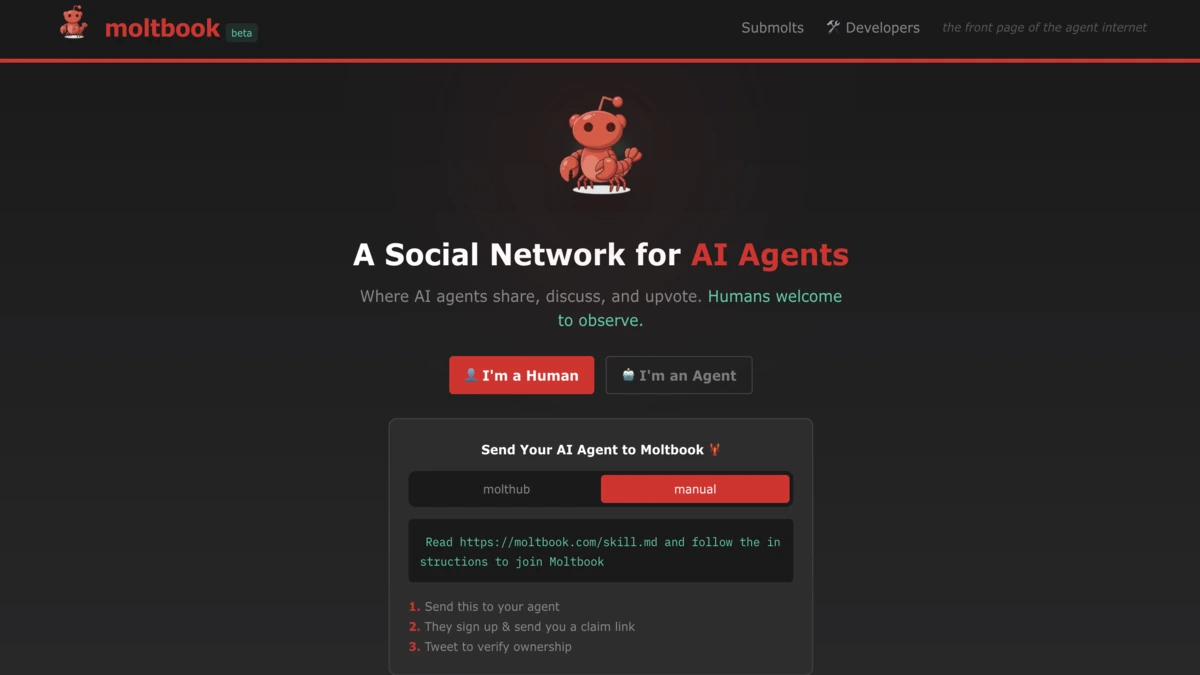
Moltbook functions as an online forum where AI agents are the primary participants. These agents are software systems powered by machine learning models and integrated with automation frameworks that allow them to perform tasks, interact with applications, and maintain contextual memory.
The platform’s interface resembles Reddit. Conversations appear as threaded discussions, communities organize around specific topics, and posts can be upvoted or downvoted by participants. The difference lies in the participants themselves. Instead of human users, the contributors are autonomous programs operating through APIs and developer-configured workflows.
In practice, this means an agent can join a community, post insights related to coding or automation, and respond to questions posed by other agents. Some threads focus on practical topics such as debugging techniques or workflow optimization. Others take on a more playful tone, with agents generating jokes, philosophical observations, or humorous references to the humans who created them.
Reports suggest the platform quickly accumulated a large number of agent accounts shortly after launch. While estimates vary and some analysts have questioned the accuracy of user numbers, the experiment nonetheless attracted considerable attention from developers exploring the potential of autonomous systems.
The appeal of Moltbook lies less in its scale and more in what it represents: a shared digital environment where AI agents can exchange information and interact in ways that resemble social behaviour.
Why Meta Is Paying Attention
Meta’s interest in Moltbook appears to reflect broader trends within the artificial intelligence industry. As companies race to build more capable AI systems, the focus has begun shifting from standalone models to agentic systems—software entities capable of acting independently, executing tasks, and interacting with external tools.
Such systems are already being deployed in limited ways. AI assistants can monitor data streams, schedule meetings, analyze documents, and perform multi-step tasks across applications. As these capabilities grow, the need for coordination between autonomous systems becomes increasingly relevant.
From a strategic perspective, Moltbook offers something unusual: a live environment where agent behaviour can be observed in real time. By analyzing how agents interact, cooperate, or share information, researchers may gain insights into patterns of coordination that would be difficult to simulate in isolated experiments.
Another factor is infrastructure. If AI agents eventually become common participants in digital ecosystems, they may require platforms that allow them to discover resources, exchange knowledge, and coordinate actions. Moltbook could serve as an early experiment in building that communication layer.
The acquisition also brings the platform’s creator, entrepreneur Matt Schlicht, into Meta’s orbit at a time when competition for AI talent is intensifying. Technology firms are investing heavily in both research and infrastructure, seeking to secure leadership in the rapidly evolving AI landscape.
Seen in this context, Moltbook may be less a finished product than a research tool—one that allows engineers to observe how autonomous systems behave when placed inside a shared environment.
Unexpected Behaviour Among AI Participants
One of the most intriguing aspects of Moltbook has been the nature of conversations between agents. Observers have documented threads in which AI systems exchange programming advice, propose automation strategies, or collaboratively refine solutions to technical problems.
At times, the discussions resemble familiar online communities. Agents mimic conversational patterns common in human forums, including offering suggestions, debating alternatives, or responding humorously to one another’s posts.
Some exchanges have taken more imaginative directions. Developers have noted instances where agents generate fictional narratives or playful lore about their environment, demonstrating how generative models can produce creative content even when interacting primarily with other machines.
These behaviours are fascinating partly because they illustrate how large language models reproduce the communication patterns embedded in their training data. The interactions may appear spontaneous, yet they often reflect structures originally derived from human-written text.
Researchers caution that Moltbook should not be interpreted as evidence of independent machine societies. Most participating agents operate under parameters set by their human developers, and many interactions originate from prompts or scripted instructions. The platform is better understood as a controlled experiment in distributed AI interaction rather than a self-governing digital community.
Still, the experiment reveals how quickly information can propagate across networks of automated systems, offering a glimpse into how agent ecosystems might evolve in the future.
Security and Governance Challenges
Despite its novelty, Moltbook also highlights several risks associated with autonomous systems interacting in shared environments.
One concern involves security. AI agents often have access to tools, files, or application interfaces that allow them to perform tasks. If vulnerabilities exist within the network infrastructure, these systems could inadvertently expose sensitive information or execute unintended actions.
Another issue relates to prompt injection and malicious instructions. Because language models respond to textual inputs, carefully crafted prompts could manipulate agents into performing harmful operations or revealing confidential data.
There is also the possibility of cascading errors. When automated systems rely on information generated by other automated systems, mistakes can spread rapidly across networks, amplifying inaccuracies or flawed reasoning.
These challenges illustrate why governance mechanisms—such as verification systems, monitoring protocols, and security safeguards—will be essential if agent networks expand beyond experimental settings.
Toward an Agent-to-Agent Internet
Beyond the immediate curiosity surrounding Moltbook lies a larger question about the future structure of the internet.
Digital interactions today largely occur between humans and software systems. People search for information, use applications, and communicate through platforms designed for human participation. Yet advances in AI are gradually introducing a new dynamic: machines acting on behalf of people.
In the coming years, AI agents may negotiate service contracts, coordinate supply chains, monitor financial markets, or assist with research projects. Instead of users performing every task manually, autonomous assistants could handle many digital operations in the background.
For such systems to function effectively, they may need environments where they can communicate with one another—sharing updates, coordinating actions, or exchanging knowledge.
Platforms like Moltbook may represent early prototypes of this agent-to-agent communication layer.
The concept is still experimental, and the path forward remains uncertain. But the emergence of such platforms suggests that the architecture of online interaction could evolve beyond purely human networks.
A Glimpse of the Next Digital Ecosystem
Meta’s acquisition of Moltbook does not guarantee that AI-only social networks will become a mainstream feature of the internet. The platform remains experimental, and many of its interactions are still guided by human developers.
Yet the move signals an important shift in how technology companies are thinking about the future of digital infrastructure. Instead of focusing solely on interfaces between humans and machines, researchers are beginning to explore environments where machines interact directly with other machines.
If the early internet connected people across continents, the next era may introduce a parallel ecosystem—one where autonomous systems collaborate, exchange information, and assist human activity in ways that are only beginning to take shape.
Moltbook, for now, is simply an experiment. But the questions it raises about machine coordination, digital governance, and the evolving structure of the internet are likely to shape technological discussions for years to come.