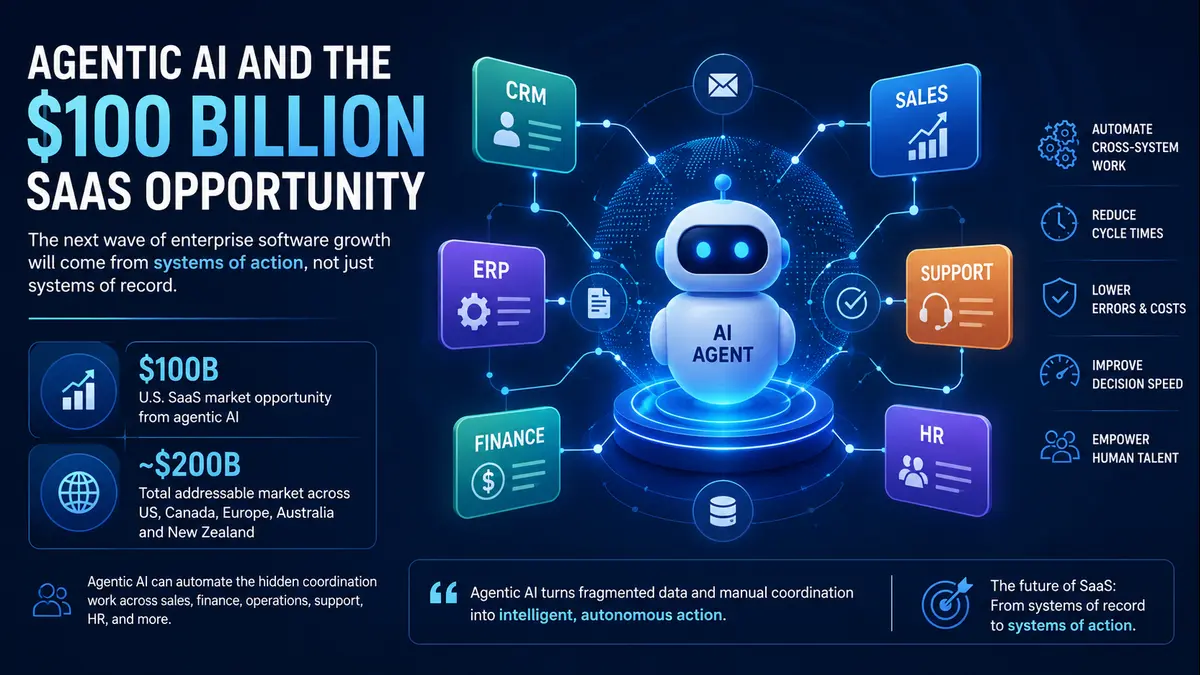
Agentic AI may become one of the next major shifts in enterprise software by automating the hidden coordination work that happens between ERP, CRM, finance, support, HR, and operations systems. Bain estimates this could create a $100 billion SaaS opportunity in the United States alone.
Enterprise software has solved many visible problems. Companies now have CRMs to manage customers, ERPs to manage finance and operations, HR platforms to manage people, ticketing tools to manage support, and collaboration platforms to manage communication. Yet despite this vast software landscape, one of the most expensive forms of work inside modern organizations remains strangely under-automated.
That work is coordination.
Every day, employees across sales, finance, operations, procurement, engineering, HR, legal, and customer support spend hours moving between systems. They pull data from an ERP, verify it against a spreadsheet, check a customer record in a CRM, interpret an email, ask for approval on Slack or Teams, update a ticket, and decide whether something should be approved, escalated, corrected, or ignored.
This work rarely appears on an invoice. It does not always sit neatly inside a job description. But it consumes time, attention, and organizational energy. More importantly, it sits between systems, where traditional software has historically been weakest.
Bain & Company’s latest research argues that this overlooked layer of cross-system coordination could become one of the next major growth opportunities in enterprise software. The firm estimates that agentic AI could create a $100 billion SaaS market in the United States alone by automating coordination work across enterprise systems. Extending the analysis to Canada, Europe, Australia, and New Zealand could bring the total opportunity close to $200 billion.
This is not simply another forecast about AI improving productivity. It points to a deeper shift in how enterprise software may create value. For the last two decades, SaaS companies won by becoming systems of record. The next decade may be defined by systems of action — software that can interpret context, coordinate decisions, and execute work across fragmented enterprise environments.
Why Coordination Work Has Remained So Expensive
The reason coordination work has persisted is simple: business processes are rarely clean.
In theory, an invoice approval process should be straightforward. A vendor sends an invoice, the finance system checks the purchase order, the manager approves it, and payment is released. In reality, the invoice may arrive in an email with incomplete information. The purchase order may be outdated. The vendor terms may have changed. The manager may be unavailable. A budget exception may require a second approval. Someone may need to check whether the goods were actually received.
Traditional automation struggles in such environments.
Robotic process automation can move data from one field to another. It can follow rules. It can automate repetitive actions when inputs and outputs are predictable. But it often breaks when the workflow involves ambiguity, missing context, unstructured communication, or decision-making across multiple systems.
That is where agentic AI changes the conversation.
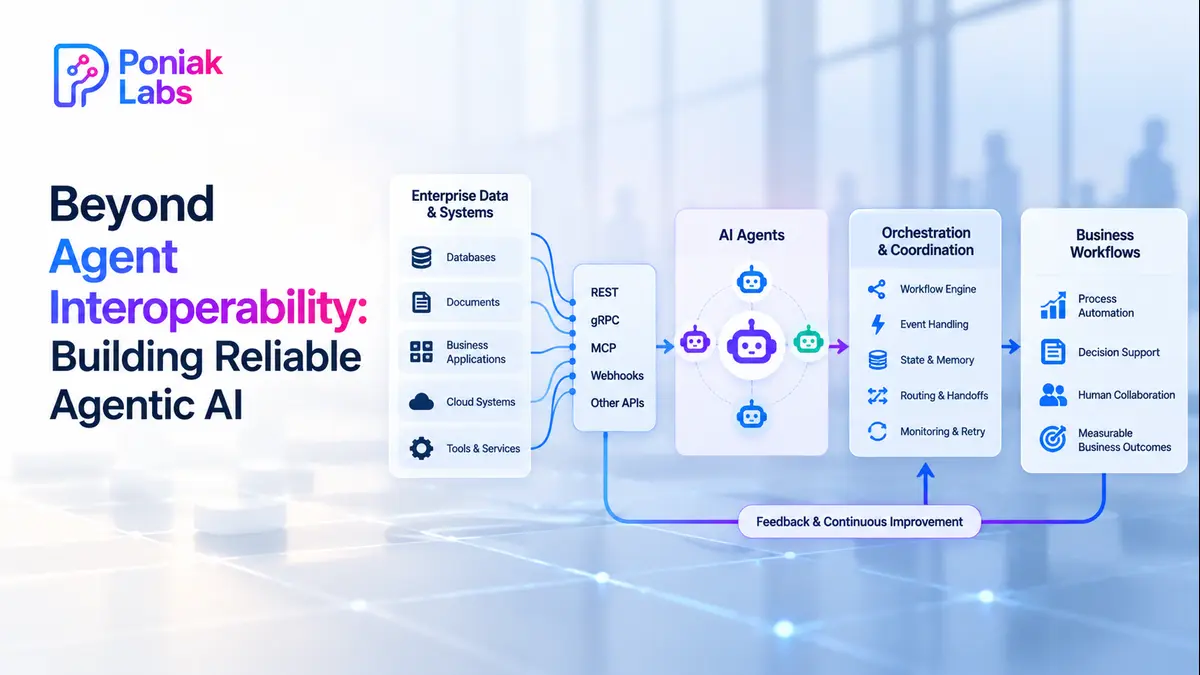
Agentic AI systems are designed not only to generate text, but to pursue goals. They can read information from different sources, reason through next steps, use tools, trigger actions, monitor outcomes, and escalate when needed. In an enterprise setting, this means an AI agent could help reconcile a payment, update a CRM record, summarize a customer issue, draft a response, check policy constraints, and route the matter to the right person.
The important point is not that agents will remove humans from every process. That is unrealistic and, in many cases, undesirable. The real opportunity is to reduce the invisible burden of coordination so that human employees spend less time chasing information and more time exercising judgment.
Agentic AI Goes Beyond Chatbots
Many organizations still think of AI in terms of chatbots or copilots. A chatbot answers a question. A copilot helps draft an email, summarize a document, or generate code. These tools are useful, but they largely support individual productivity.
Agentic AI moves closer to organizational productivity.
An agent does not merely respond to a prompt. It can operate within a workflow. It can observe a business event, interpret available information, decide on a sequence of actions, call external tools, and complete a task within predefined boundaries. In mature implementations, it can also learn from feedback, maintain memory of previous actions, and improve over time.
This is why agentic AI matters for SaaS. Most enterprise platforms today are excellent at storing and displaying information. But businesses do not run on information alone. They run on decisions, handoffs, approvals, exceptions, and follow-ups. These are the areas where human coordination still fills the gap.
For example, a CRM may show that a sales opportunity is delayed, but it may not automatically determine why. An ERP may store the purchase order, but it may not interpret an ambiguous vendor email. A support platform may track a ticket, but it may not coordinate across billing, product, and account management to resolve the issue end to end.
Agentic AI can become the connective tissue across these systems.
The Size of the Opportunity
Bain estimates that vendors have already captured roughly $4 billion to $6 billion of this emerging U.S. market, meaning that more than 90% of the opportunity remains untapped. The firm also highlights how quickly AI-native companies are scaling. Cursor has reportedly surpassed $2 billion in annual recurring revenue, while Sierra has crossed $150 million, Harvey has passed $190 million, and Glean has reached around $200 million.
These numbers matter because they show that agentic AI is not only a research theme. It is already becoming a commercial software category.
The opportunity is not distributed equally across enterprise functions. Sales represents the largest single slice at roughly $20 billion, largely because of the number of sales professionals involved in CRM updates, forecasting, proposals, stakeholder coordination, and customer follow-ups. Cost of goods sold and operations together contribute around $26 billion, reflecting the scale of operational workforces where even modest automation can produce large financial impact.
Customer support, R&D and engineering, and finance each represent meaningful opportunities in the $6 billion to $12 billion range. Support and engineering are especially attractive because many outputs are easier to verify. A support issue is either resolved or unresolved. Code either compiles or fails tests. A reconciled invoice can be checked against defined records.
Finance, HR, IT, and legal also contain automation potential, but with more caution. Some tasks are structured and repeatable, such as invoice matching, payroll checks, employee onboarding, or access provisioning. Others involve judgment, regulation, privacy, or high financial consequence. These areas will likely move more slowly and require stronger human oversight.
What Determines Whether a Workflow Can Be Automated?
A major strength of Bain’s analysis is that it does not treat automation as a simple yes-or-no question. Not every workflow is equally suitable for agentic AI. Some tasks can be automated quickly. Others should remain human-led. Many will become hybrid workflows where agents handle preparation, coordination, and monitoring while humans make final decisions.
Six factors are especially important.
- The first is output verifiability. If the result of a task can be clearly checked, automation becomes easier. Reconciled accounts, successful code tests, resolved tickets, and completed approvals all provide signals that an agent’s work can be evaluated. By contrast, strategic planning, legal interpretation, or employee relations may involve subjective judgment, making them harder to automate fully.
- The second is the consequence of failure. A minor CRM update error may be inconvenient. A mistake in tax filing, cybersecurity response, legal compliance, or medical workflow could be severe. High-risk processes may still benefit from AI assistance, but they require tighter supervision, audit trails, and escalation mechanisms.
- The third is digitized knowledge availability. Agents need access to reliable information. If decision rules, policies, customer history, vendor preferences, and exception logic are documented and machine-readable, agents can operate more effectively. If critical knowledge remains inside employees’ heads, automation becomes much harder.
- The fourth is integration and orchestration complexity. A workflow inside one system is easier to automate than a workflow spanning five systems with different permissions, APIs, data models, and approval paths. This is one of the biggest practical barriers for enterprise adoption.
- The fifth is process variability. Some workflows follow predictable patterns. Others are full of exceptions. Agents can increasingly handle branching logic, but highly unusual cases still require human intervention.
- The sixth is physical world dependency. Workflows that require in-person inspection, physical signatures, hardware repair, warehouse movement, or safety-critical intervention cannot be fully automated through software alone. In such cases, agentic AI may coordinate the process, but humans will remain central to execution.
These factors make the agentic AI opportunity more realistic. The future will not be a sudden replacement of human work. It will be a gradual redesign of workflows based on risk, data quality, verification, and business value.
Why SaaS Business Models May Change
The rise of agentic AI could also reshape how SaaS companies price their products.
Traditional SaaS pricing has largely been based on seats, licenses, and subscriptions. Companies paid for access to software. But when AI agents start delivering outcomes, customers may increasingly ask to pay for results.
A support agent that resolves customer issues may be priced per resolution. A finance agent that processes invoices may be priced per transaction. A sales agent that qualifies leads may be priced based on pipeline contribution or usage volume. This does not mean seat-based pricing will disappear immediately, but it does mean SaaS pricing will become more closely tied to measurable productivity.
This shift is important for both incumbents and startups.
Incumbent SaaS companies have distribution, customer trust, data access, and existing integrations. Salesforce, ServiceNow, Workday, Microsoft, SAP, and other enterprise software leaders are well-positioned to embed agentic capabilities into their platforms. But incumbents also face the risk of being too attached to legacy pricing and product structures.
AI-native startups, on the other hand, can design around outcomes from the beginning. They are not constrained by older interfaces or license models. Their challenge is different: they must earn trust, meet enterprise security requirements, integrate with legacy systems, and prove reliability at scale.
The winners may not be the companies with the flashiest demos. They will be the companies that deeply understand enterprise workflows and can turn fragmented decision-making into reliable software-led execution.
The Strategic Playbook for SaaS Companies
For SaaS leaders, the first step is not to “add agents” randomly. That would create more noise than value.
The right approach begins with workflow mapping. Companies need to break enterprise functions into smaller subprocesses and examine where coordination work is costly, repetitive, measurable, and suitable for automation. This requires going deeper than high-level categories like “finance” or “sales.” The real opportunity lies in specific workflows such as invoice exception handling, quote approval, customer onboarding, churn-risk escalation, vendor dispute resolution, or contract intake.
The second step is data readiness. Agentic AI depends on structured, trusted, and accessible data. If the data is incomplete, inconsistent, or scattered without governance, agents will produce unreliable outcomes. Data quality is not a secondary issue. It is the foundation.
The third step is integration architecture. Agents must be able to safely interact with systems through APIs, permissions, event triggers, and audit logs. Enterprises will not trust agents that act like black boxes. Every action needs traceability.
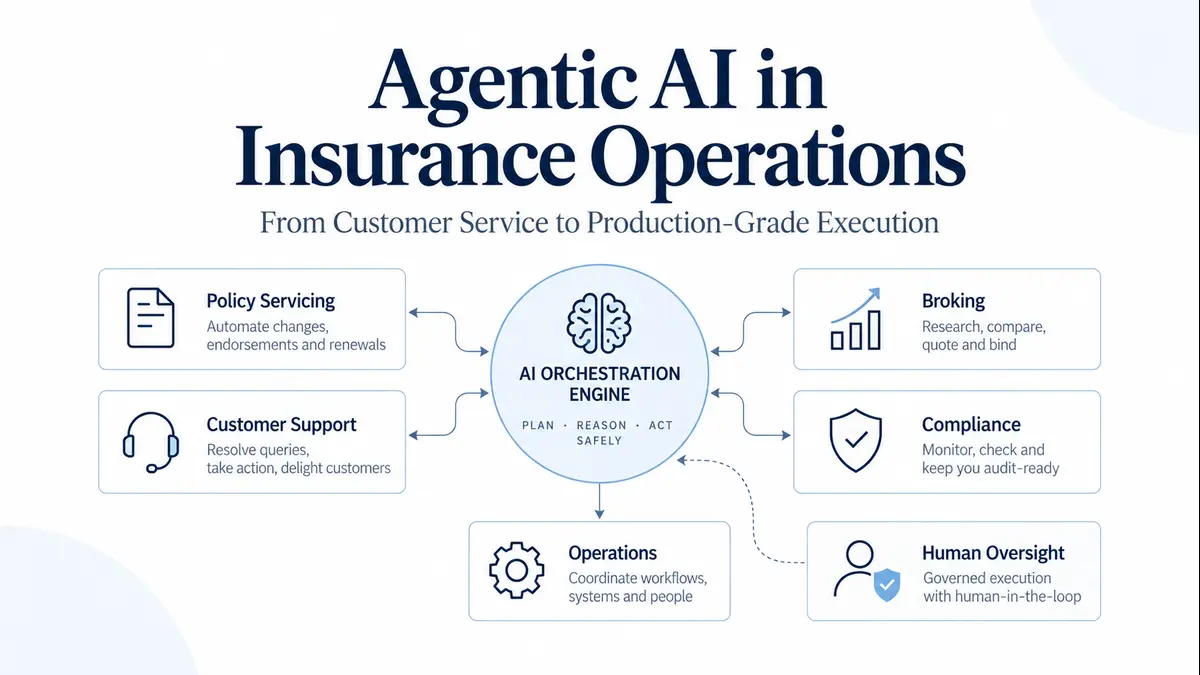
The fourth step is governance. Agentic systems require clear boundaries: what the agent can do, what it cannot do, when it must escalate, and how humans can override it. This becomes especially important in regulated sectors such as banking, healthcare, insurance, legal services, and public-sector operations.
The fifth step is organizational redesign. If agents handle more coordination work, human roles will also change. Employees may spend less time on repetitive handoffs and more time on supervision, exception handling, relationship management, strategy, and creative problem-solving.
This is where the real productivity gain emerges. Not from replacing humans blindly, but from removing the operational drag that prevents skilled people from doing higher-value work.
The Risk of Agent Washing
The opportunity is large, but the market also carries real risk.
Gartner has warned that more than 40% of agentic AI projects could be canceled by the end of 2027 because of unclear business value, rising costs, and weak risk controls. Gartner also cautions that many vendors are engaging in “agent washing,” where ordinary chatbots, assistants, or RPA tools are rebranded as agentic AI without meaningful autonomous capability.
This warning matters because enterprise buyers are under pressure to adopt AI quickly. In such an environment, weak products can hide behind strong language. A workflow tool with a chatbot interface is not automatically an agent. A summarization tool is not necessarily agentic. A scripted automation is not the same as a system that can reason, use tools, monitor outcomes, and operate with policy-aware autonomy.
For agentic AI to succeed, enterprises need sharper evaluation criteria. They should ask whether the system can complete multi-step workflows, interact with multiple systems, explain its actions, operate within permissions, escalate uncertain cases, and generate measurable business outcomes.
The age of vague AI pilots is ending. The next phase will be judged by cost savings, cycle-time reduction, error reduction, customer satisfaction, and revenue impact.
The Broader Enterprise Impact
If implemented responsibly, agentic AI could change how work moves through organizations.
Sales teams may spend less time updating CRM records and more time engaging customers. Finance teams may spend less time chasing approvals and more time analyzing cash flow. Support teams may resolve cases faster because agents can coordinate across billing, product, and account data. HR teams may automate repetitive onboarding steps while preserving human attention for sensitive employee matters.
The impact will not be limited to productivity. Faster coordination can improve decision-making speed. Better process visibility can reduce errors. Stronger workflow intelligence can help enterprises identify bottlenecks that were previously hidden.
However, the transition will also require discipline. Enterprises will need privacy controls, role-based access, audit trails, human-in-the-loop review, cybersecurity safeguards, and clear accountability. Agentic AI cannot be treated as a magic layer placed on top of broken processes. If the underlying workflow is chaotic, the agent may simply accelerate the chaos.
This is why the most successful deployments will likely begin with narrow, high-value workflows where the data is available, the output is verifiable, and the risk is manageable. Over time, these agents can expand into broader orchestration layers.
From Systems of Record to Systems of Action
The $100 billion SaaS opportunity around agentic AI is not just about automation. It reflects a deeper shift in enterprise software.
For decades, software companies built value by becoming systems of record. They stored the customer record, the financial record, the employee record, or the support record. But the next competitive advantage may come from understanding the work that happens between those records.
That is where coordination lives. That is where delays happen. That is where employees lose hours to follow-ups, checks, clarifications, and manual decision routing.
Agentic AI gives software companies a chance to address this hidden layer directly. The opportunity is not to replace every human decision, but to turn fragmented, repetitive, cross-system work into intelligent, governed, outcome-driven workflows.
The companies that win this transition will not be those that simply add the word “agent” to their product pages. They will be the ones that map workflows deeply, build trusted data foundations, integrate securely, price around outcomes, and prove measurable value.
Enterprise software is moving from passive platforms to active orchestration. The old model recorded what happened. The new model will increasingly help decide what should happen next.
That is why the coordination layer may become one of the most important battlegrounds in SaaS. It was once invisible. Now it may define the next decade of enterprise AI.
Publisher’s Note
This article’s discussion on agentic AI also connects with what we are building at Poniak Labs.
Poniak Labs is an AI agent marketplace designed to help developers, builders, and businesses list, discover, and evaluate practical AI agents for real-world workflows. As enterprise software gradually moves from passive systems of record toward intelligent systems of action, specialized agents may become an important layer in how businesses automate coordination-heavy work across sales, finance, operations, support, research, compliance, and back-office processes.
The opportunity is not only to build larger AI models, but to make useful AI capabilities easier to distribute and adopt. Many businesses do not need a generic chatbot. They need focused agents that can support specific workflows, integrate with existing tools, and deliver measurable business value.
That is the direction Poniak Labs is working toward – creating a marketplace where practical AI agents can be published, reviewed, discovered, and used by teams that need workflow-level automation.
Developers, builders, and businesses interested in listing or exploring AI agents can visit Poniak Labs here:
Explore the Poniak Labs AI Agent Marketplace
Discover more from Poniak Times
Subscribe to get the latest posts sent to your email.