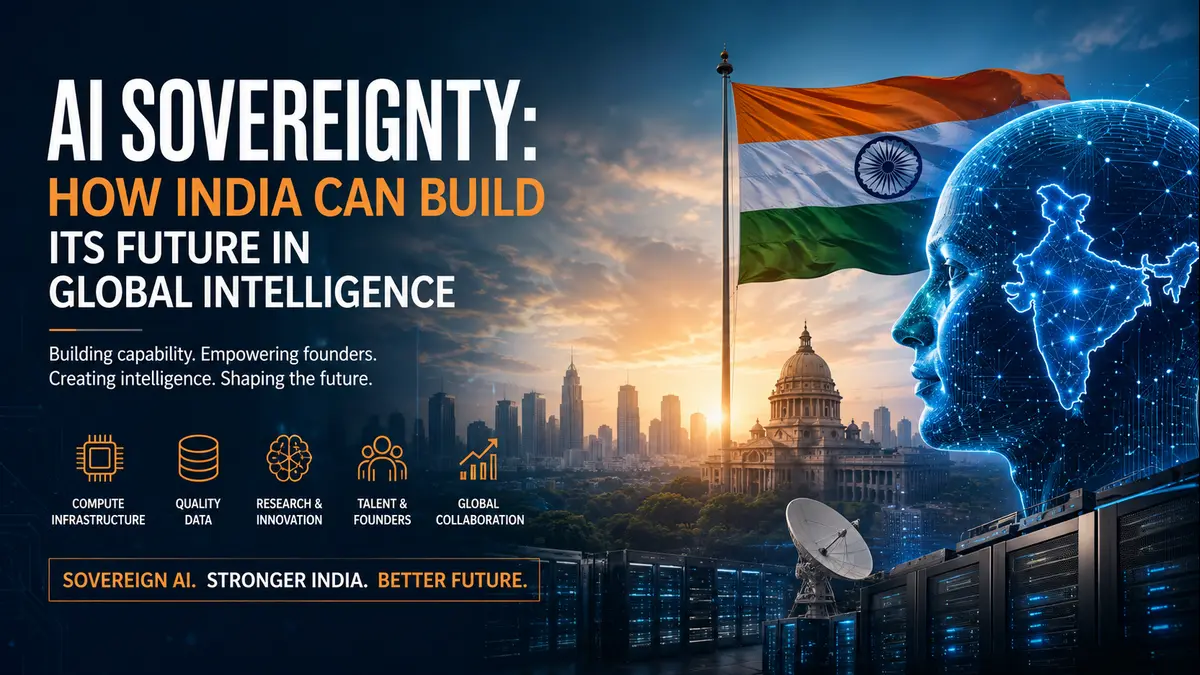
AI sovereignty is not about isolation but strategic capability. As AI becomes foundational infrastructure, India must invest in compute, research, talent, and deep-tech founders to become a creator of intelligence rather than merely a consumer of global AI technologies.
The history of technology has repeatedly shown that nations which participate in the creation of foundational technologies shape the future, while those that depend entirely on external capabilities often remain consumers of value. From the industrial revolution to semiconductors and the internet age, strategic technologies have never been merely commercial products ,they have influenced economic power, national security, and global competitiveness. Artificial Intelligence is rapidly becoming the next such foundational technology.
In June 2026, the AI ecosystem witnessed an unexpected moment when access to Anthropic’s newly introduced Claude Fable 5 and Mythos 5 became subject to restrictions following concerns surrounding American export controls and national security considerations. The immediate practical impact was limited because these were newly released systems and had not yet become deeply embedded within enterprise or public workflows.
However, the broader lesson was far more significant. The episode demonstrated how access to cutting-edge AI capabilities can be influenced by geopolitical decisions, regulatory environments, and strategic considerations beyond the control of developers, startups, or even entire nations that rely upon foreign technology providers.
This is not an argument against international collaboration. In fact, modern AI itself is the result of a global ecosystem of researchers, open-source communities, semiconductor manufacturers, cloud infrastructure providers, universities, and private enterprises working across borders. Yet, collaboration and capability are not the same thing.
A nation can actively participate in the global AI ecosystem while simultaneously developing its own strategic competencies. This idea sits at the heart of what many policymakers today describe as AI sovereignty.
Understanding Sovereign AI
The phrase “sovereign AI” is sometimes misunderstood as a call for technological isolation or the rejection of foreign innovation. Such an approach would neither be realistic nor beneficial in a world where AI supply chains span multiple countries and organizations.
Sovereign capability does not mean building every component domestically. It means ensuring that a nation has meaningful control over critical layers of the AI stack and possesses the ability to develop, deploy, and govern intelligent systems according to its own economic, cultural, and strategic requirements.
True AI capability extends across multiple layers:
- Advanced computing infrastructure, including access to high-performance GPUs and future accelerators.
- High-quality datasets that represent local languages, industries, and societal contexts.
- Foundational and specialized AI models optimized for regional requirements.
- Inference infrastructure that enables large-scale and secure deployment.
- Evaluation, safety, and alignment frameworks.
- A strong pipeline of researchers, engineers, and entrepreneurs.
Owning these capabilities creates resilience. It ensures that a country is not merely consuming intelligence created elsewhere but actively contributing to the next generation of technological breakthroughs.
Why AI Leadership Is Becoming a National Priority
Throughout history, transformative technologies have reshaped the economic hierarchy of nations. The countries that built expertise in manufacturing during the industrial era became global economic powers. The nations that invested early in semiconductors, telecommunications, and internet infrastructure became leaders in the digital economy.
AI is expected to follow a similar trajectory. Its impact will extend across virtually every sector – healthcare, agriculture, manufacturing, finance, education, transportation, scientific discovery, and public administration. Intelligent systems will increasingly influence how decisions are made, how businesses operate, and how productivity is created.
This is why countries across the world are treating AI as a strategic national priority rather than simply another software industry. The question for nations is no longer whether they will use AI.
The more important question is whether they will have a meaningful role in creating the technologies that define the AI era.
The Global Playbook: How Nations Build Deep-Tech Ecosystems
One of the biggest lessons from successful technology ecosystems around the world is that breakthrough innovation rarely emerges in isolation. It is usually the outcome of long-term collaboration between governments, academia, private industry, investors, and ambitious founders willing to solve extremely difficult problems.
The United States: Research, Risk Capital, and Entrepreneurial Culture
The United States provides perhaps the strongest example of how sustained investment across multiple decades creates technological leadership.
Government-backed research programs, especially through institutions such as DARPA, played a historic role in advancing technologies that later transformed civilian industries. Universities including Stanford, MIT, Carnegie Mellon, and others became centers for world-class research and talent creation.
This scientific foundation was complemented by a venture capital ecosystem willing to finance high-risk ideas with uncertain outcomes. The combination of research, capital, talent, and entrepreneurial ambition helped create many of the companies shaping modern AI.
Europe: Strategic Capital and Technological Independence
Europe’s approach to AI demonstrates another important lesson: even regions with strong scientific capability must actively translate research into globally competitive companies.
The emergence of companies such as Mistral AI shows how strategic venture investment, strong research talent, and a long-term vision can create serious competitors in a field dominated by much larger players. The European AI strategy has increasingly emphasized technological resilience, open models, responsible AI development, and reducing excessive dependence on external technology providers. The broader lesson is clear: breakthrough AI companies do not emerge overnight. They are the result of years of research, patient capital, infrastructure access, and an ecosystem willing to support ambitious technological bets.
China: Long-Term Strategic Investment and Industrial Coordination
China offers a different but equally important model. The country has treated artificial intelligence as a strategic priority through long-term national plans, large-scale infrastructure investments, and strong collaboration between government institutions and domestic technology companies.
Major technology companies such as Alibaba, Tencent, and Baidu have invested heavily in AI research, cloud infrastructure, and foundational models. Systems such as Alibaba’s Qwen demonstrate how sustained ecosystem support can accelerate domestic innovation. China’s approach highlights an important principle: building frontier technology requires patience, infrastructure, and a willingness to invest over many years.
Israel: The Power of Research, Defense, and Entrepreneurial Networks
Israel provides another compelling example of how a relatively small country can become a global center of deep technology.
The country’s innovation ecosystem has been shaped by close collaboration between universities, defense research institutions, experienced entrepreneurs, and venture capital networks. This combination has created a culture where solving highly complex technological challenges is encouraged from an early stage. The lesson for the AI era is not to replicate any single country’s model, but to understand a common pattern: nations that lead in strategic technologies create environments where researchers and entrepreneurs are empowered to pursue difficult problems over long periods of time.
Why India Must Empower the Next Generation of AI Founders
India today stands at a unique moment in its technological journey. The country possesses one of the world’s largest pools of engineering talent, a rapidly expanding digital economy, and public digital infrastructure that has become a global reference point. From large-scale digital identity systems to real-time payments and open digital networks, India has already demonstrated that it can execute technology projects at extraordinary scale.
However, the AI era demands a new layer of ambition. Building world-class AI capabilities will require not only the adoption of global technologies but also the creation of new intellectual property, research breakthroughs, specialized models, and companies capable of competing internationally.
This requires a strong ecosystem where the next generation of founders can take ambitious bets. Deep-tech entrepreneurship is fundamentally different from conventional software startups. Building foundational models, advanced AI infrastructure, robotics systems, or semiconductor technologies requires years of research, expensive computing resources, highly specialized talent, and significant experimentation before commercial outcomes become visible.
The early stages of such companies often involve uncertainty. Many ideas will fail. Some will pivot. A few may eventually become institutions that define an entire generation of technology. This is exactly why ecosystem support matters. Emerging AI companies need:
This is exactly why ecosystem support matters.
Emerging AI companies need:
- Access to affordable high-performance computing infrastructure.
- Long-term patient capital that understands deep-tech development cycles.
- Easier access to high-quality public and industry datasets.
- Research collaborations between academia and industry.
- Government grants and challenge programs for high-risk innovation.
- Regulatory environments that allow experimentation while maintaining safety.
- Early adoption opportunities through enterprises and public-sector initiatives.
The most successful technology nations understand that today’s small research team or startup can become tomorrow’s strategic technology leader. The objective is not to predict which company will succeed, but to create an environment where many ambitious teams have the opportunity to try.
India’s Opportunity in the AI Century
India does not need to choose between global AI collaboration and domestic AI capability. The future will belong to countries that successfully combine both.
Global models, open-source communities, international research collaboration, and foreign technology partnerships will remain essential components of progress. At the same time, building domestic capabilities in critical areas ensures resilience and creates long-term economic value. India’s advantages are significant.
Its linguistic diversity creates a compelling need for multilingual AI systems. Its massive industrial base presents opportunities for AI-driven manufacturing, logistics, agriculture, healthcare, and financial services. Its vast developer community provides a foundation for innovation at unprecedented scale.
The challenge now is converting these advantages into globally competitive technology.
This requires sustained investment in computing infrastructure, world-class research institutions, entrepreneurial ecosystems, and an environment where difficult problems are rewarded rather than avoided.
A Moment of Strategic Reflection
The temporary restrictions surrounding Claude Fable 5 should not be viewed as a crisis or a reason to reject global AI innovation.
Instead, it serves as a reminder of a larger reality: the technologies that shape the future are often influenced by economic competition, national priorities, regulations, and geopolitical considerations. Artificial intelligence is likely to become as fundamental to the twenty-first century as electricity, computing, and the internet were to previous generations.
Countries that participate only as users of intelligence will benefit from AI, but those that contribute to building the underlying technologies will shape its direction, capture greater economic value, and develop stronger strategic resilience.
India has already shown that it can build technology platforms at national scale. The next chapter is more ambitious. It is about ensuring that the country is not merely a marketplace for the world’s intelligence, but also one of the places where that intelligence is created.
Discover more from Poniak Times
Subscribe to get the latest posts sent to your email.