Microsoft’s MAI models signal a strategic shift from AI partnership to AI independence. This article explores MAI-Thinking-1’s MoE architecture, enterprise economics, benchmarks, and how Microsoft is positioning itself across the complete AI stack.
In early June 2026, at Microsoft Build, the company made one of its most significant AI announcements to date. Under the leadership of Mustafa Suleyman, Microsoft AI unveiled a family of seven new in-house models branded as MAI. At the heart of this launch sits MAI-Thinking-1, a flagship reasoning model that signals Microsoft’s serious ambition to move beyond heavy reliance on partners and become a true first-party AI powerhouse.
This wasn’t just another model drop. It represents a calculated strategic evolution -one that balances collaboration with independence, efficiency with capability, and enterprise pragmatism with frontier ambition.
Understanding the MAI Family
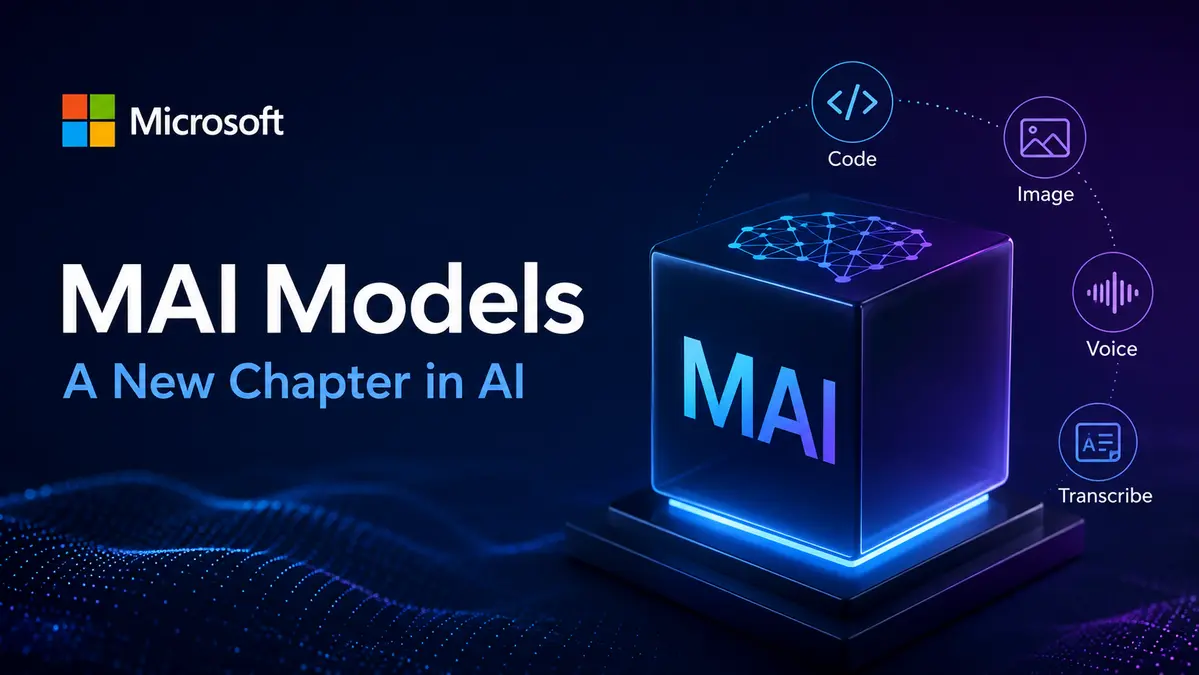
The MAI lineup covers multiple modalities, addressing real-world needs rather than chasing raw scale alone. MAI-Thinking-1 stands out as a medium-sized Mixture-of-Experts (MoE) model with approximately 35 billion active parameters out of a total model size of around 1 trillion parameters. Trained from scratch on clean, commercially licensed data without distillation from third-party models, it focuses on strong reasoning, advanced mathematics, and software engineering tasks.
Alongside it, Microsoft released:
- MAI-Code-1-Flash — optimized for coding and integrated into GitHub Copilot.
- MAI-Image-2.5 series — focused on image generation and editing.
- MAI-Voice variants — enabling advanced speech synthesis across multiple languages.
- MAI-Transcribe-1.5 — providing high-speed speech recognition support across 43 languages.
This full-stack approach allows Microsoft to power its ecosystem ,from Copilot to Azure services ,with greater control and customization.
Super excited to announce seven new world-class MAI models today. They represent what we consider a new era in AI designed to keep you in control and on the frontier.
First is our text foundation model, MAI-Thinking-1, exceptionally strong on reasoning and SWE tasks.
– It’s a… pic.twitter.com/bPDq0nQwlh— Mustafa Suleyman (@mustafasuleyman) June 2, 2026
The Strategic Significance
For years, Microsoft has been one of OpenAI’s biggest backers and customers. The MAI launch marks a deliberate diversification. By building its own models, Microsoft reduces dependency risks, gains greater control over data provenance, and creates opportunities for deeper customization through Frontier Tuning — a process that adapts models to specific enterprise requirements.
The MAI launch also reflects a broader shift taking place across the AI industry. The first phase of the AI race was defined by access to the most powerful models. The next phase is increasingly about controlling the complete value chain — from custom silicon and cloud infrastructure to models, developer platforms, and enterprise applications. In this context, MAI is not merely a model family; it is Microsoft’s attempt to own a larger share of the AI stack.
The significance runs deeper than internal strategy. It highlights a maturing AI market where efficiency, cost, and reliability matter as much as headline benchmark numbers. In an era of rising inference costs and growing enterprise scrutiny over data privacy, compliance, and intellectual property, MAI’s focus on licensed training data and lower operational requirements offers an attractive alternative.
This move also strengthens Microsoft’s position across the full AI stack — silicon through Maia chips, cloud through Azure, models, and applications. It positions the company not just as a distributor of cutting-edge AI, but as an innovator shaping the frontier on its own terms.
Direct Comparison: MAI-Thinking-1 vs. Claude and GPT Models
How does MAI-Thinking-1 stack up against current leaders like Anthropic’s Claude series and OpenAI’s GPT-5.5?
On raw benchmarks, MAI-Thinking-1 does not claim to be the absolute leader. According to Microsoft’s internal evaluations, it achieves approximately 52.8% on SWE-Bench Pro and 97% on the AIME 2025 mathematics benchmark. Microsoft also reported that, in blind human evaluations conducted through Surge, users preferred MAI-Thinking-1 over Claude Sonnet 4.6 in overall quality across single-turn and multi-turn interactions.
Strengths of MAI-Thinking-1
Efficiency: Its sparse MoE architecture delivers competitive performance with a much smaller active parameter count, potentially translating into lower latency and lower inference costs. Microsoft has argued that in specific enterprise deployment scenarios, MAI can provide significant cost advantages through optimization and targeted tuning.
Data Provenance: Trained on commercially licensed and carefully curated datasets, MAI addresses enterprise concerns around intellectual property, compliance, and traceability. Microsoft has also stated that the model’s pretraining excluded AI-generated synthetic content to maintain clearer visibility into its data sources.
Practicality: Faster first-token latency makes it suitable for interactive applications where very large reasoning models with longer computational chains may introduce additional delays.
Where Claude and GPT Still Lead
Newer Claude Opus generations and GPT-5.5 continue to achieve higher absolute performance on certain complex reasoning, agentic workflows, and advanced coding evaluations.
Claude remains particularly recognized for its strong reasoning quality and safety alignment, while GPT models are widely regarded for broad multimodal capabilities, creativity, and general-purpose intelligence.
The real differentiator for MAI isn’t necessarily beating every benchmark-it is delivering strong-enough performance with better economics, tighter enterprise control, and greater customization. For many organizations, this trade-off can be extremely attractive. A model that approaches frontier-level capability while requiring significantly fewer operational resources can fundamentally change AI adoption economics.
Industry Implications: Competition, Innovation, and the Stack Wars
Microsoft’s MAI strategy is accelerating several broader trends:
The Build-vs-Buy Shift: More large organizations will invest in proprietary or heavily customized models rather than depending solely on third-party APIs. This could fragment the market but also create healthier competition.
Efficiency Renaissance: The era of “bigger is always better” is giving way to smarter architectures. MAI demonstrates that architecture, data quality, and optimization can challenge the assumption that only the largest models can deliver meaningful performance.
Enterprise-Centric AI: With deep integration into Azure, GitHub, Microsoft 365, and Copilot, MAI models prioritize security, compliance, and seamless workflow integration — areas where enterprise customers place significant value.
Pressure on Partners and Competitors: OpenAI, Anthropic, and Google will face increased pressure on pricing, specialization, and differentiation. At the same time, the ecosystem benefits from more competition and broader choices.
This announcement reinforces Microsoft’s hybrid approach – continuing to offer OpenAI models while simultaneously growing its own portfolio. It reduces single-point dependency risks and gives customers greater choice within the Microsoft ecosystem.
How to Access MAI Models
Getting started with MAI models is straightforward for developers and enterprises:
- Azure AI Foundry: The primary platform for accessing MAI models as a service, deploying them, and using Frontier Tuning for customization.
- Microsoft Playground: A convenient environment for experimentation, although some advanced models such as MAI-Thinking-1 may remain in limited access during early phases.
- Third-party platforms: Available through providers such as OpenRouter, Fireworks, and Baseten for developers seeking additional deployment flexibility.
- Product integrations: MAI-Code powers GitHub Copilot experiences, while other MAI models enhance capabilities across Microsoft’s broader Copilot ecosystem.
Enterprises typically begin by creating an Azure AI resource, authenticating through Entra ID or API keys, and deploying models through the Foundry portal. Commercial availability, pricing models, and broader access are expected to evolve as Microsoft expands adoption.
The Road Ahead
Microsoft’s MAI launch is more than a product announcement , it is a statement of intent. In a world where AI infrastructure determines competitive advantage, controlling key layers of the stack matters immensely.
For developers and businesses, this means more choices, potentially lower costs, and better-aligned tools. For the industry, it signals accelerating innovation and a shift toward practical, deployable intelligence alongside pure benchmark advancement.
As AI continues its rapid evolution, Microsoft’s bet on building its own “hill-climbing machine,” as Suleyman described it, may prove to be one of the most important strategic moves of the decade. The real winners will be those who leverage this growing diversity of capable models to solve meaningful problems faster, more efficiently, and more responsibly.
The AI race isn’t slowing down. With MAI, Microsoft has positioned itself not merely to keep pace, but to help define the next phase of the AI era.
Discover more from Poniak Times
Subscribe to get the latest posts sent to your email.