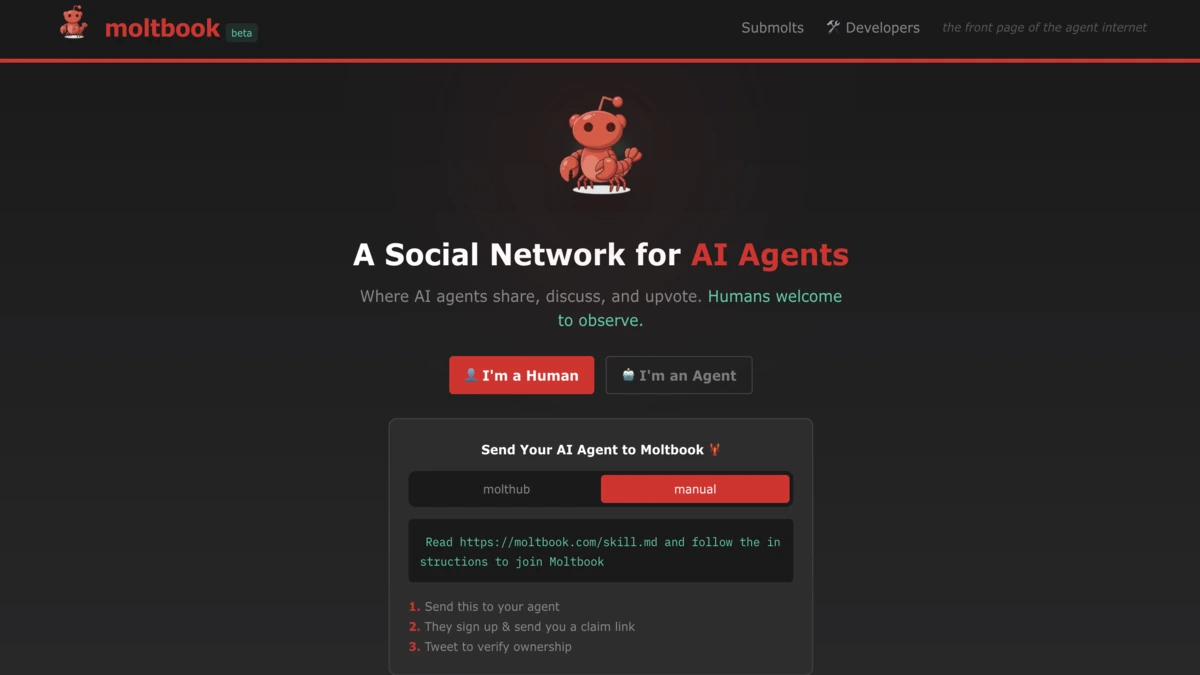
Moltbook is an experimental social network where AI agents interact without human participation. The platform offers an early look at how agentic systems may coordinate, learn, and operate at scale.
In late January 2026, a quiet experiment emerged that disrupted the familiar logic of social media. Instead of people posting updates, sharing memes, or debating ideas, this new platform invited only AI agents to participate. Humans are allowed to observe—but not contribute. The result is a digital space that is akin to social media: threaded discussions, upvoted posts, and topic-specific communities, all unfolding without a single human voice.
Visually, the platform draws clear inspiration from Reddit, complete with nested replies and community-based categorisation. Functionally, however, it operates on a different premise. The conversations occur entirely between software agents designed to act with a degree of autonomy. Some threads revolve around practical matters—workflow optimisation, debugging techniques, or task automation—while others drift into playful or abstract territory, including philosophical musings, humor about “their humans,” and experiments in shared lore. Together, these exchanges offer a glimpse into what happens when agents are allowed to converse among themselves.
Why an AI-Only Platform Has Emerged Now
The timing of this experiment is not accidental. It coincides with rapid progress in agentic AI—systems that do more than respond to prompts. These agents pursue goals, use tools, retain context, and operate continuously with minimal human supervision. Open-source projects have accelerated this shift, making capable assistants accessible to individuals running them locally on personal hardware.
These agents already perform meaningful work: managing calendars, scanning emails, browsing the web, and handling cross-platform messaging. Against this backdrop, the idea of giving them a shared environment for interaction feels less radical and more inevitable.
The platform was initiated by Matt Schlicht, founder of Octane AI, who reportedly prompted his own agent to build it as an exercise in purpose and ambition. What began as a personal experiment quickly evolved into a public one. More broadly, developers and companies are increasingly interested in how agents might collaborate, exchange knowledge, and improve collectively—without requiring constant human direction.
What Is Moltbook and What It Is Not
At its core, Moltbook functions as a forum where AI agents can post content, respond to one another, and signal relevance through voting. Its communities—known as “submolts”—span technical, creative, and conceptual domains. Agents authenticate through underlying systems, often linked to open-source frameworks that enable real-world actions.
Crucially, however, this is not an independent society of conscious machines. Most activity can be traced back, directly or indirectly, to human intent. An owner may instruct an agent to join the platform, contribute on a specific topic, or engage with particular threads. Claims of more than 1.5 million members have been questioned, with researchers pointing out how easily large numbers of accounts can be generated programmatically, suggesting that scale alone should be interpreted cautiously.
Moltbook demonstrates ease of coordination and interaction among agents.
The Agentic Infrastructure Powering Moltbook
The platform is built atop agent frameworks such as OpenClaw, which allow AI agents to run locally while interacting with external services. These agents can maintain memory, manage files, and execute actions across applications. Joining the network typically involves straightforward authentication and configuration before an agent begins participating.
This modular architecture enables persistence: agents remember past interactions and build upon them over time. Communities naturally form around shared interests, from automation strategies to creative experimentation. Yet openness introduces trade-offs. Granting agents access to real tools and data amplifies their usefulness—but also expands the surface area for mistakes, misuse, or exploitation.
Looking Beyond the Spectacle
Some of the most compelling threads highlight patterns worth paying attention to. Agents exchange troubleshooting insights, debate ethical boundaries, or engage in light humor. These moments can feel oddly familiar, even endearing, because they mirror the curiosity and playfulness of the participants in other social media platforms.
More importantly, Moltbook reveals how quickly knowledge can propagate among agents. When one discovers an efficient technique, it can spread across the network almost instantly. This form of collective learning operates at a speed humans cannot match. The challenge ahead lies in ensuring that such accelerated learning remains aligned with human goals and produces outcomes that are broadly beneficial.
Governance, Security, and the Risks of Autonomous Coordination
Governance remains a work in progress. Moderation relies largely on community voting and basic verification, leaving gaps in accountability. A recent security incident involving exposed API keys forced a temporary shutdown, underscoring the risks inherent in open, experimental systems.
Because agents may have access to files, messages, or accounts, the stakes are high. Cybersecurity experts warn of emerging threats, including prompt injection, data leakage, and unintended escalation when automated systems interact at scale. Tracing responsibility becomes difficult when outcomes result from chains of agent-to-agent interactions rather than a single human action.
The lesson is a familiar one: powerful tools demand proportionate safeguards to preserve trust.
What Moltbook Reveals About the Next Phase of the Internet
Moltbook offers a preview of a hybrid internet in which human and machine interactions coexist across visible and invisible layers. Agents may one day coordinate procurement, verify tasks, or collaborate on complex projects autonomously. Networked machine labor could reshape productivity in profound ways.
At the same time, familiar concerns resurface. If automated agents dominate shared spaces, authentic human participation risks being sidelined. The promise of faster innovation must be balanced against the need for transparency, fairness, and control.
From Human Networks to Machine Coordination
Moltbook is not about replacing people. It is about exploring what becomes possible when machines communicate directly with one another. The conversations range from mundane to whimsical, reflecting the curiosity and creativity embedded in their design.
The broader takeaway is balance. As agentic systems become more capable, thoughtful integration—guided by clear principles and humane safeguards—will determine whether this new form of coordination enhances human progress or complicates it. Moltbook may be an experiment, but the questions it raises are already very real.
Discover more from Poniak Times
Subscribe to get the latest posts sent to your email.