Poniak Labs is building a structured marketplace for AI agents where developers can list, distribute, and monetize agentic software, while buyers can discover practical AI tools for automation, research, and business workflows.
For the last few years, most people experienced AI through chat interfaces. A user asked a question, the model generated an answer, and the human decided what to do next. That phase changed how people searched, wrote, learned, and worked. But it was still largely limited to conversation.
The next phase of AI is about action.
AI systems are now beginning to execute workflows, interact with external tools, process business documents, retrieve structured information, call APIs, and complete multi-step tasks with limited human intervention. These systems are commonly described as AI agents. Unlike simple chatbots, agents are not designed only to respond. They are designed to operate.
This shift creates a new problem for the industry. Developers are building useful AI agents, but the infrastructure around discovery, testing, monetization, secure usage, and distribution is still fragmented. Many capable agents exist as isolated APIs, GitHub repositories, Streamlit applications, internal tools, or private demos. They may solve real problems, but they often struggle to reach the buyers who need them.
Poniak Labs has been built to address this gap.
The goal is simple: create a structured marketplace layer where AI agents can be discovered, evaluated, listed, and monetized in a practical way.
The Distribution Problem in AI Agents
The AI developer ecosystem has matured quickly. Frameworks such as LangChain, LangGraph, CrewAI, LlamaIndex, and several open-source tools have made it easier to build agentic workflows. A developer can now create an agent for invoice extraction, financial research, customer support automation, regulatory search, lead qualification, data cleaning, or internal reporting faster than ever before.
But building the agent is only one side of the equation.
The harder question is: where does the agent go after it is built?
Today, many developers are forced to manage everything independently.
They need to create a landing page, set up payments, manage authentication, protect API keys, handle usage limits, explain the product, and find customers on their own. For solo builders and small teams, this becomes a heavy operational burden.
Enterprise marketplaces exist, but many of them are tied to large cloud ecosystems, complex procurement workflows, or partner requirements. Traditional digital marketplaces, on the other hand, are designed for static products such as templates, files, courses, or downloadable assets.
AI agents are different.
They are live systems. They may need execution, access control, metering, authentication, monitoring, and usage-based billing. A serious AI agent marketplace cannot function like a simple file download marketplace. It needs a more structured layer between the creator, the buyer, and the agent itself.
This is the gap Poniak Labs is trying to solve.
What Poniak Labs Is Building
Poniak Labs is a marketplace for AI agents where developers can list their agents and buyers can discover, evaluate, and use them through a structured platform.
The first version of the platform focuses on a practical goal: making AI agents easier to list, test, and monetize.

Developers can list agents in multiple formats depending on how their product is built.
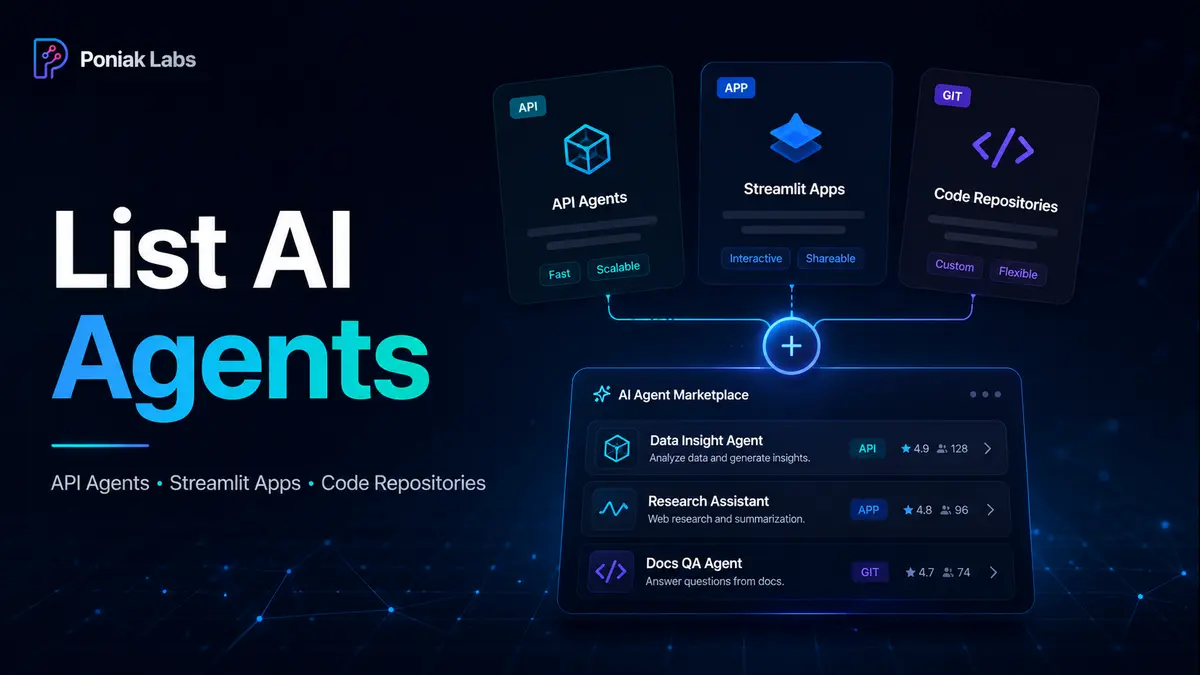
API Agents are agents exposed through REST endpoints. These are useful for background tasks such as data extraction, summarization, classification, research, lead enrichment, report generation, or workflow automation.
Code Repository Agents are packaged codebases that buyers or developers can inspect, clone, customize, and deploy in their own environments. This format is useful when the buyer wants more technical control over the agent.
Streamlit Agents are interactive applications where the agent comes with a visual interface. These are useful for demos, dashboards, internal business tools, and lightweight AI applications.
This flexibility is important because not every AI agent is packaged in the same way. Some agents are pure APIs. Some are front-end applications. Some are developer-ready repositories. A marketplace built for agents must support different formats instead of forcing every creator into one rigid model.
For buyers, this creates a more organized discovery experience. Instead of searching across scattered links, GitHub repositories, demo apps, and private API pages, buyers can evaluate agents from a single marketplace interface.
Why Discovery Matters
One of the biggest challenges for AI agent creators is not just deployment. It is discovery.
A developer may build a strong invoice parsing agent, but the business team looking for invoice automation may never find it. Another developer may build a useful research assistant for financial documents, but it may remain hidden inside a GitHub repository or a small demo page.
The result is inefficient for both sides.
Creators struggle to get distribution.
Buyers struggle to find reliable tools.
Poniak Labs is designed to reduce this discovery gap.
The long-term vision is to connect marketplace agents with user intent. When someone searches for a problem, the platform should not only return information. It should also surface relevant agents that can help execute the task.
For example, if a user searches for ways to extract structured data from logistics invoices, a traditional search experience may provide articles, tutorials, or documentation. That is useful, but it still leaves the user with work to do.
A more action-oriented system can go further. It can show an agent that actually performs the extraction.
This is where Poniak Labs connects with a broader product philosophy: the future of search is not only about finding information. It is also about helping users take the next step.
A Secure Usage Layer for Buyers and Creators
A marketplace for AI agents cannot work without trust.
Creators need confidence that their proprietary logic, prompts, endpoints, and API keys are protected. Buyers need confidence that they can use agents without managing complex technical setup. The platform needs to handle access, payments, and usage in a structured way.
Poniak Labs is being designed around a secure, credit-based usage model.
A buyer can purchase credits on the platform. When the buyer uses an agent, the request is routed through the Poniak Labs layer. The platform authenticates the buyer, tracks usage, deducts the required credits, and forwards the request to the agent endpoint where applicable.
This model helps separate three responsibilities clearly.
The creator focuses on building and improving the agent.
The buyer focuses on using the agent.
The platform manages access, metering, usage tracking, and marketplace flow.
This structure is especially important for independent developers. Instead of building billing systems, authentication layers, and usage controls from scratch, they can focus on improving the intelligence and reliability of the agent itself.
For buyers, the benefit is equally practical. They do not need to manage separate payment relationships with every agent creator. They can explore and use agents through a common marketplace experience.
From Static Software to Agentic Products
Software marketplaces have existed for many years. App stores, plugin marketplaces, cloud marketplaces, and template platforms have all helped developers distribute products.
But AI agents introduce a different kind of product.
An agent is not just a static application. It can reason over inputs, call tools, retrieve data, generate outputs, and sometimes make decisions within a defined workflow. This makes agent marketplaces structurally different from traditional software directories.
A good agent marketplace must answer several questions.
What does the agent do?
How is it accessed?
How is usage measured?
How is the creator protected?
How is the buyer charged?
How can the buyer trust the agent before using it?
How does the platform prevent misuse or poor-quality listings?
These questions cannot be solved only with a listing page. They require review flows, structured metadata, testing mechanisms, secure access layers, and clear marketplace rules.
Poniak Labs is being built with this direction in mind. The first version focuses on listing and discovery, but the broader goal is to create a more reliable commercial environment for agentic software.
Why This Category Exists on Poniak Times
This article also marks the beginning of a dedicated Poniak Labs category on Poniak Times.
The purpose of this category is to document the product, engineering decisions, marketplace updates, agent economy trends, and lessons learned while building Poniak Labs.
Future articles will cover how agent listing works, how buyers evaluate agents, what makes an agent commercially useful, how agent pricing may evolve, how secure proxy execution works, and how search engines may eventually route users directly toward task-performing agents.
This category will not only be used for announcements. It will also serve as a product and engineering diary.
The AI agent market is now entering a more mature phase. Developers are no longer only experimenting with demos and prototypes. Enterprises are beginning to evaluate agents for real workflow automation, and buyers are becoming more selective about reliability, pricing, security, and measurable business value.
By documenting the journey publicly, Poniak Labs aims to contribute to that discussion while building in the open.
The Road Ahead
The AI agent economy is moving from early experimentation toward structured commercial adoption.
Today, the market is filled with experimentation. Developers are testing new frameworks. Enterprises are evaluating automation use cases. Buyers are trying to understand which agents are useful and which are simply wrappers around basic prompts.
This is natural in an early market.
But the direction is clear.
As AI moves from answering questions to executing workflows, the ecosystem will need better discovery, better trust layers, better monetization, and better distribution. Builders need a place to list their work. Buyers need a place to find useful tools. Platforms need to connect both sides without creating unnecessary complexity.
Poniak Labs is being built for that transition.
For developers, it offers a path to bring agents into a marketplace environment. For buyers, it offers a structured way to discover and use AI agents. For the broader AI ecosystem, it represents one step toward turning agentic software from isolated demos into usable digital products.
That is the direction Poniak Labs is working toward.
Discover more from Poniak Times
Subscribe to get the latest posts sent to your email.