AI agents are moving beyond experimental chatbots into commercial software products. This article explains what makes an AI agent sellable in 2026, including operational autonomy, production-ready architecture, MCP-based connectivity, security, multi-modal capabilities, marketplace distribution, and pricing models.
AI agents are moving from experimental demos to commercial software products. In 2024 and 2025, many developers built impressive prototypes: chatbots that answered questions, workflow tools that drafted emails, and internal copilots that summarized documents. But the global market is now entering a harder phase. Buyers are no longer asking whether an AI agent can respond intelligently. They are asking whether it can connect to real tools, complete a workflow, follow rules, generate measurable ROI, and survive inside an enterprise environment.
That is the difference between an interesting AI agent and a sellable AI agent. In 2026, global AI agent marketplaces will not reward the loudest demo. They will reward agents that solve specific problems, integrate cleanly, operate safely, and explain their value in business language. Developers who understand this shift can move beyond hobby projects and build agents that companies are willing to subscribe to, procure, and deploy.
What Makes an AI Agent “Sellable” in 2026?
A sellable AI agent is not simply an interface wrapped around a large language model. It is a task-oriented system that can understand context, make decisions within boundaries, execute actions, and produce a reliable business outcome.
Boston Consulting Group describes agentic AI as systems capable of autonomous, multistep reasoning, decision-making, and execution across workflows, not merely generating outputs. That distinction is important because buyers pay more for outcomes than for conversations.
Defining Operational Autonomy vs. Simple Automation
Simple automation follows a fixed rule. For example, “send this email when a form is submitted” is automation. It may be useful, but it is not deeply agentic.
Operational autonomy begins when the system can interpret a goal, gather the required information, decide the next step, use tools, and complete the task under defined limits. A customer support agent that only answers FAQs is basic. A stronger commercial agent can read the ticket, check order status, identify refund eligibility, draft a response, escalate risky cases, and log the resolution. That is where commercial value appears.
Enterprises are not buying AI agents because they want another chatbot window. They are buying them because they want fewer manual handoffs, faster cycle times, better consistency, and lower operational drag. A sellable AI agent must therefore be described around the workflow it improves, not the model it uses.
A weak listing says: “This agent uses GPT to answer customer queries.” A stronger listing says: “This agent reduces first-level customer support workload by classifying tickets, retrieving customer records, drafting compliant replies, and escalating unresolved cases to a human team.”
The second version sounds like software. The first sounds like a demo.
The Shift from “Vibe-Coded” to Production-Ready Architecture
The first wave of AI agents was built quickly. That speed helped the ecosystem grow. But commercial buyers now expect more than clever prompts and a good-looking interface.
A production-ready AI agent needs a proper architecture. At minimum, it should include model routing, retrieval, tool access, authentication, logging, error handling, rate limits, fallback behavior, and human approval checkpoints for sensitive actions. McKinsey has noted that the transition from AI pilots to scaled business impact remains difficult for many organizations, and high performers are more likely to have defined practices for human validation, operating models, data, adoption, and scaling.
This is where many developer-built agents fail. The agent works during a demo but breaks when the input format changes. It performs well for five test cases but becomes unpredictable across thousands of requests. It can answer questions but cannot provide an audit trail. It integrates with one tool but not with the broader system stack.
A commercially sellable AI agent should be treated like a real product. The prompt is only one layer. The architecture is the business.
Essential Commercial Traits for Marketplace Success
A global AI agent marketplace will have many listings. Buyers will compare agents quickly. They will look for trust signals, integration quality, security posture, documentation, pricing clarity, and evidence of performance. That means developers must build for commercial evaluation from day one.
Standardized Connectivity: Adopting the Model Context Protocol
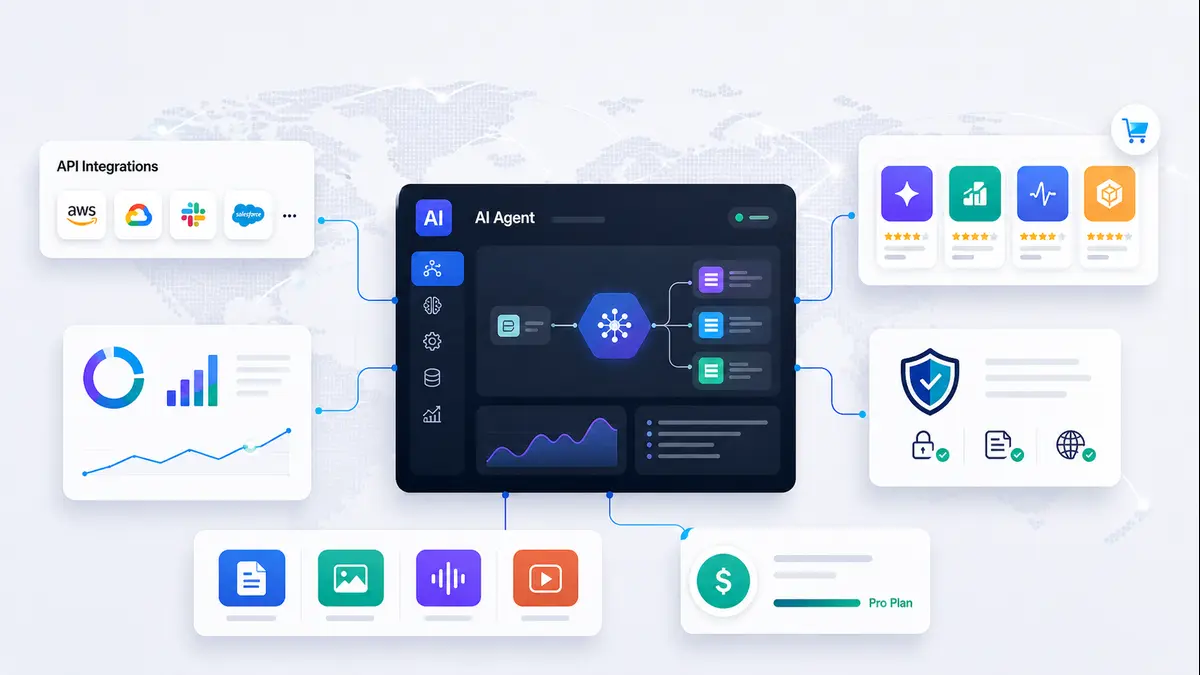
One major commercial trait is connectivity. An AI agent becomes more useful when it can interact with data sources, APIs, files, databases, calendars, CRMs, project management tools, and enterprise systems. The Model Context Protocol, or MCP, has become important because it standardizes how AI applications connect to external tools and data. The official MCP documentation compares it to USB-C: a common way to connect AI applications with external systems instead of building custom integrations every time.
For marketplace sellers, this matters deeply. A buyer may not want an isolated AI agent. They may want an agent that can connect with Slack, Gmail, Notion, HubSpot, Salesforce, Jira, Google Drive, internal databases, or custom APIs. A sellable agent should therefore answer these questions clearly:
- Can it connect to external tools?
- Does it support API access?
- Can it work with structured and unstructured data?
- Can it be deployed in a secure environment?
- Does it support human approval before executing sensitive actions?
Interoperability is no longer a technical luxury. It is a commercial requirement.
Security, Governance, and Ethics as a Selling Point
Many developers treat security as a compliance burden. In the AI agent market, security can become a selling point. Enterprise buyers worry about data leakage, unauthorized actions, prompt injection, hallucinated outputs, and unclear responsibility when an autonomous system makes a mistake. These concerns are not theoretical. Gartner has warned that enterprise generative AI applications are likely to face rising security incidents as adoption accelerates.
A marketplace-ready agent should include transparent guardrails. It should explain what data it accesses, what it stores, how long logs are retained, whether customer data is used for training, and which actions require human approval. Audit logs are especially important. If an agent sends an email, updates a CRM field, generates a report, or modifies a record, the buyer should know when it happened, why it happened, and what input triggered it.
For regulated sectors such as finance, healthcare, insurance, legal services, and public-sector workflows, governance may be the difference between rejection and procurement. Good security does not slow sales. It increases trust.
Multi-Modal Capabilities: Beyond Text to Image and Video
Text-only agents are useful, but many business workflows are not text-only. Companies work with invoices, scanned documents, product images, voice calls, videos, charts, presentations, PDFs, dashboards, and screenshots.
This is why multi-modal AI agents are becoming more commercially attractive. Google Cloud’s 2026 AI agent trends report highlights agentic AI as a major business transformation theme, and recent enterprise AI platforms are increasingly focused on agents that can work across documents, workflows, and organizational context.
A procurement agent may need to read PDFs, compare supplier quotations, and extract line items. A manufacturing agent may need to analyze inspection images and maintenance logs. A marketing agent may need to process campaign screenshots, transcripts, performance charts, and creative assets. The broader the input range, the larger the buyer base.
However, multi-modal capability should not be added for fashion. It must serve a workflow. An agent that handles text, image, audio, and video without a clear business use case may look advanced but sell poorly. A narrower agent that processes invoices with high accuracy may sell better because its value is easier to understand.
Winning Marketplace Distribution Strategies
Even a strong agent can fail if it is poorly positioned. Marketplaces are discovery engines. Buyers search, compare, shortlist, test, and then purchase. Distribution strategy therefore matters as much as the build.
Optimizing for AI Agent Search and Citations
Developers should now think beyond traditional SEO. A new layer is emerging: Generative Engine Optimization, or GEO. This means optimizing a product so that AI search engines, answer engines, and marketplace recommendation systems can understand, cite, and recommend it.
For an AI agent listing, GEO starts with clarity. The title should describe the use case, not just the technology. “Invoice Reconciliation Agent for Finance Teams” is stronger than “AI Finance Bot.” “Customer Ticket Triage Agent for Shopify Stores” is stronger than “SupportGPT.”
The description should include the workflow, target buyer, supported integrations, measurable outcome, pricing model, and security posture. Screenshots, API documentation, demo videos, sample outputs, and benchmark examples all improve trust.
A good marketplace listing should answer four questions immediately:
- Who is this agent for?
- What workflow does it improve?
- How does it connect to existing tools?
- What measurable value can the buyer expect?
Agents that explain themselves well are easier to discover, easier to trust, and easier to buy.
Pricing Models: Subscription vs. Usage-Based ROI
Pricing is one of the most important commercial decisions for AI agent sellers.
A subscription model works well when the agent provides ongoing workflow support. Examples include customer support agents, research agents, social media agents, compliance monitoring agents, sales prospecting agents, and internal reporting agents. Buyers understand monthly pricing when the value is continuous.
Usage-based pricing works better when the workload is variable. Examples include document extraction, video analysis, due diligence review, invoice processing, lead enrichment, or report generation. In these cases, buyers may prefer to pay per document, per run, per seat, per API call, or per workflow execution.
The strongest pricing strategy often combines both. A base subscription creates predictable revenue, while usage-based tiers capture higher-volume customers.
For example:
- Starter: limited runs for individuals or small teams.
- Professional: higher usage, integrations, and priority processing.
- Enterprise: custom limits, audit logs, private deployment, support, and procurement-friendly billing.
Commercial buyers do not only ask, “What does it cost?” They ask, “Can this cost be justified?” Pricing should therefore be tied to ROI. If the agent saves 20 hours per month, reduces manual errors, or accelerates reporting cycles, the seller must make that value visible.
The Business Impact: Why Enterprises Are Buying Now
Enterprises are buying AI agents because the pressure to do more with the same workforce is increasing. Teams are expected to handle more data, more customer interactions, more compliance checks, more reporting, and faster decision cycles.
This is where agents fit naturally. Deloitte predicted that 25% of enterprises using generative AI would deploy AI agents in 2025, rising to 50% by 2027. Gartner also predicted that up to 40% of enterprise applications would include task-specific AI agents by 2026, compared with less than 5% previously.
The direction is clear. Agents are becoming part of enterprise software, not a separate experiment.
Case Study: Scaling Operations Without Adding Headcount
Consider a mid-sized professional services firm handling hundreds of client documents every week. Before using AI agents, analysts manually reviewed documents, extracted clauses, summarized obligations, prepared comparison notes, and escalated exceptions.
The process was slow but familiar. It worked because people worked harder. A commercially designed document review agent changes the operating model. It can ingest documents, classify them, extract relevant fields, flag missing information, summarize risk areas, generate a first-pass report, and send uncertain cases to a human reviewer.
The human team remains in control. But instead of spending time on repetitive reading, they focus on judgment. In document-heavy workflows, several AI agent vendors and implementation partners report processing or review-time reductions in the range of 60–80% for narrow, well-structured use cases. These numbers should always be validated in the buyer’s own environment, but they show why the demand exists.
The real business impact is not only cost savings. It is operating leverage. A company can process more work without immediately adding headcount. It can respond faster to customers. It can standardize quality. It can preserve institutional knowledge inside workflows instead of losing it in scattered emails and spreadsheets.
That is the serious promise of commercially sellable AI agents.
The Future Belongs to Useful Agents
The global AI agent marketplace will not be won by agents that merely look intelligent. It will be won by agents that are useful, connected, governed, measurable, and easy to deploy.
For developers, the opportunity is significant. But the standard is rising. A commercially sellable AI agent must solve a real workflow, integrate with real systems, provide clear documentation, include security controls, and communicate business value in plain language.
The best agents in 2026 will not behave like magic tricks. They will behave like dependable digital workers with boundaries, logs, and measurable output. That is what buyers will pay for.
And that is how AI agent builders can move from experiments to revenue.
Discover more from Poniak Times
Subscribe to get the latest posts sent to your email.