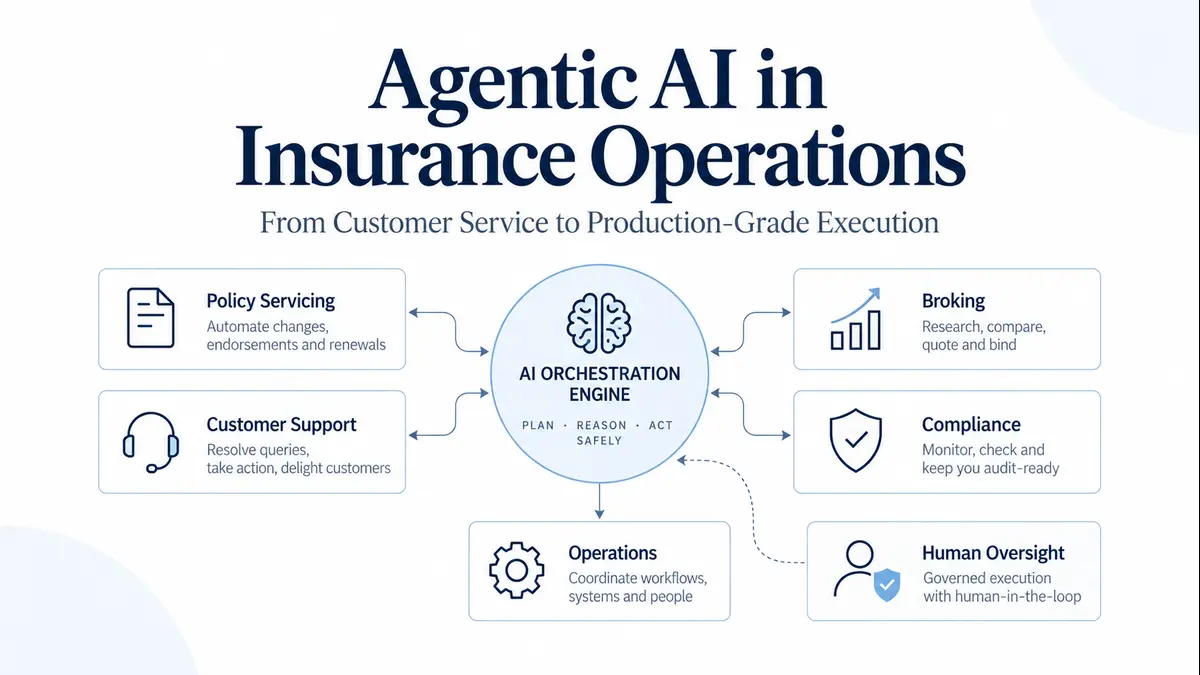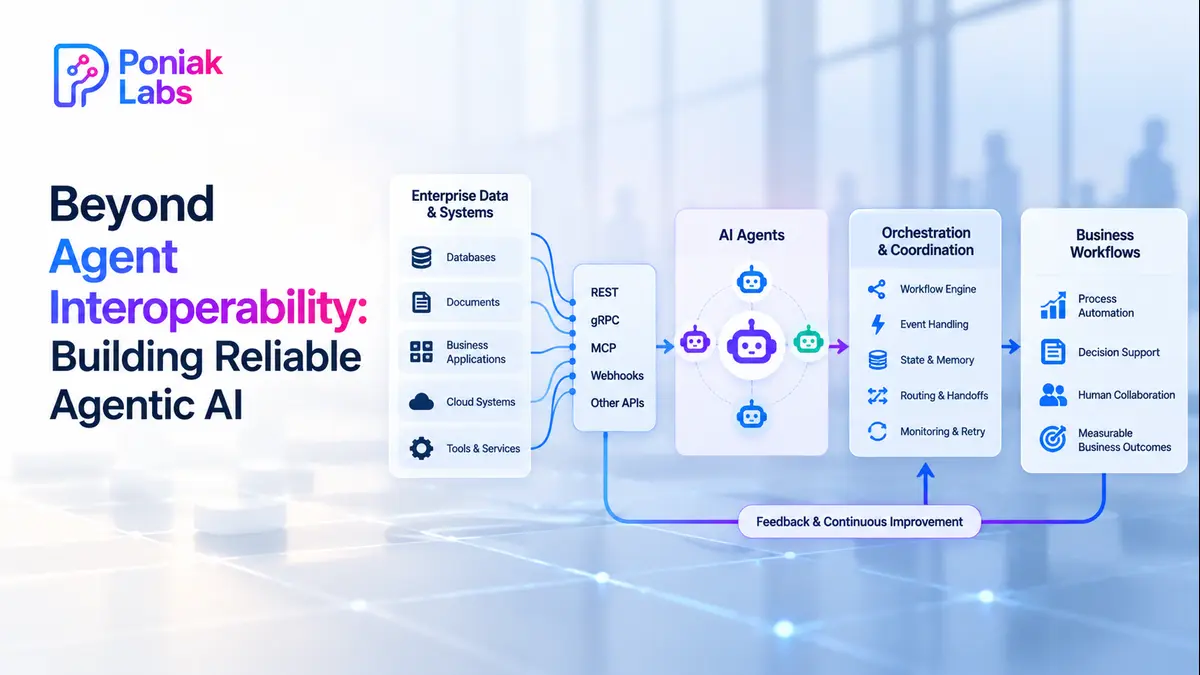
Enterprises are moving beyond generative AI experiments toward agentic AI systems that can reason, act, and execute within business workflows. This article explains how autonomous intelligence can drive real cash flow, improve operations, and turn AI from a productivity tool into a core growth engine.
For the last few years, enterprise AI has been surrounded by noise. Boards wanted AI strategies. CEOs wanted demos. Teams built chatbots that could draft emails, summarize documents, answer internal questions, and generate reports faster than before.
Those tools were useful. They saved time. They improved productivity in pockets.
But they rarely changed the economics of the business.
That is the uncomfortable truth many enterprises are now facing. Generative AI created excitement, but excitement alone does not improve margins. A chatbot that helps an employee write faster is helpful. An AI system that reduces procurement leakage, accelerates claims processing, improves inventory placement, or resolves customer issues end-to-end is economically meaningful.
This is why the next phase of enterprise AI is not about better prompts. It is about agentic operations: AI systems that can reason over a goal, use tools, retrieve live data, follow rules, escalate exceptions, and complete defined actions inside business workflows.
Deloitte has framed this shift as a move from assisted intelligence to artificial intelligence and then toward autonomous intelligence, where systems decide and execute within defined boundaries. The important distinction is agency: generative AI produces an answer, while autonomous intelligence pursues an outcome with tools, data, and guardrails.
The Real Difference Is Execution
Traditional generative AI stops at the answer. Agentic AI moves closer to execution.
In a normal chatbot workflow, the user asks a question and receives a response. The human still decides what to do next. In an agentic workflow, the system can break down a goal, identify the right data source, call APIs, compare options, trigger an approval, update a record, or escalate a case when rules require human judgment.
That difference matters because enterprises do not run on answers. They run on processes.
A supply chain team does not need only a summary of vendor delays. It needs an updated sourcing decision. A finance team does not need only a report on overdue invoices. It needs prioritization, follow-up, reconciliation, and exception handling. A customer service team does not need only suggested replies. It needs resolution.
This is where the business case becomes stronger.
Gartner has predicted that by 2029, Agentic AI could autonomously resolve 80% of common customer service issues without human intervention, contributing to a 30% reduction in operational costs. That prediction is not just about chatbots becoming more polite. It reflects a deeper shift from reactive service to automated service execution.
Where Enterprises Are Already Seeing Value
The strongest examples are appearing in workflows with high volume, clear rules, measurable cost, and frequent decisions.
Klarna is one of the most cited examples. In 2024, the company said its AI assistant handled two-thirds of customer service chats in its first month, performed work equivalent to 700 full-time agents, reduced repeat inquiries by 25%, and cut average resolution time from 11 minutes to under two minutes. In its Q3 2025 earnings call, Klarna later said the assistant was doing the work of about 853 full-time jobs and had generated around $60 million in savings.
Walmart offers another useful example because its AI work is connected to operational execution, not just content generation. Its fulfillment systems use predictive models, real-time decision intelligence, and an ensemble of AI agents to choose fulfillment nodes, optimize routing, account for weather and demand, and support delivery promises.
In HR operations, AMD’s deployment of AI agents with Kore.ai reportedly reduced HR resolution time by 80%, achieved a 50% self-service deflection rate, and increased employee satisfaction by 70%. The important lesson is not simply that HR added a bot. It is that the agent was connected to systems such as SAP SuccessFactors, ServiceNow, Microsoft SharePoint, and Microsoft Teams, allowing it to support real workflows rather than sit outside the operating model.
Procurement is also becoming a serious use case. Kärcher implemented an AI-native procurement automation platform for tail-spend negotiations. The system selected suitable purchase requisitions, executed negotiations, and helped secure an average 6% discount with 90% supplier engagement.
These cases show a clear pattern. AI creates real cash flow when it is embedded inside cost-heavy or revenue-sensitive workflows. It creates less value when it remains a disconnected productivity layer.
Start With a Decision Audit, Not a Demo
Many enterprises make the same mistake. They begin with the technology.
They ask: “Which model should we use?”
The better question is: “Which decisions are slowing down the business?”
A decision audit is the right starting point. It maps how decisions are currently made across a value chain. Who owns the data? Who has authority? Where do handoffs fail? Which actions require human judgment? Which actions are repetitive, rules-based, and safe to automate?
Deloitte’s guidance is similar: pick one or two value chains where outcomes are bottlenecked by decisions, not just tasks, and then map how those decisions happen today. This exposes both the economic opportunity and the hidden gaps that could break the pilot later.
This is old-school business discipline, and it still works. Before automating, understand the process. Before scaling, fix the foundation. Otherwise, the organization simply automates confusion.
Decision-Grade Data Is the New Foundation
Most enterprise data systems were designed for reporting, not autonomous action. That is a major problem.
A dashboard can tolerate some delay because a human interprets the result before acting. An AI agent executing a transaction cannot rely on stale data. If it approves a purchase order, changes an inventory route, or updates a customer case, the data must be fresh, traceable, and authorized.
This is why enterprises need decision-grade data, not just reporting-grade data. Data must carry lineage, timestamps, access controls, and business context. The agent must know whether the data is current enough to act on and whether it has permission to use it.
Deloitte’s interview makes the same point: many enterprise data estates were built for human analysts, while autonomous systems need freshness, provenance, and access controls before they can safely execute.
In practical terms, this means enterprises need stronger integration with ERP, CRM, HRIS, supply chain systems, contract repositories, approval workflows, event streams, and identity platforms. The model is only one part of the system. The operating architecture matters more.
Governance Is Not a Final Step
The biggest gap between AI pilots and production is governance.
A pilot can work beautifully with curated data, a friendly test team, and limited risk. Production is different. Production means real users, live systems, legal review, audit trails, cost controls, security reviews, and business accountability.
This is where many AI projects slow down.
JPMorgan Chase has explained that AI agents operate with delegated authority, access services, call APIs, and perform actions on behalf of users or systems. That makes identity, authorization, monitoring, and traceability foundational.
This is not a new principle. Banks, manufacturers, insurers, and large retailers have always cared about control. What has changed is the operating condition. Now the actor inside the workflow may be an AI agent, not a human employee clicking a button.
That means every enterprise agent needs a clear identity. It needs permissions. It needs logs. It needs limits. It needs escalation paths. It needs a kill switch.
Without this, agentic AI becomes a compliance risk instead of a productivity engine.
Platform Thinking Beats Point Solutions
The companies that win with agentic AI will not build one-off demos forever. They will build reusable platforms.
A proper enterprise AI platform should include model routing, tool access, identity management, retrieval, evaluation, monitoring, approval workflows, cost controls, human-in-the-loop checkpoints, and audit logs. Once this foundation exists, the second and third use cases become faster to build.
This is exactly where many organizations fail. They treat each AI pilot like a separate experiment. Different teams choose different tools, create different governance rules, and build different integrations. The result is fragmentation.
A platform approach is slower at the start but faster over time. It is the traditional enterprise lesson again: build the foundation once, then scale from it.
The India Opportunity
Indian enterprises are well positioned for this shift.
They operate in complex environments, manage cost pressure closely, and have deep engineering talent. Sectors such as banking, insurance, manufacturing, logistics, healthcare, retail, and government services all contain workflows where agentic systems can reduce delays and improve execution.
But the opportunity should be approached carefully. The first wave should not chase full autonomy everywhere. It should focus on narrow, high-value lanes: claims triage, procurement support, invoice reconciliation, compliance checks, HR service resolution, field service routing, supplier monitoring, and customer support automation.
Start small. Prove value. Build trust. Expand the boundary.
That is how serious enterprise systems have always scaled.
The Bottom Line
Generative AI gave enterprises the spark. Agentic AI can deliver the operating leverage.
The next phase of enterprise AI will not be judged by how impressive a demo looks. It will be judged by cash flow, margin improvement, cycle-time reduction, risk control, and customer experience.
The winners will not be the companies with the most pilots. They will be the companies that identify the right workflows, build decision-grade data foundations, govern agents properly, and scale reusable platforms.
AI hype is easy. Enterprise cash flow is harder. But this is where the real value begins.
Discover more from Poniak Times
Subscribe to get the latest posts sent to your email.