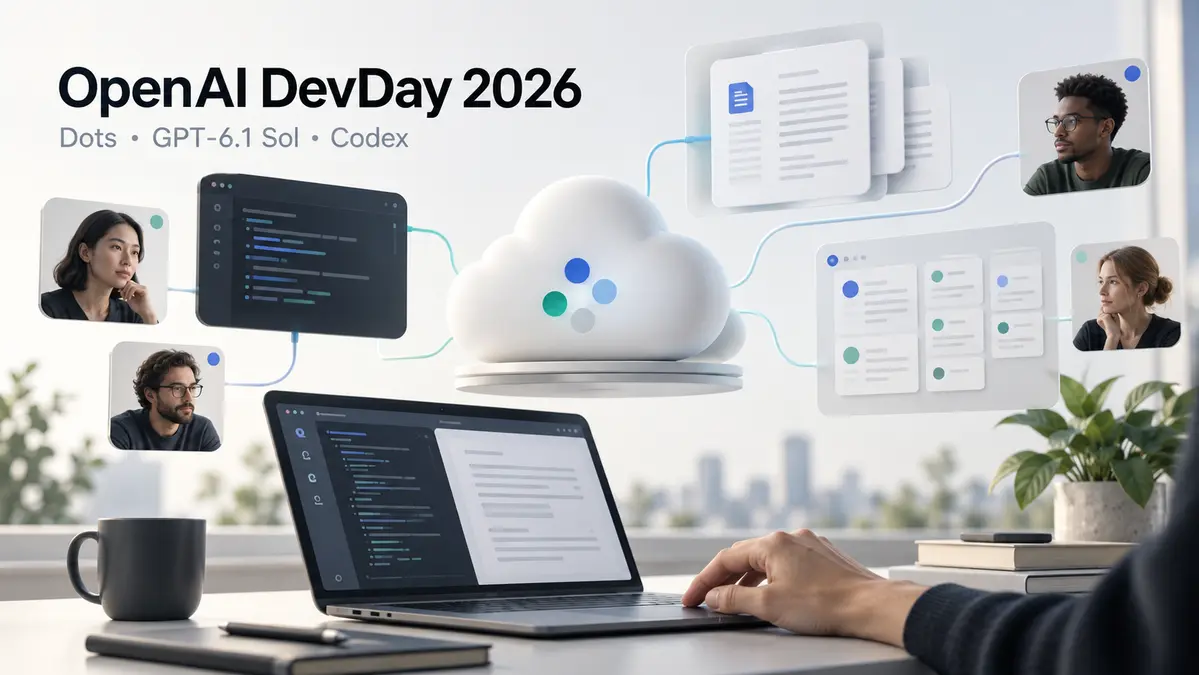
OpenAI DevDay 2026 introduced Dots agents, GPT-6.1 Sol and AI tools for developers and teams. The article examines model pricing, Codex upgrades, collaboration features and agent permissions, exploring what persistent AI could mean for daily work, enterprise adoption and responsible human oversight.
OpenAI’s annual developer conference returned on September 29, 2026, at Fort Mason in San Francisco, marking what the company described as its biggest DevDay yet. More than twenty major announcements spanned models, agents, developer tools, collaboration features, and subscription updates. The day centered on a clear theme: moving artificial intelligence beyond single interactions toward persistent systems that can take ongoing responsibility and work alongside people in meaningful ways.
The opening keynote, featuring CEO Sam Altman, set the tone. OpenAI framed the releases as tools that expand what individuals and teams can achieve, giving people more time for higher-value work while lowering barriers for developers. The keynote was livestreamed, with regional DevDay Exchange events scheduled across Asia, Europe, and Latin America in the subsequent months.
Dots: Always-On Agents That Keep Working
The standout announcement was Dots, OpenAI’s new class of always-on agents. Powered by the company’s GPT-6 Astra model, each Dot runs on its own dedicated cloud computer complete with a browser. Through plugins, Dots can connect to more than four thousand applications, subject to users’ authorization and existing account permissions. Users assign goals or ongoing responsibilities-monitoring issues, preparing materials, coordinating workflows,and the agent continues working between conversations.
Dots are designed to learn preferences over time and operate with defined boundaries. Conversations with a Dot do not count against standard ChatGPT usage limits, while tasks it starts or manages in ChatGPT Work and Codex follow normal metering. The feature began rolling out to ChatGPT Pro and Business Premium subscribers in eligible markets, with an admin-controlled beta available for Enterprise, Education, and Healthcare workspaces. OpenAI also previewed specialist Dots for organizational use, with distinct identities and focused enterprise pilots.
An important distinction is how Dots behave without a new assignment. Their proactive research uses read-only tools in connected apps: it cannot send messages, change app content, or control a browser or computer. Assigned tasks can involve actions within the applicable permissions and approval rules. Users can set additional boundaries, inspect progress, and review consequential work.
This release represents a practical step toward agentic AI that can continue working between interactions. It positions ChatGPT as a surface where people and autonomous systems can share context and divide labor more fluidly than before.
GPT-6.1 Sol: Near-Frontier Capability at a Fraction of the Cost
Alongside the agent announcement, OpenAI introduced GPT-6.1 Sol, a significant upgrade to its earlier GPT-6 Sol model. The company reported that the new version approaches GPT-6 Astra performance on evaluations of agentic coding, computer-use tasks, and professional knowledge work, while pricing standard API input and output tokens at one-fifth of Astra’s rates—$2 per million input tokens and $10 per million output tokens, with cached inputs at $0.10 per million tokens.
One concrete example comes from DeepSWE v1.1, which evaluates complex software-engineering tasks in real codebases. OpenAI reported that Sol matched Astra at roughly one-fifth of the cost and exceeded GPT-6 Sol’s best score by 6.4 percentage points at a lower reasoning effort. These are reported evaluation results; production outcomes may differ with the tools, prompts, and workflows used.
GPT-6.1 Sol launched in the API and began rolling out in ChatGPT Work and Codex, with release notes describing access starting with Pro and expanding to Plus, Business, Enterprise, and Education. Enterprise and Education administrators must enable access. At launch, the model was not yet available in ordinary Chat.
The pricing shift makes high-capability reasoning more accessible for iterative development, longer agent runs, and production workloads that previously required careful budget management. An Ultrafast speed tier, already live for Astra on supported plans and API configurations, was also announced as forthcoming for Sol.
However, lower token prices do not automatically translate into the same reduction in the cost of a completed workflow. The number of retries, amount of context, task completion rate, and human review required will also influence whether an agent makes economic sense.
Separately, The Wall Street Journal reported ahead of DevDay that OpenAI had scrapped a planned October release of GPT-6.1 Astra following safety concerns raised during internal testing. That reporting should be distinguished from the conference’s official announcements. The decision highlights the unresolved challenge of ensuring that increasingly capable agents respect authorization boundaries.
Developer Infrastructure and Codex Improvements
DevDay placed heavy emphasis on tools that help developers build and operate agentic systems. The Agents API gained computer-use capabilities, allowing applications to interact with software through graphical interfaces rather than text alone. Codex expanded its cloud-based execution options, enabling developers to start and monitor long-running tasks from supported devices. The Codex CLI received voice input, improved multi-agent views, and better support for parallel work.
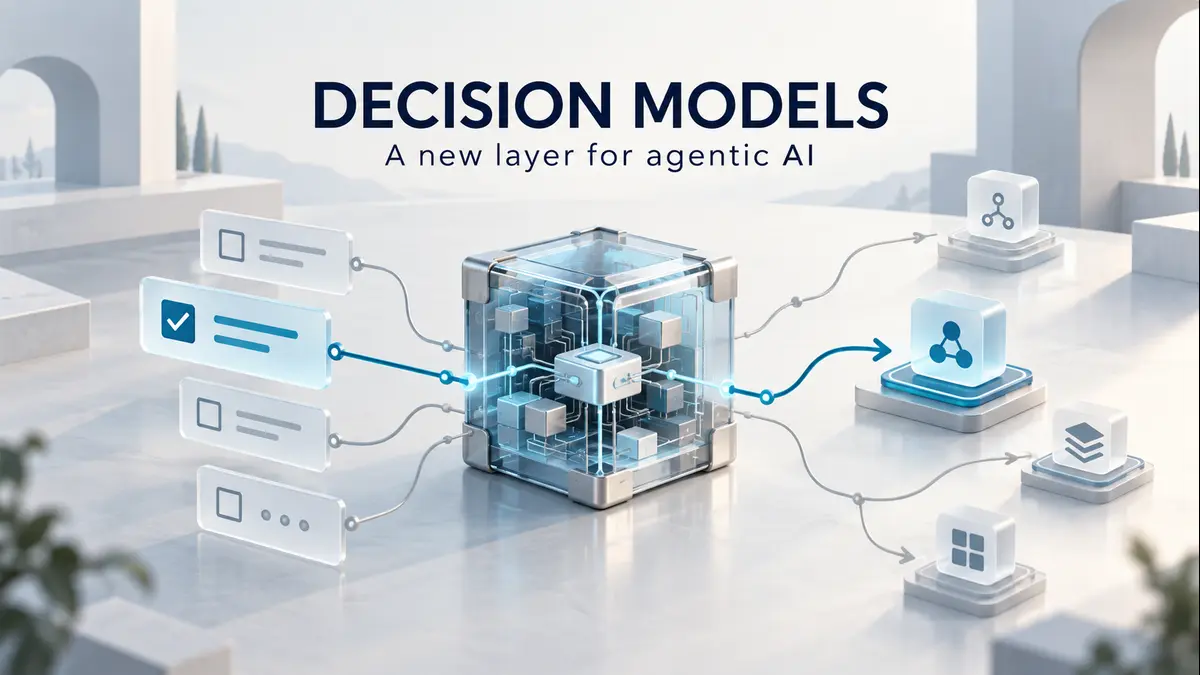
Additional releases included enhanced code review features that integrate with GitHub and GitLab, Codex Security Cloud for repository scanning, and a Decisions API in limited preview. The latter focuses on questions with finite, predefined answers, such as classifying content, routing requests, or selecting an agent’s next action. These updates aim to reduce friction for teams building multi-step systems and reflect a platform increasingly focused on production use.
Collaboration Features and Platform Openness
ChatGPT Space introduced a shared workspace where teams, individual users, and their agents can maintain common context, documents, and ongoing projects. Plugin extensions expanded customization options, allowing richer native experiences inside ChatGPT and enabling supported Sites to host plugins. OpenAI also highlighted Sign in with ChatGPT for partner applications.
The company’s Marketplace announcement introduced a more specific enterprise purchasing model. In beta, eligible customers can apply part of their existing OpenAI commitment toward qualifying partner software. Customers contract with and receive invoices from the partners, and the initial program does not offer self-service checkout.
Collectively, these changes treat ChatGPT less as a standalone chat interface and more as a collaborative operating surface. Developers gain additional ways to reach users, while organizations gain structured ways to keep humans and agents aligned on shared work.
Insights Emerging from the Event
Several broader patterns stood out. First, the announcements suggest a continued shift from pure model capability toward long-running agents. Dots and the computer-use enhancements illustrate that the practical value of frontier models increasingly depends on persistent execution environments, tool access, and clear authorization boundaries.
Second, pricing strategy has become a competitive lever. OpenAI’s reported combination of near-Astra performance on selected evaluations and substantially lower token prices could expand the set of economically viable use cases. Whether this produces a lower total cost of ownership will depend on how reliably those systems complete real work.
Third, safety and governance remain active constraints. The reported withdrawal of a more advanced model version, alongside controls around agent permissions and enterprise admin oversight, highlights both deployment safeguards and continuing reliability concerns. As agents gain the ability to act independently, questions of accountability, auditability, and human oversight will only grow in importance.
Finally, the conference reinforced OpenAI’s dual focus on consumer accessibility and enterprise readiness. Private Intelligence includes Zero Data Retention with Private Safety Processing, which enables automated safety review without OpenAI personnel accessing the underlying content. A separate Private Inference preview, planned for fall, combines confidential computing with verifiable controls. These features may help address enterprise privacy requirements, but they should not be treated as blanket guarantees of regulatory compliance or local data residency.
Implications for Different Audiences
For individual power users and professionals, Dots and the more affordable high-performance model open new possibilities for personal automation and sustained project support. Developers gain additional building blocks for multi-agent systems and remote execution. Enterprises receive more controls and collaboration surfaces, although oversight still depends on permissions, configuration, and review practices.
An illustrative workflow makes the change easier to understand. A team could assign a Dot to review authorized project documents, investigate outstanding issues, and prepare a weekly update. The team could require approval before the update is sent. The value lies in combining ongoing preparation with clearly defined authority, rather than assuming that every step should run independently.
The regional DevDay Exchange events are scheduled to follow the San Francisco flagship, beginning in Bengaluru on October 16, followed by Tokyo on October 20 and Seoul on October 22. Further events are planned in Berlin, Paris, London, São Paulo, and Mexico City through November 10. The program extends these conversations into local developer communities, signaling OpenAI’s intent to cultivate a broader global ecosystem.
OpenAI DevDay 2026 paired a model upgrade with a broader set of systems intended to make advanced AI more persistent, more usable, and more economically viable. The emphasis on agents that maintain state, tools that support execution, and interfaces that keep people in the loop reflects a maturing phase of the technology.
As these capabilities roll out and real-world usage data accumulates, the industry will learn which agent patterns prove durable and which require further refinement. The conversation increasingly includes how people and organizations can responsibly direct systems that keep working long after an interaction ends. DevDay 2026 provided new tools for that next chapter; their lasting value will depend on reliability, oversight, and measurable outcomes.
Discover more from Poniak Times
Subscribe to get the latest posts sent to your email.