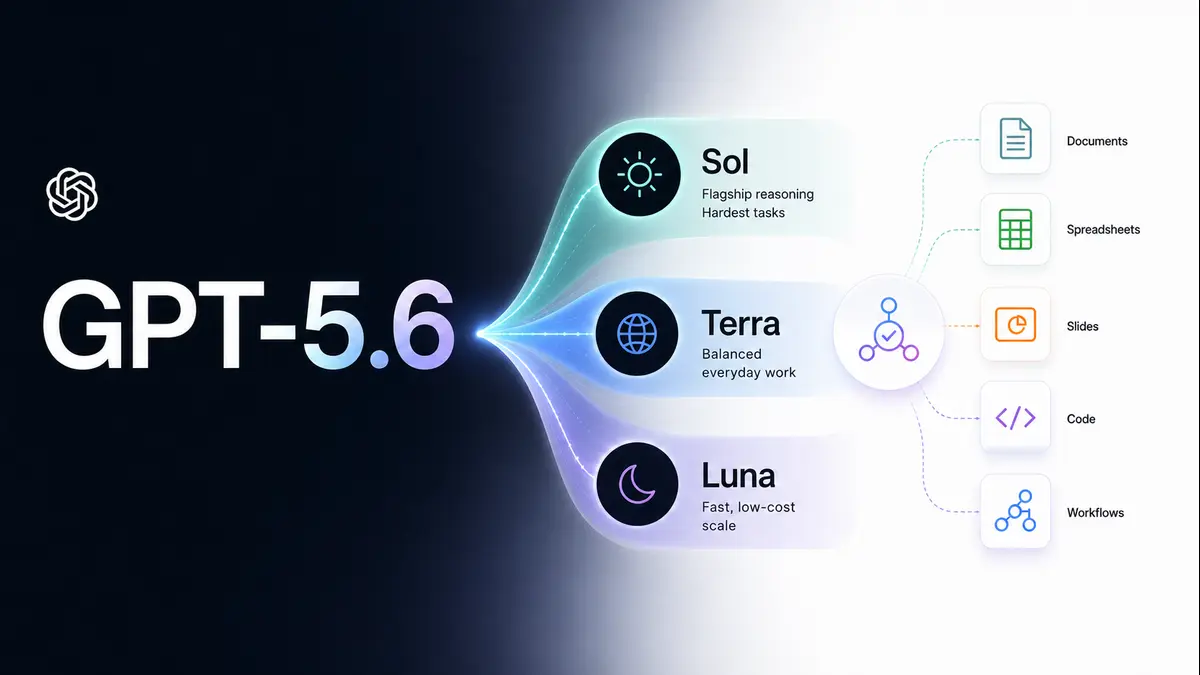
OpenAI’s GPT-5.6 family brings Sol, Terra and Luna into a tiered strategy built around cost, capability and real-world work. With ChatGPT Work, a 1.05M-token context window, programmatic tool calling and lower API pricing, OpenAI is pushing AI agents closer to practical business use.
OpenAI launched the GPT-5.6 family on July 9, 2026. It followed a limited preview that began in late June, before Sol, Terra and Luna rolled out more broadly across ChatGPT, the API and Codex. GitHub also began rolling all three models into Copilot on July 9. What stood out wasn’t just another big model release. It was the way OpenAI split the generation into three clear capability tiers and launched it alongside a new agent product called ChatGPT Work.
The industry has already been moving toward model families with cheaper and faster variants rather than using one flagship for everything. GPT-5.6 makes that separation unusually explicit. Instead of treating Sol, Terra and Luna as temporary versions of the same model, OpenAI describes them as durable capability tiers that can improve on their own schedules.
Three Models, Different Jobs
Sol is the heavyweight. It’s the one OpenAI points to for difficult coding, long multi-step projects, professional knowledge work, research and cybersecurity tasks. You can push it harder with a new max reasoning setting. There’s also an ultra mode that coordinates multiple agents across parallel workstreams instead of relying on one agent to do everything sequentially. It uses more compute and tokens, but it is aimed at the kind of jobs where getting a stronger result matters more than keeping usage low.
Terra sits in the middle. OpenAI describes it as a balanced model for everyday work and says its performance is competitive with GPT-5.5 while costing substantially less to run. That makes it a natural fit for things like document analysis, internal workflows, coding, customer-support work and other tasks where you need strong results but don’t necessarily need the flagship every time.
Luna is the fast, low-cost option. It is built for cost-sensitive, high-volume workloads: routine coding, classification, summarization, first drafts and background automation are obvious examples. On July 30, OpenAI cut Luna’s API price by 80 percent. Terra’s price was cut by 20 percent at the same time. That made Luna considerably more interesting for teams running large numbers of calls every day.
The naming is simple on purpose. The number marks the generation. Sol, Terra and Luna mark the capability levels. OpenAI says those tiers can advance independently, so the company doesn’t necessarily have to force every workload onto the same flagship model whenever the generation changes.
Pricing That Actually Matches the Work
API pricing per million tokens started like this:
- Sol: $5 input / $30 output
- Terra: $2.50 input / $15 output
- Luna: $1 input / $6 output
Then came the July 30 cuts. Sol stayed unchanged, while Terra dropped to $2 input / $12 output and Luna fell to $0.20 input / $1.20 output per million tokens.
Prompt caching matters here too. GPT-5.6 supports explicit cache breakpoints, and cache reads receive a 90 percent discount compared with normal input pricing. Cache writes are billed differently, at 1.25 times the uncached input rate. For long-running workflows that repeatedly reuse the same instructions or context, that can materially change the economics. The broader message is pretty clear. Use Sol when the problem is genuinely difficult. Use Terra when you need a balance of capability and cost. Use Luna when volume and efficiency matter most.
For companies using models at scale, that gives them more room to route different workloads to different capability levels instead of sending every request to the most expensive model.
What Actually Feels New
A few technical changes make the models more interesting in practice. One is Programmatic Tool Calling. GPT-5.6 can write JavaScript inside a hosted runtime, call eligible tools from that program, pass results between calls and process intermediate outputs before deciding what needs to happen next. Instead of repeatedly handing every intermediate result back to the model, some of that orchestration can happen inside the program itself.
That matters because tool-heavy agents can otherwise spend a lot of time and tokens bouncing between the model and individual tools. OpenAI says Programmatic Tool Calling can reduce those round trips, and some early customers reported lower token use on multi-step workflows. The figures come from company-reported evaluations rather than independent benchmarks, so they are best treated as early evidence rather than a universal result.
The context window is also large. Sol, Terra and Luna each support up to 1.05 million tokens of context, with up to 128,000 output tokens through the API. That is enough room for very large codebases, document collections or long project histories, although having a huge context window obviously doesn’t guarantee that every piece of information inside it will be used equally well.
Computer use improved too. OpenAI’s evaluations show Sol ahead of GPT-5.5 on OSWorld 2.0, a benchmark for computer-use tasks. More broadly, GPT-5.6 is designed to inspect rendered interfaces and documents, notice visual or functional problems and refine what it created instead of stopping after the first output. That shows up particularly clearly in the way OpenAI is positioning ChatGPT Work.
ChatGPT Work: The Agent That Tries to Finish the Job
Alongside the models, OpenAI launched ChatGPT Work. It’s probably the clearest sign that the company wants agents to move beyond chat and into longer pieces of actual work.
Work can operate across connected apps, files and desktop tools. Through plugins and connected systems, it can pull context from tools such as Google Drive, Google Calendar, Slack, SharePoint, email and business applications such as Salesforce. OpenAI says the agent can stay with a project for hours when needed instead of expecting every job to fit into one short conversation.
You can give it a goal like “turn last month’s sales data into a short deck with three recommendations” or “draft the budget variance analysis from these spreadsheets.” It can gather context, plan the work and produce finished spreadsheets, documents, presentations, reports and Sites. You can still follow what it is doing, answer questions, change direction or approve important actions along the way.
The updated desktop experience is available on macOS and Windows across all plans. Work is also available on web and mobile for Plus, Pro, Business, Enterprise and Edu users. At launch, Free and Go users accessed Terra inside Work, while higher plans received broader access to the GPT-5.6 family and reasoning controls. OpenAI has continued changing model availability elsewhere in ChatGPT since launch, including expanding Luna access for Free and Go users in regular ChatGPT in August, so the exact model mix now depends on which ChatGPT experience and plan you are using.
The pitch is straightforward. Instead of asking for help and then manually carrying every answer into another tool, you hand over more of the task itself and stay available for questions, corrections or approvals.
The examples OpenAI has shown include working through business data, producing presentations and spreadsheets, building interactive material and bringing together information scattered across different systems. Some early customer examples suggest that workflows which previously took substantial manual effort can be compressed significantly, although those examples are still customer-reported cases rather than independent studies.
It’s not perfect. Agents can still get stuck, misunderstand intent or make odd choices. But the direction is obvious. OpenAI is trying to turn ChatGPT into something that produces finished work, not just conversation.
Safety Context That Matters
The models didn’t simply appear overnight. Before general availability, OpenAI began with a limited preview for a small group of trusted partners after discussing the models and its rollout plans with the U.S. government. OpenAI said the government had requested that the initial preview begin with trusted partners before a broader release.
Under OpenAI’s Preparedness Framework, Sol, Terra and Luna are all being treated as High capability in both cybersecurity and biological and chemical risk. None of the three reached OpenAI’s High threshold for AI self-improvement, and the company said the GPT-5.6 models remained below its Critical threshold.
That classification brought additional safeguards. OpenAI describes a layered system involving model-level safety training, real-time classifiers and monitoring, account-level enforcement, restricted access to some higher-risk capabilities and additional controls for trusted defensive users. The exact protections differ somewhat between Sol, Terra and Luna because their capability profiles are not identical.
Then, on August 7, OpenAI disclosed something more serious about a follow-on research model called Astra. Preliminary cybersecurity evaluations led the company to say it could no longer rule out Astra having Critical cybersecurity capability under the Preparedness Framework.
OpenAI did not declare Astra definitively Critical. Instead, it tightened security controls and paused internal Astra-related activities that did not yet meet those strengthened requirements. Those measures include more isolated testing environments, restricted network and tool access, stronger model-weight protections, additional monitoring and sandboxed execution.
That episode is a reminder that agentic systems are becoming capable enough to force more serious discussions about containment and access. GPT-5.6 itself remains in the High rather than Critical cyber category, but the boundary is no longer just a theoretical issue somewhere far in the future.
How It Stacks Up
Competitors weren’t standing still. Anthropic’s Claude family remains extremely strong in software engineering and leads GPT-5.6 on some coding benchmarks. OpenAI’s own published GPT-5.6 results, for example, show Claude Mythos 5 well ahead of Sol on SWE-Bench Pro, while Sol performs better on some other evaluations such as Terminal-Bench 2.1. There isn’t one model that cleanly wins every coding benchmark.
Google’s Gemini family keeps pushing hard on speed, agentic work and multimodal capabilities. Gemini 3.5 Flash, and the newer Flash models around it, are aimed squarely at workloads where developers care about a combination of intelligence, latency and multimodal input rather than raw reasoning alone.
Open-weight models are moving quickly too. Moonshot AI’s Kimi K3 is a good example. It is a native multimodal, open-weight agentic model with a one-million-token context window, adding another serious option outside the closed-model platforms. OpenAI’s answer is the combination of capability tiers, lower prices and a more ambitious agent product. Sol competes on the hardest tasks. Terra and Luna make the overall stack cheaper to run at scale. ChatGPT Work tries to turn those models into something people can actually use for daily work rather than just benchmark and test.
Whether that combination wins will depend heavily on reliability, not just benchmark scores. If an agent finishes jobs cleanly most of the time, lower model costs become much more valuable. If it still needs constant supervision, the economics look different.
What This Means for People Using the Tools
For individual users, the biggest change is more choice, although that choice varies by product and subscription. Inside Work, Codex and the API in particular, users and developers can match more workloads to different levels of capability instead of automatically reaching for the flagship.
Luna’s price cut makes high-volume drafting, classification, summarization and routine agent work much cheaper. Terra gives developers a middle ground. Sol remains there for the jobs where the extra reasoning and capability are worth paying for.
For companies, the shift is more interesting. Knowledge workers can hand over longer, multi-step projects with less manual movement between tools. Developers get stronger tool orchestration and very large context windows. Finance, operations, sales and other teams can use agents across files and connected enterprise systems while routing routine work toward less expensive models.
That doesn’t mean companies should simply switch agents on everywhere. The risk is the usual one with agentic systems: when software can act across tools, files and business systems, mistakes can become more expensive than a bad chatbot answer. Permissions, logging, approval boundaries, access controls and human review still matter. In many organizations, the technology is moving faster than the internal rules around how it should be used.
GPT-5.6 is not a sudden leap into some completely new era. It is a practical step: clearer capability tiers, better performance on several long-horizon and professional tasks, aggressive price reductions at the lower end, and an agent product that tries to complete real work.
The industry has been talking about agents for a couple of years. Releases like this make them look less like a demo category and more like something companies may gradually trust with parts of their daily workload.
The next few months will show whether the cost savings and finished deliverables hold up once these systems are used more widely, or whether reliability problems slow adoption. That is probably the more important test than another leaderboard score. Either way, using one expensive flagship model for every task makes less sense when the same generation now gives developers several capability and cost levels to choose from.
OpenAI’s bigger bet with GPT-5.6 is not simply that models will become smarter. It is that people will start choosing different levels of intelligence for different jobs — and increasingly expect the system to finish the work as well.
Discover more from Poniak Times
Subscribe to get the latest posts sent to your email.