OpenDAC shows how AI can accelerate the search for better carbon capture materials. By combining quantum chemistry simulations with machine learning, the Georgia Tech–Meta project gives researchers a faster way to screen MOFs for direct air capture. But simulation is not reality, and the lab still gets the final vote.
Direct air capture sounds simple: pull CO₂ from the air and store it. The hard part is finding the right material inside the system.
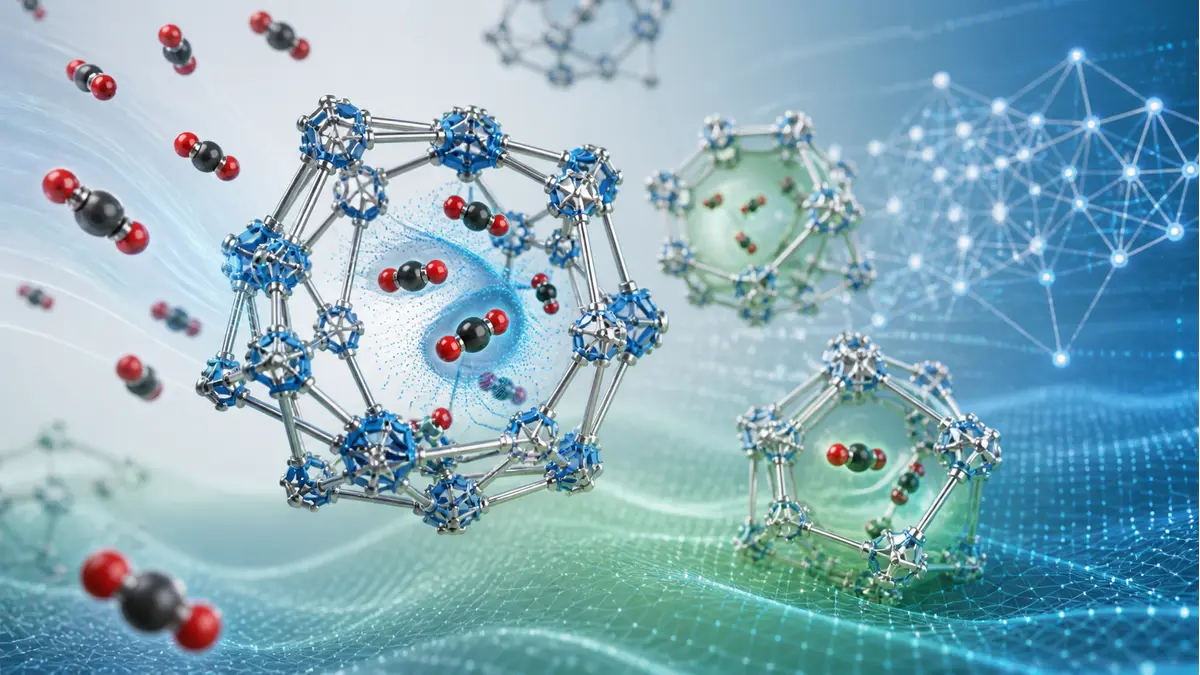
OpenDAC, a collaboration between Georgia Tech and Meta’s Fundamental AI Research team, uses quantum chemistry simulations and machine learning to search for better carbon-capturing materials. These materials include metal-organic frameworks, or MOFs – porous molecular cage-like structures that can trap gases such as CO₂.
The 2023 dataset included more than 38 million DFT calculations across more than 8,400 MOF materials, while the 2025 expansion grew the dataset to 15,000 MOFs with tens of millions more calculations involving CO₂, H₂O, N₂, and O₂.
But OpenDAC is not “AI solving climate change.” It is a discovery tool. It can help researchers avoid wasting time on weak candidates, but the final proof still has to come from chemistry, manufacturing, and real-world testing.
Key Terms Before You Read
DAC: Direct air capture. A carbon removal technology that pulls CO₂ directly from ordinary air.
MOF: Metal-organic framework. A porous material made from metal nodes and organic linkers. Think of it as a tiny molecular cage that can trap gases like CO₂.
DFT: Density Functional Theory. A quantum chemistry method used to simulate how atoms, electrons and molecules behave.
Sorbent: A material that captures or holds another substance. In this article, the sorbent is the material trying to capture CO₂.
Adsorption: A process where molecules stick to the surface of a material. In DAC, CO₂ molecules adsorb onto the capture material.
The Primary Challenge in Direct Air Capture Is the Capture Material, Not the Machinery
The real battle happens at the molecular level. Inside many direct air capture systems is a material that has to behave like a very selective sponge. It must love CO₂ enough to grab it from the air, but not so much that it refuses to let go later.
Too sticky, and the system wastes energy releasing the CO₂. Too loose, and it captures almost nothing.
That is the awkward chemistry at the heart of direct air capture. The material must work in real air, not in a perfect classroom diagram. It has to deal with water vapour, oxygen, nitrogen, heat, dust and changing weather. A material that behaves beautifully in a clean simulation may fail in a humid coastal region or a hot industrial zone.
This is where OpenDAC becomes interesting.
OpenDAC is a research effort from Georgia Tech and Meta that uses quantum chemistry simulations and machine learning to search for better direct air capture materials. It does not build a DAC plant. It does not store CO₂ underground. It does something earlier in the chain: it helps researchers search through thousands of possible materials faster than traditional methods alone.
And in climate technology, finding the wrong material five years late is not just a scientific problem. It is a cost problem.
Technical and Economic Obstacles Facing Direct Air Capture
Direct air capture, or DAC, removes CO₂ directly from ambient air. This is different from capturing CO₂ from a factory chimney or power plant exhaust, where the concentration of CO₂ is much higher.
That difference matters.
CO₂ in the open atmosphere is highly diluted. Capturing it is possible, but it requires moving large volumes of air, using energy carefully, and ensuring that the capture material is not distracted by other gases.
This is one reason DAC remains expensive and difficult to scale.
The International Energy Agency noted in its April 2024 tracker that 27 DAC plants had been commissioned worldwide, together capturing almost 0.01 million tonnes of CO₂ per year. That number shows how early the sector still is compared with the scale of global emissions.
There has been progress since then. Climeworks’ Mammoth facility in Iceland entered operational ramp-up in 2024 and is designed for a nameplate capture capacity of up to 36,000 tonnes of CO₂ per year once fully operational. But even that is tiny relative to the climate problem.
This is not a reason to dismiss DAC. It is a reason to understand why the materials challenge matters so much. Better materials could reduce energy use, improve performance in humidity, extend operating life and lower costs over time.
The machine matters. But the material inside the machine may decide whether DAC can become practical.
Metal-Organic Frameworks: A Promising Material Class With a Vast Search Space
One promising class of materials for carbon capture is called metal-organic frameworks, or MOFs.
Think of MOFs as molecular cages. They are porous crystalline materials made from metal nodes connected by organic linkers. Because their internal structure can be tuned, researchers can design them with different pore sizes, chemical surfaces and gas-binding properties.
That makes them attractive for direct air capture. In theory, a carefully designed MOF could capture CO₂ efficiently while ignoring other gases. It could also release the CO₂ without requiring too much energy.
But there is a brutal catch: there are too many possible MOFs.
The design space is enormous. Each change in metal centre, linker, pore geometry or surface chemistry can alter the material’s behaviour. Testing all of them physically would be impossible. Even simulating them with high-accuracy chemistry methods takes serious computing power.
This is the bottleneck OpenDAC is trying to attack.
Instead of asking researchers to test every candidate one by one, OpenDAC gives them a large open dataset of simulated interactions between gases and MOF materials. Machine learning models can then learn patterns from this dataset and help screen future candidates faster.
It is not replacing chemistry. It is making the search less blind.
OpenDAC: A Quantum Chemistry Dataset and Machine Learning Pipeline for Material Screening
The OpenDAC 2023 dataset was built to study how potential DAC materials interact with CO₂ and water. It contained more than 38 million Density Functional Theory calculations across more than 8,400 MOF materials involving adsorbed CO₂ and/or H₂O.
Density Functional Theory, or DFT, is a quantum chemistry method. In simple terms, it is a virtual chemistry laboratory that estimates how electrons, atoms and molecules behave.
DFT is useful because it can simulate material-gas interactions before researchers physically synthesise a material. But it is also slow and computationally expensive. Running DFT calculations for thousands of structures can require large resources.
That is why OpenDAC matters.
The dataset gives machine learning models a large training ground. Once models learn from many DFT examples, they can approximate similar interactions much faster. That does not make them perfect, but it can help researchers shortlist candidates before spending money on deeper simulations or lab testing.
Meta’s summary of the Georgia Tech collaboration stated that the OpenDAC database contained data for 8,400 materials and was powered by nearly 40 million quantum mechanics calculations. The trained machine learning models were then used to predict how thousands of MOFs would interact with CO₂.
In 2025, the project expanded further with ODAC25. The newer dataset covers 15,000 MOFs and includes adsorption calculations for CO₂, H₂O, N₂ and O₂. Meta’s research page describes ODAC25 as containing nearly 70 million DFT single-point calculations, while the arXiv version describes it as nearly 60 million DFT calculations. The exact number varies by source version, but the direction is clear: the dataset became larger, more diverse and more representative of real air.
That last point is important. Real air is not pure CO₂. A useful DAC material must compete with water vapour, nitrogen and oxygen. If a material fails in humidity, it may be useless in many real-world locations.
OpenDAC at a Glance
| Dataset | Materials studied | Scale | Gases included | Why it matters | Key limitation |
|---|---|---|---|---|---|
| ODAC23 | 8,400+ MOFs | 38M+ DFT calculations | CO₂ and H₂O | Established a large open baseline for DAC sorbent screening | No N₂ or O₂; real-air performance understated |
| ODAC25 | 15,000 MOFs | Roughly 60M–70M DFT calculations | CO₂, H₂O, N₂, O₂ | Added more real-air complexity and improved screening depth | Still DFT-based; experimental validation not included |
Limitations of Simulation: Why Computational Predictions Require Experimental Validation
This is the part that keeps the story honest.
A material can look promising in a computer and still fail in the real world.
It may be hard to synthesise. It may degrade after repeated cycles. It may bind water too strongly. It may be too expensive to manufacture. It may work in a simulation but perform badly inside a full DAC system with fans, filters, heat, pressure swings, maintenance constraints and local climate conditions.
Systematic Biases in Density Functional Theory
DFT is powerful, but it remains an approximation of quantum behaviour. If the underlying simulation has bias, a machine learning model trained on that simulation can learn the same bias. If the dataset overestimates how strongly a material binds CO₂, the AI model may also overestimate that material.
This is the old rule of computing wearing a laboratory coat: better data gives better predictions; flawed data gives confident mistakes.
The laboratory still gets the final vote.
This is not just a generic warning. OpenDAC has already faced scientific scrutiny. In 2025, EPFL highlighted a correspondence in ACS Central Science arguing that some recommended MOF structures associated with OpenDAC 2023 may have been artefacts of the methodology used. In plain terms, some materials that looked attractive in the computational pipeline may not have been reliable real-world candidates.
That does not erase the value of OpenDAC. It strengthens the case for open science.
When datasets are open, other researchers can inspect them, challenge assumptions, identify weaknesses and improve the next version. That is how serious science has always worked. AI does not remove that process. It makes the process even more necessary.
Practical Benefits of OpenDAC for Materials Discovery
OpenDAC changes the early stage of materials discovery.
Before large open datasets, many research groups ran their own smaller simulations, used different assumptions and compared results across fragmented workflows. OpenDAC gives the field a more common starting line.
That helps in three ways.
First, it improves screening speed. Researchers can use machine learning to prioritise candidates instead of testing blindly.
Second, it improves benchmarking. Different research teams can compare models on a shared dataset.
Third, it improves transparency. Open datasets make it easier for outside scientists to find weaknesses, propose corrections and build better tools.
This is a meaningful shift. Climate technology does not only need heroic machines. It also needs better research infrastructure.
Boundaries of OpenDAC: What the Project Does Not Address
OpenDAC does not eliminate the hard parts of direct air capture.
It does not prove that a promising MOF can be manufactured cheaply. It does not prove that the material will survive thousands of capture-and-release cycles. It does not solve plant-level energy demand. It does not make DAC affordable overnight.
A great material in a dataset can still become a nightmare in the factory.
That is why OpenDAC should not be described as “AI solving carbon capture.” That headline would be tempting, but it would be misleading.
A better framing is this: OpenDAC uses AI to make the search for direct air capture materials more scalable. It reduces the number of bad bets that researchers may otherwise chase. That is not magic. It is useful infrastructure.
Artificial Intelligence as Scientific Infrastructure, Not a Panacea
The most important AI systems of the next decade may not look like chatbots.
Some will look like scientific tools.
They will screen materials, predict molecular behaviour, optimise energy systems, analyse protein structures, improve batteries and help researchers explore technical search spaces that are too large for manual trial and error.
OpenDAC belongs to that quieter category of AI progress.
It is not glamorous in the consumer-app sense. It will not trend because of a slick interface. But it represents a serious direction for climate AI: open datasets, physics-based simulations, machine learning baselines and real-world validation.
Direct air capture still has major challenges. It is expensive, energy-intensive and commercially immature. It should never become an excuse to avoid cutting emissions at the source.
But if the world is serious about residual emissions and long-term carbon removal, better DAC materials will matter.
OpenDAC will not build a DAC plant. It will not solve the climate crisis by itself. But it may help researchers avoid wasting years on the wrong molecule.
In climate technology, that may not sound like a miracle. It may be something more useful: progress.
Discover more from Poniak Times
Subscribe to get the latest posts sent to your email.