Physical AI is rapidly reshaping robotics as foundation models enable machines to perceive, reason and adapt. From humanoid robots in factories to expanding robotaxi services, real-world deployments and record investment are pushing robotics toward broader commercial use.
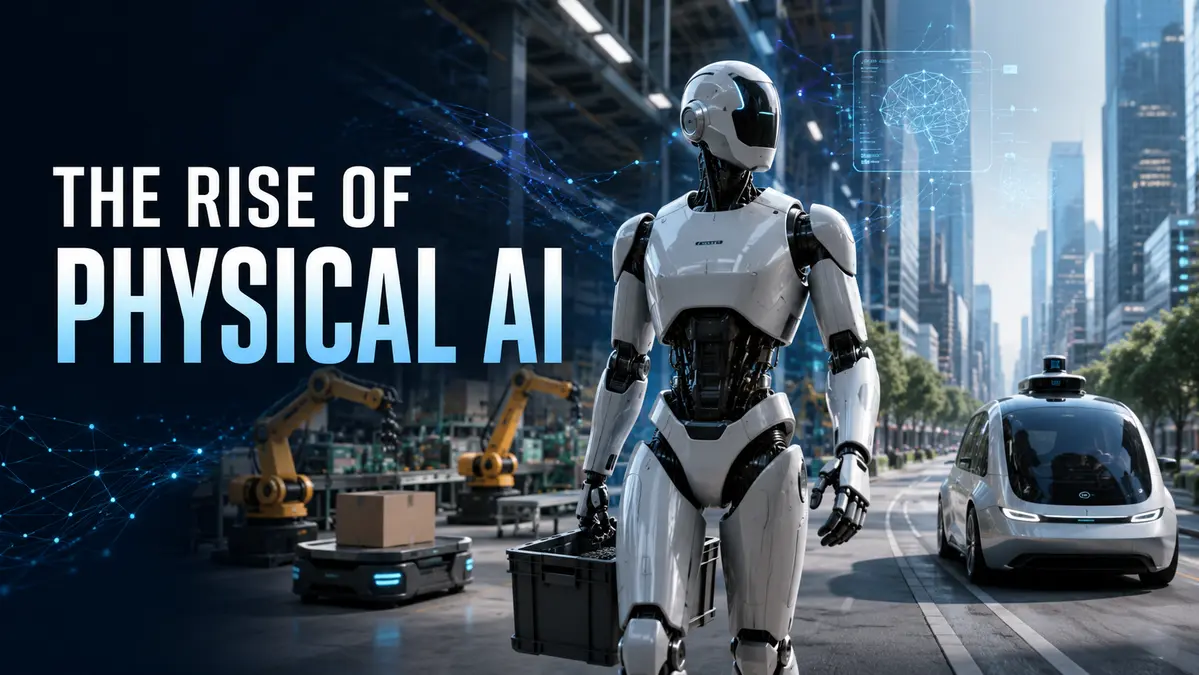
The robotics industry has entered a decisive new phase. After years of specialized machines limited to narrow, repetitive tasks, foundation models are enabling robots to perceive, reason, adapt, and act in unstructured environments. This shift-widely known as Physical AI-is driving record investment, commercial humanoid deployments, and expanding autonomous vehicle services throughout 2025 and 2026.
The intersection of artificial intelligence and the physical world has reached a clear inflection point over the past two years. Robots are moving beyond controlled laboratory demonstrations into factories, logistics centers, and city streets. The progress is measurable, the capital is substantial, and the implications for manufacturing, mobility, and labor are significant.
Record Investment Fuels the Physical AI Boom
Venture capital has responded aggressively. According to Crunchbase, robotics startups raised approximately $15 billion globally in 2025 and had already attracted $18.8 billion by late June 2026. Separately, PitchBook estimates that robotics and Physical AI companies raised $16.3 billion across 492 deals in the first quarter of 2026-the strongest quarter on record in its dataset.
This capital is flowing into both hardware platforms and the intelligence layer that powers them. Companies developing robot foundation models, humanoid systems, and autonomous mobility solutions have secured multi-hundred-million-dollar rounds. Investors increasingly treat capable Physical AI systems more like scalable software platforms than traditional capital-intensive hardware businesses. The underlying thesis is straightforward: once robots can generalize across tasks, the addressable market expands dramatically across manufacturing, warehousing, healthcare, retail, and service industries.
From Specialized Machines to General-Purpose Robots
Traditional industrial robots excel at high-speed, high-precision tasks in highly structured environments. They struggle when conditions change-different object shapes, variable lighting, unexpected obstacles, or the need to collaborate with human workers. Foundation models trained on large-scale visual, sensor, and interaction data are closing that gap.
These models enable robots to understand scenes, plan multi-step actions, track progress, and recover from errors. Vision-language-action architectures allow a single system to interpret natural language instructions, process continuous video feeds, and generate appropriate motor commands. The result is greater flexibility and reduced need for custom programming for every new task.
Google DeepMind’s Gemini Robotics ER 2, released in July 2026, exemplifies this approach. The model functions as a high-level reasoning layer for robots, supporting continuous video understanding, multi-step task orchestration, progress monitoring, and multi-robot collaboration. It can coordinate different types of robots working together on complex workflows that a single machine could not complete alone.
NVIDIA has advanced the autonomous vehicle side of Physical AI with Alpamayo 2 Super, made available for commercial use in August 2026. This frontier-scale open reasoning vision-language-action model processes full-surround camera input, generates trajectories, produces inspectable reasoning traces, and supports long-tail driving scenarios. Its commercial licensing and benchmark-leading performance in NVIDIA’s evaluations position it as a foundational tool for robotaxi and Level 4 autonomous vehicle developers.
Real-World Deployments Demonstrate Progress
Perhaps the most compelling evidence of progress comes from factory floors and city streets. At BMW Group’s Spartanburg plant in South Carolina, Figure AI’s humanoid robots have completed one of the most thoroughly documented commercial deployments to date. The earlier Figure 02 completed an 11-month deployment at the plant, including roughly six months of daily production runtime. The robots logged more than 1,250 operating hours, moved over 90,000 components, and contributed to the production of more than 30,000 BMW X3 vehicles. The robots performed sheet-metal insertion tasks that require both speed and precision while reducing physical strain on human workers.
Building on that experience, BMW is deploying the upgraded Figure 03 for logistics sequencing. The robot sorts unsorted components arriving in large containers into sequencing trolleys for just-in-sequence delivery to the assembly line. New capabilities include improved tactile sensors, palm cameras, wireless charging, and speech-to-speech communication. BMW has described Plant Spartanburg as the birthplace of humanoid robotics in its manufacturing operations and continues to expand Physical AI applications, including a separate pilot with Hexagon Robotics’ AEON platform at its Leipzig plant in Germany focused on high-voltage battery assembly and component manufacturing.
In the mobility domain, Waymo has steadily scaled its robotaxi service. In August 2026, the company removed the waitlist in Dallas and opened fully autonomous rides to the general public after serving nearly 150,000 riders during the invitation-only phase. Waymo’s commercial and expanding fully autonomous operations now span more than ten U.S. markets, and the company has set a target of one million paid rides per week by the end of 2026. Additional cities, including Las Vegas, Denver, San Diego, and Tampa, are advancing through employee testing toward public service. The company continues testing freeway routes and airport operations in several markets.
These deployments illustrate a critical transition: humanoid and autonomous systems are no longer confined to research environments. They are accumulating real operational hours, generating valuable data, and delivering measurable contributions to production and transportation.
Market Opportunity Across Multiple Sectors
Industry analysts project substantial growth for humanoid and Physical AI systems. Depending on methodology, estimates for the global humanoid robot market in 2025 range from approximately $2.9 billion to $5.4 billion, with forecasts indicating rapid expansion through 2030 as production volumes increase and average unit costs decline. Longer-term projections for the broader robotics and Physical AI opportunity reach tens or hundreds of billions of dollars as applications expand beyond early industrial use cases.
Manufacturing remains the near-term leader, followed by warehousing and logistics. Healthcare, retail, and hospitality represent additional growth areas where robots that can handle variable objects and work safely alongside people offer clear value. The ability to deploy more generalist systems reduces the need for highly customized automation solutions and shortens deployment timelines.
Remaining Challenges and Realistic Expectations
Despite the momentum, significant hurdles remain. Reliability in highly unstructured environments continues to improve but is not yet at human levels across all conditions. Safety certification, energy efficiency, hardware durability, and the high cost of collecting diverse real-world training data all require ongoing attention. Scaling from successful pilots involving dozens of robots to fleets of thousands operating continuously presents engineering, supply-chain, and operational challenges.
Public acceptance and regulatory frameworks will also influence the pace of adoption, particularly for robots sharing spaces with people or operating on public roads. Companies that combine strong model performance with robust manufacturing capability, clear paths to cost reduction, and transparent safety practices are likely to lead.
The past couple of years have established Physical AI as one of the most dynamic areas in technology. Record funding, commercial humanoid deployments with documented production impact, expanding robotaxi services, and increasingly capable foundation models for both general robotics and autonomous driving form a coherent picture of accelerating progress.
For tech enthusiasts, the story is no longer primarily about what robots might do someday. It is about what they are already doing in factories and cities-and how rapidly those capabilities are expanding. Foundation models are giving robots broader perception, reasoning, and task-generalization capabilities than traditional task-specific programming alone could provide. The machines are leaving the laboratory, and the data they generate in the real world is accelerating the next round of improvement.
The coming years will reveal how quickly these systems move from early commercial footholds to widespread operational impact. For now, the trajectory is clear: Physical AI has moved from promising research to an active, well-capitalized industry with measurable results on the ground.
Discover more from Poniak Times
Subscribe to get the latest posts sent to your email.