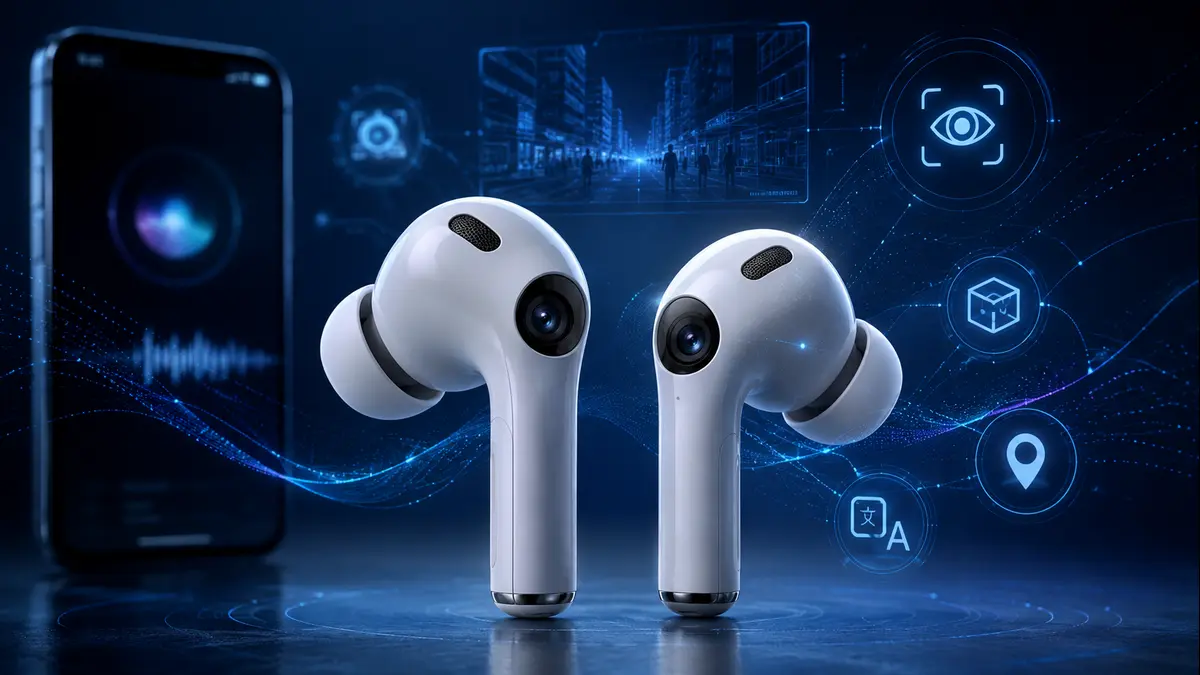
Apple is reportedly testing AirPods with built-in cameras that may help Siri understand a user’s surroundings. If launched, the device could mark an important shift toward ambient AI wearables.
Apple is reportedly testing a new version of AirPods with built-in cameras, and the idea sounds unusual at first. AirPods are audio devices. Cameras usually belong on phones, glasses, laptops, or headsets. But this reported move is not really about turning earbuds into tiny photography tools. It is about something more important: giving AI assistants more awareness of the physical world.
Basically it seems to be, Apple is working on AI-powered AirPods with built-in cameras that could help Siri understand a user’s surroundings. Some reports frame the device as a possible competitor to Meta’s AI glasses, but the more interesting question is not whether Apple can beat Meta in smart wearables. The real question is whether consumer AI is now moving beyond screens and into always-available, context-aware devices.
What Apple Is Reportedly Building
The reported camera-equipped AirPods have not been officially announced by Apple. At this stage, the product should be treated as a reported development, not a confirmed launch. However, multiple reports suggest that Apple is exploring AirPods with low-resolution cameras designed for AI-related functions rather than traditional photo or video capture.
The Verge, which cites Bloomberg, reported that Apple’s camera AirPods are in the design validation testing stage and that the cameras are intended to collect visual data for AI use cases. The report also says users may be able to ask Siri questions based on what the cameras can see, such as requesting recipe ideas from visible ingredients.
This makes the product concept very different from a normal camera device. The camera is not the final experience. The AI layer is. In simple terms, Apple may be trying to give AirPods a limited form of visual understanding, so Siri can respond with more context.
Why This Is Bigger Than an AirPods Upgrade
The important shift here is from voice-only assistance to multimodal assistance. Today, most users still interact with AI through text, voice, or a phone camera. They open an app, type a prompt, speak a command, or point their smartphone at something. That is useful, but it is still not truly ambient.
Camera-equipped earbuds could change that interaction model. Earbuds are already worn for long periods, especially during travel, work, walking, calls, and exercise. If they can capture limited visual context, they may become an AI input layer that works quietly in the background.
This does not mean the smartphone becomes irrelevant. The phone may still remain the main computing hub. But wearables could become the sensors around it. The earbuds may listen and see. The iPhone may process and coordinate. Siri may act as the interface.
Apple Intelligence may provide the reasoning and privacy layer. That is the direction this story points toward.
The AI Angle: Giving Siri Visual Context
The biggest weakness of old voice assistants was lack of context. They could set alarms, answer simple questions, play music, and control basic settings. But they usually did not know what the user was looking at, where the user was standing, or what object the user was referring to.
Visual AI changes that.
Apple already offers Visual Intelligence on iPhone, allowing users to learn more about places, objects, and text around them. Apple’s support page says Visual Intelligence can interact with text, summarize and translate it, read it aloud, identify contact information, and use ChatGPT for information about things around the user when the extension is enabled.
If similar visual understanding is extended to AirPods, Siri could become more useful in real-world situations. A user may ask what a sign means, what product is nearby, what ingredient is on a counter, or what direction to take. For accessibility, navigation, travel, shopping, and daily assistance, that could be meaningful.
The camera itself is only one part of the system. The real product is the combination of sensor, assistant, AI model, privacy architecture, and user experience.
How This May Differ from Meta AI Glasses
The comparison with Meta’s AI glasses is natural, but Apple’s reported approach appears different.
Meta’s Ray-Ban Display glasses are a face-mounted AI device with a built-in display. Meta says the glasses can show notifications, provide real-time information, support navigation, translate text, play music, take photos and videos, and work hands-free with AI features.
That makes Meta’s product more visibly camera-first and display-first. It is closer to a wearable visual computer. Apple’s reported camera AirPods, on the other hand, may be more subtle. They may not show information in front of the user’s eyes. Instead, they could use cameras mainly to give Siri environmental context.
This difference is important. Meta is trying to make glasses the next AI interface. Apple may be trying to make AI flow through devices people already use every day: iPhone, AirPods, Apple Watch, and eventually other wearables. That is a classic Apple-style approach. The company often waits, studies the market, and then integrates new behaviour into an existing ecosystem.
The Siri Problem Apple Still Has to Solve
The success of such a product would depend heavily on Siri. Camera AirPods will not matter if Siri cannot understand visual context quickly and accurately. Apple has been investing in Apple Intelligence, which it describes as deeply integrated across iPhone, iPad, and Mac, with on-device processing and Private Cloud Compute for more complex requests.
But Apple’s AI assistant strategy is still under pressure. Competitors such as Google, Meta, OpenAI, Anthropic, and others have moved aggressively in generative AI. Apple’s advantage is hardware distribution and ecosystem trust. Its challenge is making Siri feel genuinely intelligent, not merely upgraded.
For camera AirPods to work as a serious AI wearable, Siri must move from command execution to contextual reasoning. It should not only hear the user. It should understand the situation.
Privacy Will Decide Public Acceptance
Camera-equipped wearables always raise privacy concerns. Even if the cameras are low-resolution and not meant for normal recording, people may still feel uncomfortable around devices that can visually sense the environment.
This is where Apple will need to be careful. The company will likely have to rely on clear indicators, permission controls, on-device processing, and strict limits around data collection. Apple already positions Apple Intelligence around privacy, saying it uses on-device processing and Private Cloud Compute to handle more complex requests while protecting user data.
For a device like camera AirPods, privacy will not be a marketing footnote. It will be central to the product’s acceptance. Users need to know when visual data is being processed, where it is processed, and whether it is stored.
Why This Matters for the Future of AI Hardware
The reported camera AirPods show where AI hardware may be heading. The future may not belong to one device category alone. It may not be only smartphones, only smart glasses, or only headsets. Instead, AI could become distributed across many everyday devices.
The phone remains the command centre. Earbuds become audio and visual sensors. Smartwatches provide health and motion signals. Glasses may add display and spatial interaction. AI assistants sit across all of them.
That is the larger industry shift. AI is moving from apps into objects. It is leaving the chatbot window and entering the physical world.
Apple has not confirmed camera AirPods, so the product should still be discussed carefully. But the direction is clear. Consumer AI is becoming more ambient, more multimodal, and more dependent on hardware that understands context.
If Apple eventually launches camera-equipped AirPods, the product may not look dramatic from the outside. It may simply look like another pair of earbuds. But strategically, it could be a serious step toward AI devices that listen, see, understand, and assist in real time. That is why this story matters beyond Apple, beyond AirPods, and beyond one product cycle.
Discover more from Poniak Times
Subscribe to get the latest posts sent to your email.