AI Agent Marketplaces are beginning to transform how autonomous software systems are discovered, monetized, and deployed across the enterprise economy.
Software distribution has repeatedly reinvented itself whenever the underlying nature of software has changed. Licensed enterprise binaries gave way to SaaS subscriptions, which were later complemented by mobile app stores and cloud marketplaces that made software easier to discover, compare, and deploy.Each of these transitions followed the same commercial logic. Once software became more modular and abundant, a structured distribution shelf became necessary.
A similar inflection point is now visible again, but with a more profound shift underneath.Today, the software unit is no longer just an application. It is increasingly becoming an autonomous AI agent capable of executing tasks, orchestrating workflows, and making bounded operational decisions on behalf of the user.As organizations move from merely experimenting with AI models to deploying task-specific intelligent systems, an important commercial question emerges: how exactly will these agents be distributed, monetized, trusted, and operationalized at scale?
The answer is beginning to take the form of AI Agent Marketplaces. Far from being a passing startup trend, these marketplaces are quietly positioning themselves as the next software distribution layer for the autonomous enterprise era.
AI Agents Represent a Different Class of Software Product
Traditional SaaS products are designed around human supervision.A user logs in, views a dashboard, uploads data, clicks through menus, and manually triggers functions. Even API-first platforms operate as callable services waiting for explicit instructions from developers or business systems.AI agents behave differently. They are increasingly built to accept goals rather than commands.
A finance agent may reconcile invoices and identify mismatches automatically. A compliance agent may continuously monitor changing regulatory portals and flag risks without a human refreshing spreadsheets. A procurement intelligence agent can scan tender sources, classify opportunities, and route only the most relevant findings.
The distinction is commercially significant because software is no longer being purchased merely as access to tools. It is being purchased as delegated execution. That changes the very nature of software demand. Buyers are not just looking for interfaces anymore; they are beginning to look for deployable digital workers capable of producing outcomes. And when the software unit changes that dramatically, the distribution architecture around it must change as well.
Today’s AI Agent Ecosystem Is Rich in Capability but Poor in Distribution
Thousands of AI agents are being built globally across research, coding, analytics, compliance, HR, procurement, customer support, and industrial monitoring.
Yet most of them remain trapped inside fragmented channels:
- isolated GitHub repositories,
- individual demo websites,
- enterprise consulting deployments,
- or custom API endpoints requiring manual onboarding.
This fragmentation creates inefficiency on both sides of the market.
For enterprise buyers, discovering a usable agent is cumbersome. There is rarely a centralized location to compare multiple agents solving the same business problem, inspect deployment maturity, understand integration readiness, or benchmark trustworthiness.
For developers, the challenge is even more structural. Every agent often requires a separate sales explanation, individual proof-of-concept, bespoke payment arrangement, deployment walkthrough, and customer support layer. Instead of scalable monetization, distribution becomes direct founder-led evangelism.
The result is a market full of technical capability but lacking transactional circulation. Without a common marketplace shelf, every AI agent remains a disconnected island-functional, but commercially underexposed.
Why the Marketplace Layer Is Becoming Essential
Historically, software abundance always creates the need for software aggregation. Mobile applications produced the App Store.Cloud services produced AWS Marketplace.Browser plugins produced extension libraries.
AI agents are now entering the same stage of market maturity.A true AI Agent Marketplace performs far more than directory listing.
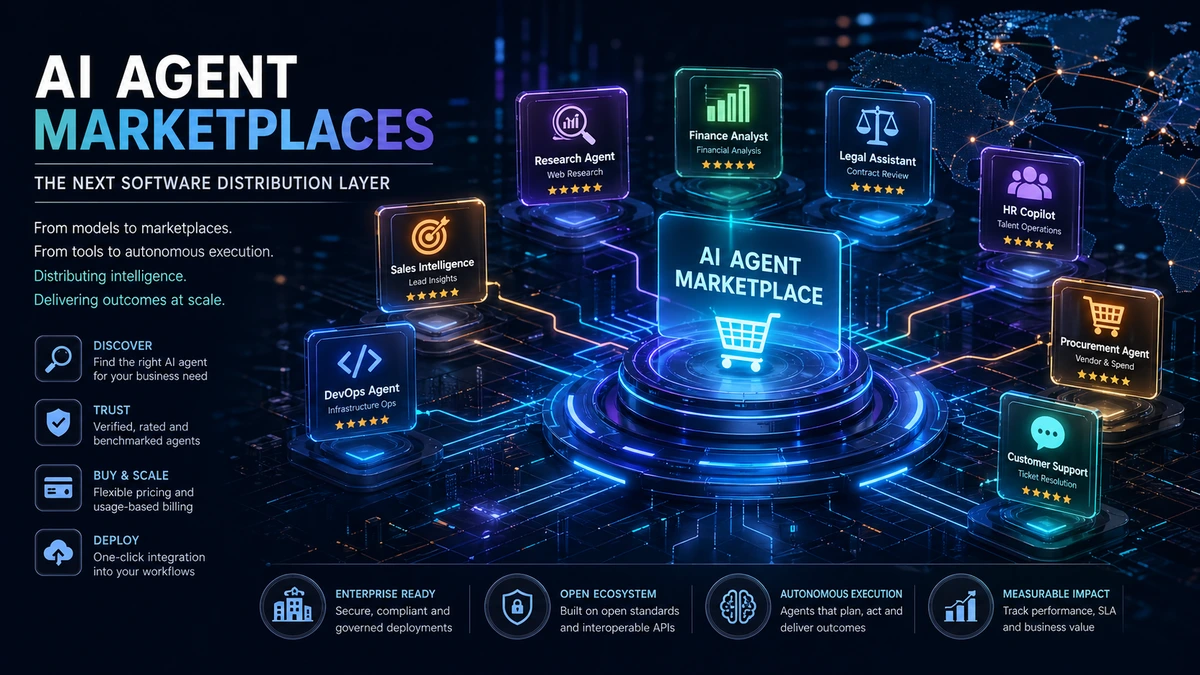
It creates four simultaneous infrastructural functions.
Discovery Infrastructure
Buyers can search by business use case rather than by already knowing which developer exists. Instead of searching the internet endlessly for “an AI contract review automation vendor,” they can directly browse a category of validated legal review agents.
Trust and Benchmarking Layer
Autonomous systems require more trust than static software because they act with varying levels of independence. A marketplace can provide demos, test sandboxes, maturity labels, customer feedback, performance benchmarks, and security disclosures.
Monetization Framework
Independent builders rarely possess strong commercial rails. Marketplaces normalize subscriptions, pay-per-use pricing, enterprise licensing, trial workflows, and payment settlement into one recurring system.
Deployment Access Layer
The strongest marketplaces will also standardize authentication, webhooks, API access, and plug-and-play provisioning so that buyers can operationalize an agent faster after purchase.In short, the marketplace becomes not just a software catalogue, but a transaction engine for autonomous capability.
Big Tech Is Already Building This Infrastructure
The strongest proof that this category is real is that large enterprise technology companies have already begun institutionalizing .Oracle now operates a dedicated AI Agent Marketplace inside Oracle Fusion, where certified partners publish validated AI agent templates that pass Oracle’s structured review criteria before enterprise deployment. Microsoft is simultaneously extending its Copilot stack beyond assistant chat interfaces into role-based enterprise agents capable of ongoing task execution across Outlook, Teams, SharePoint, and internal workflows. Google, at its Cloud Next event, expanded Gemini Enterprise with deeper agent capabilities, including managed tooling for building, deploying, and governing autonomous systems-positioning Google Cloud as an emerging distribution and orchestration layer for enterprise AI agents.
These are not isolated announcements. They indicate that the enterprise software giants are beginning to treat agents not merely as features, but as distributable software entities.That distinction matters immensely. Because Big tech companies do not build marketplace rails unless they expect sustained agent transactions to occur on top of them.

The Emergence of a Commercial Agent Economy
This changes software economics in a fundamental way. For decades, businesses purchased software seats. Increasingly, they may begin purchasing autonomous labor endpoints.
Instead of buying another analytics dashboard that still requires analysts to inspect it, a company may subscribe to:
- a vendor risk monitoring agent,
- a document intelligence agent,
- a legal clause extraction agent,
- a financial summarization agent,
- or a customer outreach automation agent.
Each one acts less like a passive tool and more like a recurring digital operator.
This lowers the barrier for small developers as well. A two-person technical team can theoretically build a highly effective niche procurement agent and distribute it globally without constructing a full-scale SaaS company from scratch.
The marketplace, therefore, becomes the commercialization bridge between narrow agent builders and broad enterprise demand. That is how an agent economy starts taking shape — not through general-purpose chatbots, but through thousands of task-specific autonomous systems being bought and sold like software labor units.
Adoption Is Not Without Friction
This transition, however, is not frictionless. Enterprises are naturally cautious about delegating sensitive workflows to autonomous systems. Questions around reliability, permission boundaries, auditability, and human override remain unresolved in many deployments. Academic work on trusted cloud agents has also highlighted the importance of observability, supervised tool access, and accountable governance before agents can safely operate at scale. There is also a standardization problem.
If every agent follows a different authentication pattern, output format, pricing logic, and API behavior, the marketplace itself becomes fragmented. But these are not arguments against marketplace emergence .They are precisely the reasons marketplace infrastructure becomes essential. Because only a structured distribution layer can impose common trust rails, validation protocols, billing logic, and governance expectations across a chaotic agent ecosystem.
The Next App Store Will Not Sell Apps. It Will Sell Work.
The AI model race has largely been about manufacturing intelligence. The next commercial race will be about packaging that intelligence into reliable, purchasable units of execution. That is where AI Agent Marketplaces are positioning themselves as the shelves where autonomous enterprise work will increasingly be bought and deployed.
Several early-stage platforms are already beginning to position around this infrastructural gap, experimenting with how autonomous agents can be listed, benchmarked, purchased, and integrated through a unified commercial layer. Among the emerging players in this space is Poniak Labs, which is building toward a structured marketplace model for deployable AI agents and business automation systems.
Software once sold interfaces and utilities. AI agent marketplaces may soon sell deployable digital workers capable of completing bounded enterprise tasks. In that shift lies the emergence of an entirely new software distribution economy.
Discover more from Poniak Times
Subscribe to get the latest posts sent to your email.