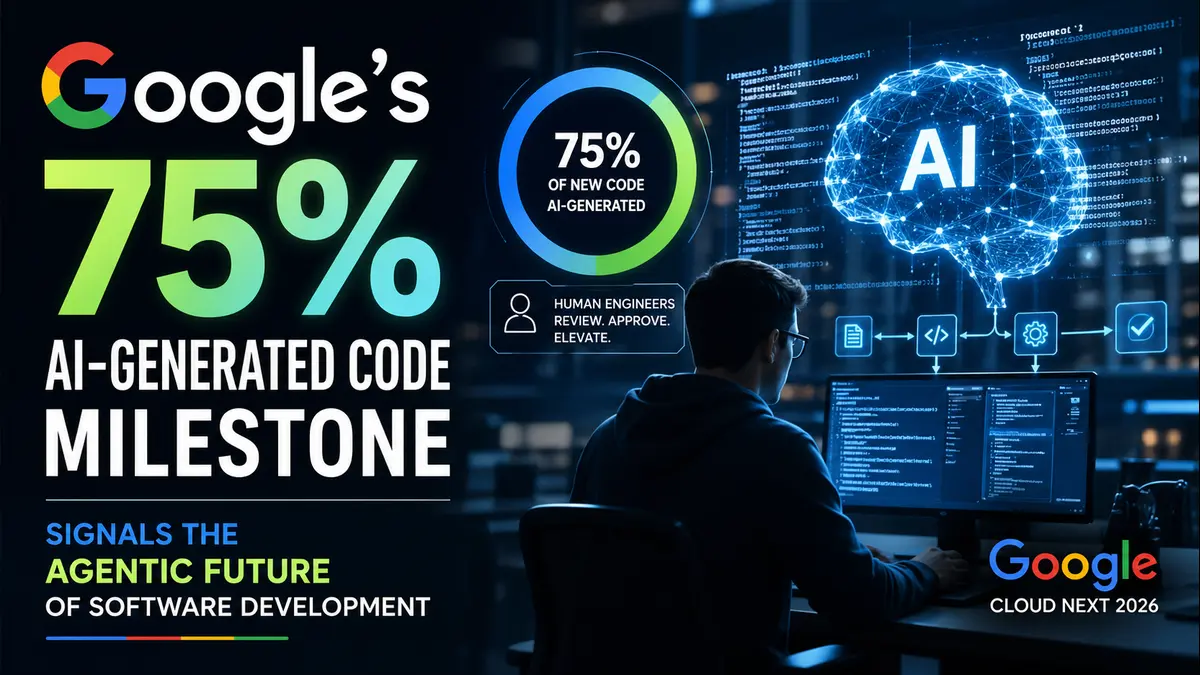
Google’s declaration that 75% of its new code is now AI-generated is more than a productivity statistic. It marks the early redesign of software organizations around AI-assisted engineering labor, changing how developers, managers, and enterprises build technology.
Software development workflows are undergoing a structural transformation. What once relied almost entirely on human keystrokes is rapidly evolving into a hybrid model where AI systems function as semi-autonomous participants in the creation process. A striking illustration of this shift came recently when Sundar Pichai, CEO of Google, disclosed that 75% of all new code at the company is now AI-generated and then reviewed and approved by human engineers. This marks a significant rise from just 50% only six months earlier.
Pichai presented the figure in connection with Google Cloud Next 2026, framing it within the company’s deliberate move toward truly agentic workflows. Engineers no longer simply prompt tools for code snippets; they orchestrate autonomous AI agents capable of planning, generating, iterating, testing, and contributing to complex executions. One notable outcome: a particularly intricate code migration, handled through combined agent and engineer efforts, finished six times faster than what human teams alone achieved a year prior. Google, acting as “customer zero” for its own Gemini-powered tools, offers a live preview of what many organizations may soon encounter when they integrate AI deeply into their development workforce.
This milestone signals more than faster coding. For enterprises ready to treat AI as an active extension of their technical teams, the implications are significant. They span release velocity, resource allocation, competitive agility, and long-term capital efficiency.
From Accelerated Coding to Enterprise-Wide Delivery Transformation
When organizations embed advanced AI coding systems into daily operations, productivity gains begin at the individual task level but quickly scale to enterprise outcomes. Routine elements—boilerplate generation, refactoring, test creation, and repetitive transformations-shift largely to AI, compressing what once consumed significant engineering hours.
The result is not merely more code produced per engineer. Delivery cycles shorten meaningfully. Features and updates reach users faster, enabling organizations to respond to market signals or competitive threats with greater agility. Marginal execution costs decline as AI absorbs volume that previously required proportional human effort. Companies can therefore sustain larger product portfolios or more ambitious technical roadmaps without expanding headcount at the same rate.
Google’s internal experience highlights this dynamic. By leveraging agentic approaches, the company demonstrated how complex, multi-step projects that traditionally demanded extensive coordination can now advance at dramatically accelerated paces. Organizations adopting similar models gain the capacity to innovate more broadly while maintaining leaner technical structures-freeing capital and talent for strategic priorities rather than pure execution volume.
Workforce Evolution: Redefining Roles in an AI-Augmented Engineering Hierarchy
As AI assumes responsibility for a growing share of code generation, the composition and expectations of technical teams begin to shift. Pure repetitive coding roles-focused primarily on implementation details—face natural contraction. In their place rises a premium on systems thinkers, architectural engineers, and those skilled at directing machine labor.
Developers who once derived primary value from the speed and accuracy of their own coding must now redefine their contribution. The competitive edge belongs to those who excel as supervisors and orchestrators of machine-generated implementation. They design effective agent workflows, evaluate outputs against subtle architectural, security, and business requirements, integrate components intelligently, and exercise judgment where models fall short. This transition elevates the profession toward higher abstraction while demanding new fluency in guiding semi-autonomous systems that can plan, iterate, and self-correct.
Junior developers encounter a changed onboarding landscape. AI can accelerate exposure to common patterns and solutions, yet organizations must deliberately safeguard the development of foundational reasoning, algorithmic intuition, and debugging depth. Without intentional mentorship and hands-on practice, there is a risk that essential skills atrophy even as surface productivity rises. The engineering hierarchy itself may flatten somewhat: fewer layers dedicated to execution oversight become necessary when AI handles significant portions of implementation volume.
Management in Transition: New Governance, Metrics, and Strategic Focus
Engineering leaders face equally profound adjustments. Traditional performance metrics centered on individual output-such as lines of code or story points-lose relevance when AI contributes the majority of new implementation. Managers must instead prioritize outcome-focused evaluation: architectural integrity, innovation quality, risk management, and the cultivation of hybrid human-AI team capabilities.
Oversight evolves from granular task coordination toward structured governance of agent outputs. New approval pipelines, audit mechanisms, and controlled environments become essential to manage risks such as subtle vulnerabilities or unintended behaviors in semi-autonomous systems. Managerial attention redistributes-from monitoring daily execution to controlling strategic risks and ensuring alignment with broader business objectives.
Hiring and talent strategies adapt accordingly. Organizations increasingly seek engineers fluent in agent orchestration alongside deep technical expertise. Training programs expand beyond coding fundamentals to include responsible supervision of AI labor, collaborative dynamics, and decision-making in high-velocity hybrid environments. Team structures may become leaner, with emphasis placed on quality of architectural decisions rather than volume of human-written code.
Responsible Navigation of the Agentic Shift
This transformation carries inherent challenges. Organizations must guard against superficial reviews amid higher throughput, potential security exposures in generated code, and difficulties in accurately measuring net productivity gains. Accountability frameworks-who bears responsibility for issues originating from agent contributions-require explicit definition.
Legacy systems or highly specialized domains may realize more modest benefits initially, while maintaining creative ownership and diverse perspectives remains vital even as AI drafts the bulk of implementation.
Leaders who approach adoption thoughtfully invest in robust review practices, balanced metrics, and cultures that treat AI as a powerful but supervised participant rather than an unchecked replacement.
The Road Ahead: Organizations Redesigning Around AI-Assisted workforce
Google’s 75% milestone is more than evidence of tool maturity. It demonstrates that leading software organizations are already redesigning themselves around AI-assisted labor. Developers transition from primary authors of code to orchestrators of intelligent systems. Managers shift from execution supervisors to architects of governed, high-velocity environments. Enterprises as a whole gain the ability to deliver faster, operate more efficiently, and innovate with greater agility.
Realizing these advantages demands deliberate action: upskilling teams in agentic practices, redesigning workflows and governance, and maintaining human judgment at the center of critical decisions. Those who execute this transition with clarity will likely establish lasting advantages in release velocity, resource efficiency, and competitive responsiveness.
The agentic era in software development has begun. Organizations that thoughtfully integrate AI as part of their coding workforce-while consciously evolving the roles of developers and managers-stand positioned to redefine what is possible in building technology for the years ahead.
————————————————————————————————————————————————————————————————————————————–
As more developers begin turning specialized agents into reusable digital products, discoverability and external distribution will matter just as much as orchestration. Poniak Labs is being built with that exact future in mind.
Explore the emerging AI agent marketplace at Poniak Labs.
————————————————————————————————————————————————————————————————————————————-
Discover more from Poniak Times
Subscribe to get the latest posts sent to your email.