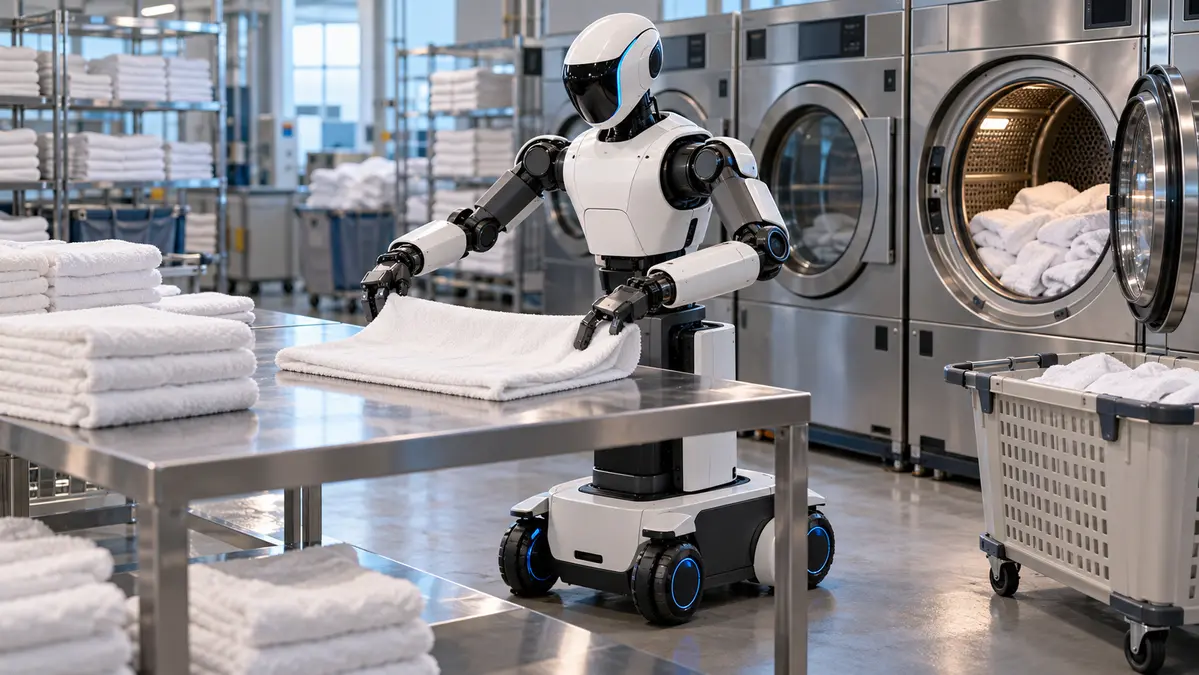
Dyna-2.1 combines whole-body control, manipulation learning and workflow reasoning to coordinate an hour-long laundry demonstration. This article examines Taku’s hardware, human-video training, error recovery and the evidence still needed to establish reliable, productive commercial robot operation.
Commercial laundry involves more than washing and folding. Someone must move loads between machines, monitor cycles, sort items, clear completed stacks and respond when a towel falls or a machine needs attention. Automating one of these activities can be useful, but the remaining work may still require a person nearby.
Dyna Robotics, an American company based in Redwood City, California, is addressing that broader workflow with Dyna-2.1, a physical-agent system introduced on September 29, 2026. Its accompanying demonstration shows Taku, the company’s new wheeled semi-humanoid robot, carrying out an hour-long laundry-room workflow. Dyna presents the footage as uncut and reports that the sequence was completed without human intervention.
The demonstration provides a useful example of long-horizon robot autonomy: a system coordinating several activities, retaining information about earlier actions and responding to changes while physical work continues. It does not, by itself, establish dependable operation across customer sites or entire working shifts. Understanding its significance requires examining both the engineering and the limits of the evidence.
What Dyna-2.1 Adds to Physical Robot Autonomy
An individual manipulation task usually has a relatively clear beginning and end. A robot picks up a towel, folds it and places it on a stack. A laundry workflow introduces dependencies: the washer must finish before its load can move to the dryer, while folding can continue during either machine’s cycle.
The robot therefore needs to decide what to do next while keeping track of work already underway. It must also recognise when an action has failed and determine whether to repeat it, change its approach or move to another activity.
Dyna-2.1 combines three software layers for these responsibilities. A whole-body controller handles coordinated movement. A manipulation policy generates the trajectories needed for physical tasks. A vision-language orchestrator monitors the workflow and selects the next step.
This division allows movement control and workflow reasoning to operate at different timescales. A decision about which machine to unload need not run as frequently as the controller maintaining the robot’s motion.
The term “physical agent” describes this integration of perception, decision-making and action. It should not be interpreted as evidence that the robot can independently perform any job in an unfamiliar workplace.
Taku: Hardware Built Around Reach and Manipulation
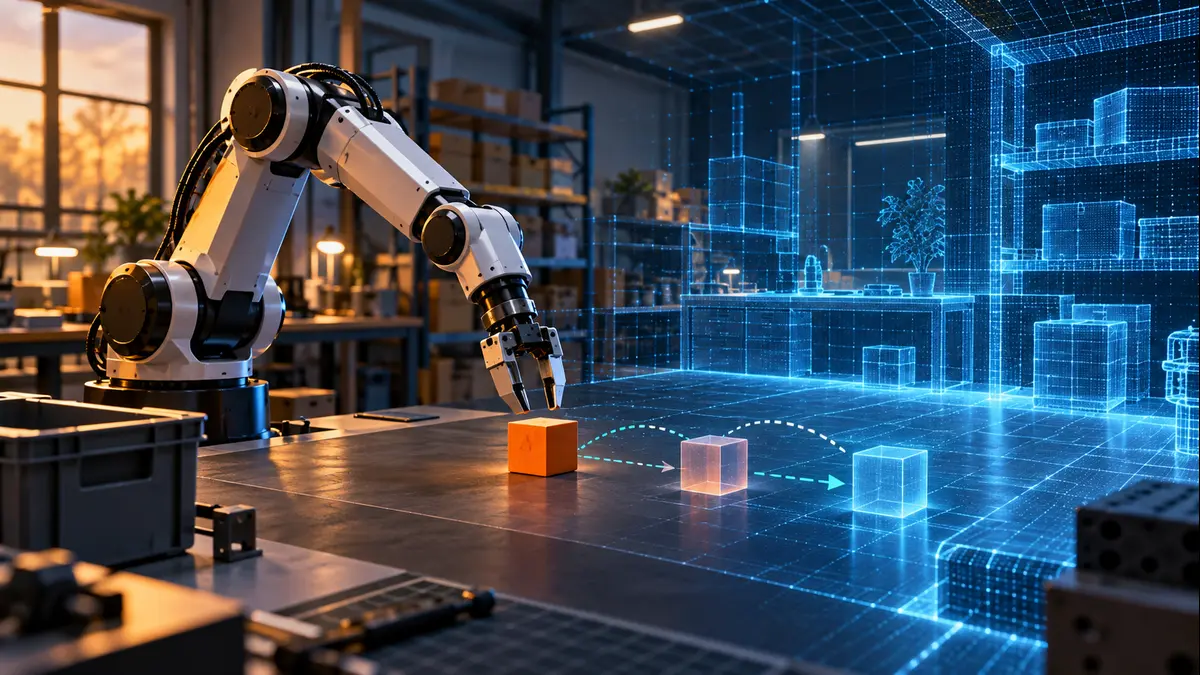
Taku has a human-shaped upper body, two seven-degree-of-freedom arms, a folding lower body and a base with four steerable wheels. Its design prioritizes movement between workstations and access to equipment built for people.
The folding body allows it to reach into a dryer and place stacks on shelves at different heights. Its arms support manipulation across that workspace, while the wheeled base avoids the continuous balancing demands of a bipedal platform. These choices suit the demonstrated laundry setting. They also illustrate why a robot’s physical design matters as much as its model: an action can be correctly planned yet remain impossible if the machine cannot reach the object or position itself appropriately.
Dyna reports that Taku’s whole-body controller was trained using reinforcement learning in simulation and operates at 100 hertz. It translates target trajectories into joint targets and wheel velocities, coordinating the base, torso and arms.
Above this controller, an improved Dyna-2 policy produces whole-body target trajectories. The orchestrator supplies the workflow decisions that guide those physical actions.
We are releasing Dyna-2.1, the first Physical Agent that achieves reliable super long-horizon whole-body autonomy. It combines our brand-new semi-humanoid hardware with an agentic system built around Dyna-2 to handle ultra-long real-world workflows.
Here is an uncut footage of Dyna-2.1 completing an entire hour-long laundry room workflow, just like a human does.
— Dyna Robotics (@DynaRobotics) September 29, 2026
How Human Video Supports the Dyna-2 Model
The underlying Dyna-2 world-action model was pre-trained on more than one million hours of egocentric human video, according to Dyna’s research report. Egocentric footage captures activities from the person’s viewpoint, providing information about how hands, objects and surrounding scenes change during physical work.
Dyna reports that increasing this pre-training data improved prediction on held-out human data and on robot data excluded from pre-training. It also evaluated physical robot tasks after adding robot-specific training data. These distinctions matter. Predicting actions in a recorded dataset is a different test from successfully executing them on hardware. Transfer to an unseen robot embodiment during an offline evaluation is also different from completing an unfamiliar customer workflow without adaptation.
The company’s reported results support human video as a useful source of pre-training experience. They do not eliminate the need for robot demonstrations, task-specific training or deployment evaluation. Dyna-2.1 also uses a shared motion interface called the Unified Robot Representation. It describes relevant body poses in a common format, helping connect human recordings, robot demonstrations and the trajectories followed by the controller. This addresses a practical learning problem: human motion must be translated into commands a robot can execute while preserving the intended interaction with an object.
What the One-Hour Laundry Demonstration Shows
In the demonstrated workflow, Taku handles activities including loading machines, operating their controls, unloading towels, folding and arranging completed stacks.
The scheduling is significant. Folding can be interrupted when a dryer needs attention, after which the robot can return to the earlier activity. The system must retain information that is no longer immediately visible, including which machines are running and how much folding has been completed.
Dyna describes a laundry cycle as approximately 79 steps, with thirteen workflow decision points. These are the company’s estimates and decomposition of the process, rather than a standardised benchmark. The orchestrator maintains textual memory of progress and machine states. Dyna also describes post-training it on the workflow’s branches, so the demonstration should be understood as execution of an established process with conditional decisions.
The company calls this, to its knowledge, the first physical agent to perform hour-long, non-linear workflows combining mobility and dexterous manipulation. That is a narrowly framed company claim, rather than an independently established finding.
Why Recovery Matters Over Longer Workflows
Small failure probabilities accumulate as tasks become longer. Consider an illustrative sequence of 79 steps, each with an independent 99% probability of success. If every step must succeed on its first attempt, the probability of completing the sequence is approximately 45%. This calculation is not a Dyna benchmark. It shows why a strong success rate on an isolated task cannot automatically establish reliable workflow completion.
Recovery changes the problem. A robot that detects a poor grasp and tries again may still complete the job. However, retries consume time, and some errors require earlier work to be repeated. Operational performance therefore depends on successful recovery, its duration and the consequences of the original mistake. The often-cited 99.4% napkin-folding result belongs to Dyna-1’s earlier 24-hour evaluation. Dyna later clarified that people still replenished its napkin supply and removed finished stacks. The folding task was autonomous; the surrounding workflow continued to require support.
Dyna-2.1’s launch materials emphasise mean time between interventions, or how long a robot works before a person must assist. This measure is relevant to staffing and supervision, although it should be assessed alongside output quality, throughput and downtime.
From Demonstration to Commercial Operation
Dyna’s launch press release states that Dyna-2.1 is being deployed in hotels, laundromats and restaurants. Its technical report, however, describes taking the new system to customer sites as the next milestone. Those statements do not provide sufficient detail to establish the maturity or extent of sustained customer operation.
For an operator, the relevant questions are concrete. How many acceptable items does the robot process? How often does someone intervene? How much time is lost to recovery, charging or maintenance? How does performance change when equipment, materials or procedures differ?
A successful hour is meaningful evidence of capability. A commercial case requires repeated results under the conditions in which customers will depend on the system. Dyna-2.1 brings hardware, manipulation learning and workflow reasoning together in a coherent demonstration. Its strongest contribution is showing how a robot can coordinate ongoing physical work rather than repeatedly execute one isolated skill. The next test is whether that capability remains reliable, productive and economical over sustained operation.
Discover more from Poniak Times
Subscribe to get the latest posts sent to your email.