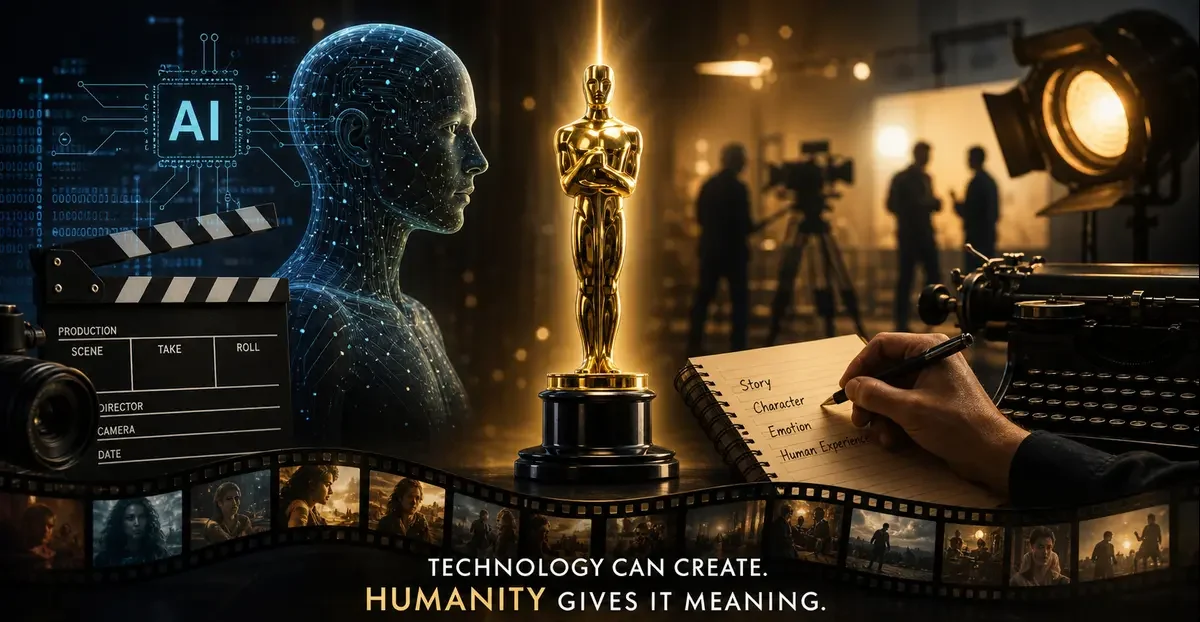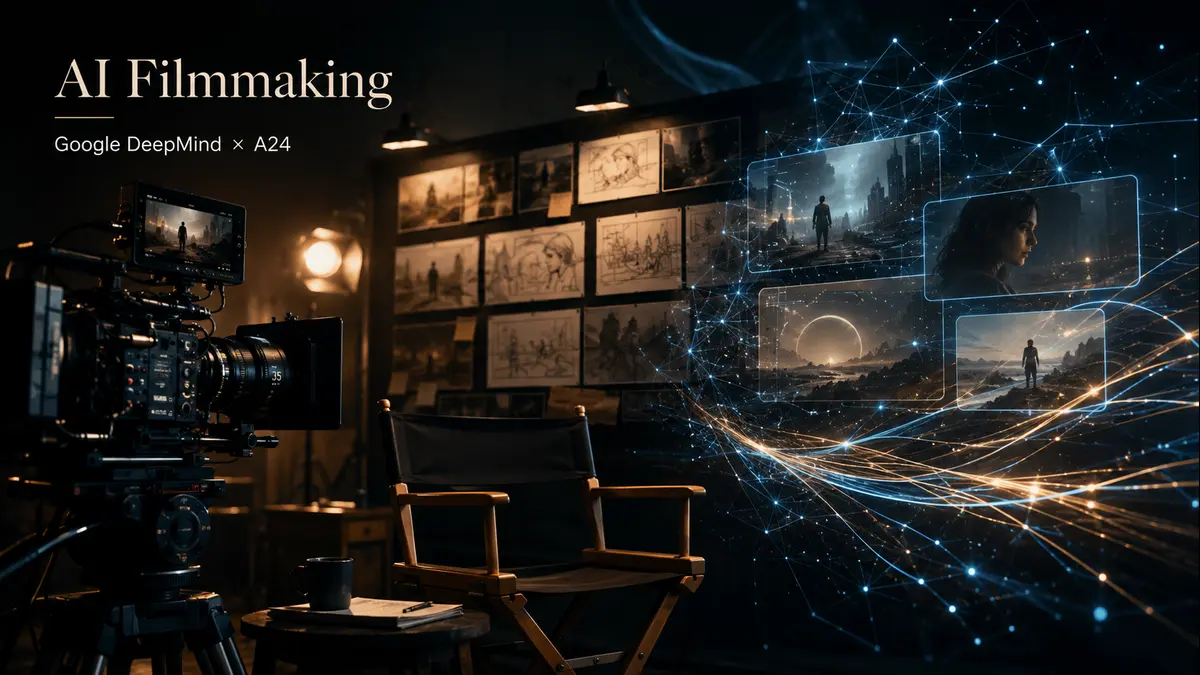
Google DeepMind’s A24 partnership shows how AI filmmaking is moving beyond demos into real production workflows, from storyboarding and pre-visualization to creator-led cinematic experimentation.
In the rapidly evolving intersection of technology and creativity, Google’s latest move stands out as particularly intriguing. As artificial intelligence moves beyond chat interfaces, search, coding, and enterprise automation, cinema is becoming one of its most important creative frontiers.
The recent multi-year research partnership between Google DeepMind and A24 represents a significant milestone ,not just in terms of investment, but in its potential to reshape how stories are developed, visualized, and produced on screen. This is not simply about AI generating short clips from prompts. The larger question is whether frontier AI can become part of serious filmmaking workflows without weakening the human imagination at the center of cinema.
Let’s delve into the details of this collaboration, A24’s distinctive legacy, the tools already in play, and what this partnership could mean for the future of film production.
Who Is A24? A Powerhouse of Bold, Auteur-Driven Storytelling
A24 has carved out a unique space in the entertainment industry since its founding in 2012 by Daniel Katz, David Fenkel, and John Hodges. Operating as an independent production and distribution company based in New York, A24 has become synonymous with daring, original voices that challenge mainstream Hollywood formulas.
Rather than relying only on conventional blockbuster logic, the studio has built its reputation around distinctive artistic perspectives, genre experimentation, and filmmaker-led storytelling. This has helped A24 become one of the rare modern studios whose brand is associated not just with scale, but with taste.
Its notable works paint a vivid picture of this commitment. “Moonlight” earned critical acclaim and won the Academy Award for Best Picture, offering a tender and groundbreaking exploration of identity and masculinity. “Everything Everywhere All at Once” became a cultural phenomenon, blending multiverse action with family drama and securing multiple Oscars, including Best Picture.
Horror fans revere titles like Hereditary and Midsommar for their psychological depth under directors like Ari Aster. Other standouts include Lady Bird, Ex Machina, Uncut Gems, The Witch, and more recent high-profile titles and projects such as Backrooms and Marty Supreme.
What sets A24 apart is its filmmaker-forward approach. The studio is known for backing directors with strong creative identities and giving unconventional stories room to breathe. That reputation makes A24 a particularly interesting partner for AI experimentation. If a company like Google wants to test AI inside real cinematic workflows while avoiding the perception that technology is simply replacing artists, A24 is one of the most credible studios to work with.
Unpacking the Google DeepMind-A24 Deal: Investment Meets Research Collaboration
Announced on June 22, 2026, the Google DeepMind-A24 partnership brings together one of the world’s leading AI research organizations and one of the most culturally influential independent film studios. Google has officially confirmed an investment in A24, while The Wall Street Journal reported the amount to be around $75 million. This has also been described in media reports as Google’s first equity stake in a traditional film studio.
The structure matters. This is not being framed as a content acquisition or a simple licensing arrangement. Instead, it is positioned as a deep research and development collaboration spanning multiple projects over time.
Key aspects of the deal include:
A Focus on Research and Practical Filmmaking Tools
The partnership is expected to support the development of AI-assisted tools and workflows for filmmakers. Early reporting points toward areas such as AI-assisted storyboarding, pre-visualization, production planning, and other tools that can help creators test ideas faster before entering expensive production stages.
This is important because serious filmmaking is not just about generating beautiful visuals. It involves planning, continuity, camera language, performance, editing, mood, rhythm, and the director’s intent. If AI is to become useful in cinema, it must fit into these practical layers rather than operate only as a novelty tool.
Non-Exclusive and Creator-Centric
The agreement has been reported as non-exclusive, meaning A24 can continue working with other technology providers. This gives the studio more flexibility and reduces the risk of becoming locked into one AI ecosystem.
Another important reported detail is that Google will not gain access to A24’s film and television library data. That distinction matters because one of the biggest concerns in the entertainment industry is whether creative archives, past scripts, performances, and finished films might be used to train generative models without clear permission or compensation.
Tools, Not Replacement
The most thoughtful part of the partnership is its stated emphasis on tools rather than replacement. A24 and Google DeepMind appear to be positioning this as an effort to augment human creativity, not automate filmmaking wholesale.
That difference is crucial. Many creators are skeptical of generic generative AI because it often feels detached from authorship, craft, and consent. But if AI tools are designed around real production bottlenecks — storyboarding, visual exploration, scene planning, continuity, asset iteration, or post-production support — they may become more acceptable as creative infrastructure.
In that sense, the partnership is not just about making AI-generated films. It is about discovering where AI can sit inside the production pipeline without taking the steering wheel away from artists.
How the Partnership Is Expected to Work: Filmmakers in the Driver’s Seat
The collaboration is designed as a two-way process. DeepMind researchers will work alongside A24 filmmakers, producers, and technical teams to co-develop workflows and techniques tailored to real production needs. A24’s creative teams will provide feedback, helping researchers understand what actually matters on a film project.
This hands-on model is important because many AI tools fail when they are designed from the technology side first and the creative side later. Filmmaking has its own grammar. A technically impressive clip may still fail if it does not match tone, blocking, lighting continuity, character psychology, or the rhythm of a scene.
By placing filmmakers inside the development loop, Google DeepMind can test its models against the messy and demanding conditions of real creative work. That could include questions such as:
- Can an AI system help a director visualize a scene without flattening their style?
- Can it maintain character, lighting, and location consistency across shots?
- Can it help production teams explore alternatives before money is spent on sets, locations, or visual effects?
- Can it support editors and designers without creating authorship confusion?
These are practical questions. They are also strategic ones. If the tools work inside A24’s environment, they could eventually influence a wider range of creative products across Google’s ecosystem. A24, in return, gains early access to frontier AI research that may help its filmmakers experiment with new visual forms and production methods.
The multi-project, multi-year horizon suggests sustained experimentation rather than a one-off marketing collaboration.
Building on Existing Foundations: Tools Like Flow and Veo
Google has not entered this space unprepared. In May 2025, it introduced Flow, an AI filmmaking tool built specifically for creative video workflows. Flow is powered by Google’s advanced models, including Veo for video generation, Imagen for image generation, and Gemini for multimodal understanding and creative assistance.
Flow is designed to help users create cinematic clips and scenes, refine ideas, and work with AI in a more structured creative environment. It is not merely a casual text-to-video generator. Google has positioned it as a tool built with and for creatives, which makes it directly relevant to the A24 partnership.
Veo, in particular, is central to Google’s AI video ambitions. Google positions Veo as a video generation model built for filmmakers and storytellers, with newer versions emphasizing realism, camera control, motion quality, and audio capabilities. These features matter because professional-grade filmmaking requires far more than a visually impressive frame. It requires movement, continuity, atmosphere, and emotional coherence.
Flow’s scene-building and conversational editing capabilities indicate where AI filmmaking tools are heading. The next phase is not only about producing isolated AI clips. It is about helping creators plan, iterate, and refine sequences in a way that connects to actual storytelling.
These existing tools provide a technical base for the A24 partnership. Rather than beginning from scratch, Google and A24 can build on Flow, Veo, Imagen, and Gemini while adapting them to the specific demands of independent and auteur-driven cinema.
A Precursor: The Primordial Soup Collaboration and Lessons Learned
This is not Google’s first serious step into AI-assisted filmmaking. In 2025, Google DeepMind worked with Primordial Soup, the storytelling innovation venture founded by director Darren Aronofsky. That collaboration produced ANCESTRA, a short film directed by Eliza McNitt that premiered at the Tribeca Festival.
The project combined live-action performances with Veo-generated visuals, using AI as part of a hybrid production process. It explored how generative video could support artistic expression while still depending on human direction, performance, and editorial judgment.
For Google DeepMind, the project served as a useful proof of concept. It allowed researchers and filmmakers to test AI tools in a controlled creative setting and gather feedback on issues such as motion, personalization, visual integration, and the relationship between live action and generated imagery.
The A24 partnership appears to build on that foundation, but at a larger and more strategic level. Instead of working on a single short film, Google is now working with a full studio known for distinct creative voices and a serious production slate. That makes the partnership more significant.
Why This Could Be Game-Changing for Film Production Workflows
The true potential of the Google–A24 partnership lies in making AI genuinely useful inside professional pipelines.
Film production is expensive because every creative decision eventually becomes a logistical decision. Locations, sets, crews, lighting, camera movement, costume, VFX, editing, and post-production all require time and money. If AI can help filmmakers visualize choices earlier, compare alternatives faster, and reduce wasted production cycles, it could meaningfully change the economics of filmmaking.
For a studio like A24, this could be especially valuable. Many of its films are ambitious not because they have the largest budgets, but because they take artistic risks. AI-assisted pre-visualization, storyboarding, and experimental scene planning could help directors explore bolder ideas before committing resources.
Broader implications include:
- AI-assisted storyboarding that preserves a director’s visual intent.
- Faster pre-production planning for complex scenes.
- Better visual consistency across shots and sequences.
- New hybrid aesthetics that combine practical filmmaking with generative elements.
- More accessible high-end production techniques for smaller teams.
- Potentially faster iteration in editing, VFX, and post-production workflows.
This does not mean AI will automatically democratize cinema. Technology can reduce some barriers, but distribution, financing, talent, and cultural taste still matter. However, if used carefully, these tools could give smaller creative teams access to capabilities that previously required larger budgets.
That is why this partnership is strategically important. It points toward AI becoming part of the filmmaking operating system, not merely a promotional gimmick.
The Creative and Ethical Questions Still Matter
The excitement should not erase the concerns. AI in entertainment remains controversial for good reasons.
Questions around authorship, training data, consent, compensation, and creative identity are still unresolved across the industry. If AI tools are trained on creative work without permission, or if they are used mainly to reduce human labor without protecting artists, resistance will be justified.
There is also the risk of aesthetic homogenization. If too many creators rely on the same model defaults, cinematic output could become visually polished but emotionally generic. Film history has always advanced through strong human taste — from directors, cinematographers, editors, actors, production designers, and composers. AI should expand that field of expression, not compress it into predictable patterns.
This is where A24’s involvement becomes important. A24’s brand is built on creative risk, not formula. If the studio can help shape AI tools around artistic control, the partnership may offer a healthier model than purely prompt-based content generation.
The real test will be whether the technology respects the filmmaker’s vision. The best outcome is not AI replacing the director. The best outcome is AI becoming a more powerful sketchbook, pre-visualization engine, and production assistant for human storytellers.
Google’s investment in A24 signals a maturing relationship between artificial intelligence and the art of filmmaking. The partnership brings together DeepMind’s technical depth, Google’s existing creative AI tools, and A24’s reputation for filmmaker-led storytelling.
By building on tools like Flow and Veo, learning from earlier experiments such as ANCESTRA, and committing to a filmmaker-led research process, the collaboration has the ingredients to influence the future of production workflows.
The most important point is this: the future of AI in cinema may not be defined by fully automated movies. It may be defined by better creative infrastructure — tools that help filmmakers imagine, test, refine, and produce stories with greater flexibility.
For the film industry, this is a development worth watching closely. For AI companies, it is a reminder that creative tools cannot be built only in research labs. They must be shaped by the people who understand story, image, emotion, and craft.
Google and A24 are now testing that idea at a serious level. If the collaboration succeeds, it could mark a turning point where AI filmmaking moves from impressive demos into real production workflows.
Discover more from Poniak Times
Subscribe to get the latest posts sent to your email.