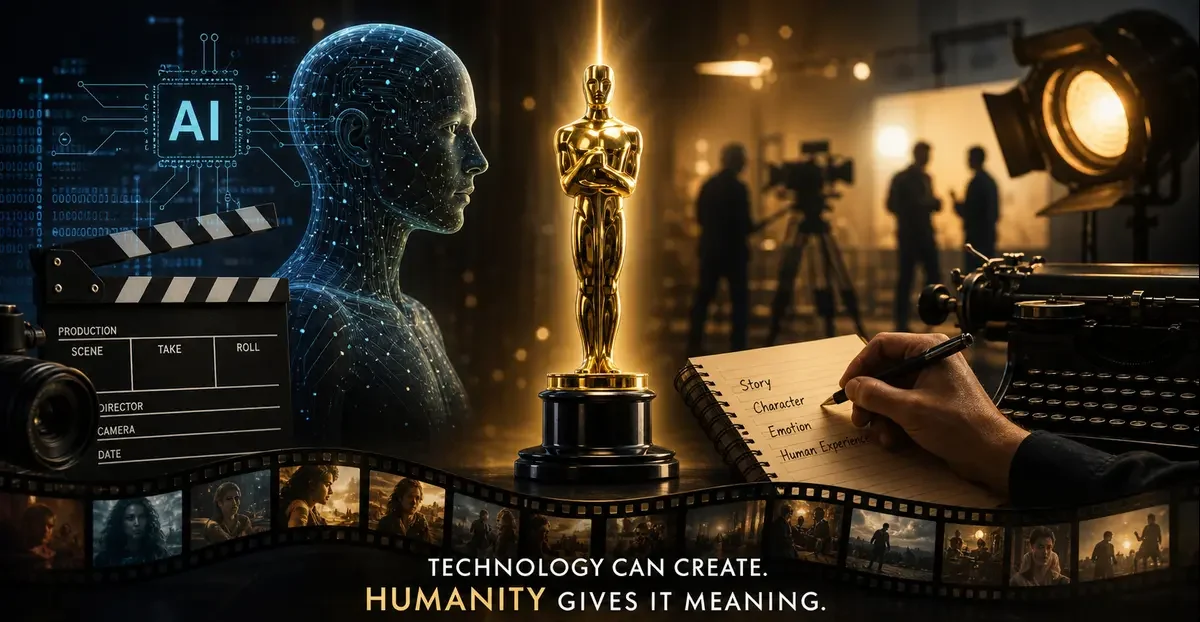
The Academy’s updated Oscars AI rules are not a rejection of technology but a defense of human creativity. As generative AI enters acting, writing, and filmmaking workflows, the Oscars are drawing a clear line around human performance, authorship, consent, and artistic recognition.
Artificial intelligence has entered almost every creative room. It can draft dialogue, generate images, imitate voices, clean up visual effects, and even simulate faces that appear emotionally convincing on screen. For cinema, this is not a small technical shift. It is a direct challenge to the meaning of performance, authorship, consent, and artistic recognition.
That is why the Academy of Motion Picture Arts and Sciences’ updated rules for the 99th Academy Awards matter far beyond Hollywood. The Academy has clarified that, for acting categories, only roles “demonstrably performed by humans with their consent” will be considered eligible. In the screenplay categories, the rules now state that scripts must be human-authored to qualify. Reuters reported that these changes apply to submissions for the Oscars ceremony scheduled for March 2027.
This is not a rejection of technology. It is a necessary boundary. The Academy is not saying filmmakers cannot use AI tools. The Academy’s framework makes one principle unmistakably clear: AI may assist the filmmaking process, but awards recognition in core creative categories will continue to depend on demonstrable human authorship. AI tools neither automatically help nor harm a film’s chances, but awards bodies will evaluate the degree to which a human remained at the center of the creative process.
That distinction is important. Cinema has always evolved with technology. Sound changed film. Color changed film. CGI changed film. Motion capture changed film. Editing software, digital cameras, virtual production, and streaming changed the economics and aesthetics of filmmaking. Yet none of these innovations removed the central importance of human interpretation. The question now is whether generative AI will be treated as another tool in the filmmaker’s kit, or whether it will begin replacing the very people whose craft the Oscars exist to honor.
The Academy’s Decision Is a Cultural Signal
The Academy’s latest rules arrive at a moment when AI-generated performers and AI-assisted scripts are no longer theoretical. Synthetic characters, voice clones, deepfake performances, and generative video models are moving from novelty demonstrations into commercial workflows. The debate is no longer about whether AI can produce convincing visual output. It can. The deeper question is whether simulation deserves the same artistic recognition as lived performance.
For acting, the issue is especially sensitive. A performance is not merely a face moving on a screen. It is the sum of memory, body language, timing, emotional intelligence, discipline, vulnerability, and collaboration. An actor does not just “deliver lines.” A good actor interprets silence, reacts to another performer, adjusts to the rhythm of a scene, and carries the invisible weight of human experience.
A synthetic actor may reproduce gestures. It may imitate sadness, anger, charm, or fear. But imitation is not the same as embodiment. A machine-generated face can look emotional without experiencing emotion. That may be useful for visual effects, advertising, gaming, or experimental cinema. But when the award is specifically for acting, the Academy is right to ask whether there was a human performer at the center of the role. This is not nostalgia. It is category integrity.
Why AI Screenwriting Raises a Different Concern
Screenwriting faces a slightly different but equally serious challenge. Generative AI can produce outlines, scenes, alternative endings, character descriptions, and dialogue at remarkable speed. Used responsibly, it may help writers brainstorm, test variations, or overcome early structural blocks. But the danger begins when pattern generation is mistaken for authorship.
A screenplay is not just a sequence of events. It is a moral architecture. It decides what a character wants, what they hide, what they lose, and what truth the audience must confront by the end. Strong writing often comes from contradiction, memory, cultural insight, grief, humor, guilt, and observation. These are human materials.
AI models are trained on existing patterns. They are powerful at recombination, but they do not possess lived accountability. They do not know why a line hurts. They do not understand the social risk of a controversial scene. They do not carry childhood, migration, failure, illness, love, humiliation, or ambition in the way a writer does.
That is why the Academy’s human-authorship requirement for screenplays is significant. It protects writing as a human craft rather than allowing studios to pass machine-generated text through minimal editing and claim full creative legitimacy. AP reported that the Academy sees human authorship as central to awards eligibility and reserves the right to seek additional information about AI use and human involvement.
The rule does not ban AI-assisted workflows. It simply says the Oscar for writing must recognize human writing.
The Economic Fear Behind the Artistic Debate
There is also a practical labor issue beneath the artistic language. Actors and writers are not only cultural workers. They are working professionals in an industry already pressured by streaming disruption, consolidation, shorter seasons, and unstable compensation models.
For studios, AI presents an obvious temptation. A synthetic performer does not require breaks, residuals, negotiations, health protections, or consent beyond whatever legal framework is created around the asset. A machine-generated script can be produced quickly, revised endlessly, and scaled at low marginal cost. In a market obsessed with efficiency, this is attractive.
But cinema built purely around cost reduction risks becoming creatively hollow. The industry may gain speed while losing depth. It may produce more “content” and fewer memorable films. That distinction matters. Audiences do not return to cinema only for visual polish. They return for scenes that feel true.
SAG-AFTRA’s concerns around AI performers have reflected this fear of replacement and unauthorized use of likenesses. The controversy around AI-generated “actress” Tilly Norwood intensified industry anxieties and triggered backlash from the actors’ union.
The Academy’s move therefore helps establish a cultural standard before market incentives alone define the future. It tells studios that synthetic shortcuts may be commercially useful, but they will not automatically receive the same prestige as human creative labor.
AI Still Has a Place in Filmmaking
The strongest version of the Academy’s position is not anti-AI. It is pro-human. That difference should not be ignored.
AI can assist filmmaking in meaningful ways. It can support pre-visualization, concept art, restoration, dubbing workflows, accessibility, background generation, editing assistance, research, and certain visual effects pipelines. It can reduce repetitive production work and help smaller teams experiment with ambitious ideas. Independent filmmakers, especially those with limited budgets, may benefit from responsible AI tools.
The problem begins when assistance becomes substitution without disclosure, consent, or creative accountability. This is where cinema can learn from its own history. Motion capture did not erase actors; it expanded performance possibilities. Andy Serkis’ work as Gollum remains powerful because there was a human performance underneath the technology. CGI did not make directors irrelevant; it gave them new visual languages. Digital editing did not remove editors; it changed how they worked.
AI should follow that path. It should become an instrument, not the author. It should accelerate craft, not replace it. It should help humans imagine, not allow corporations to remove humans from the creative chain and still claim the same artistic legitimacy.
The Consent Question Cannot Be Avoided
The most serious ethical issue is consent. AI-generated performances often depend on training data, reference footage, voice samples, facial scans, or performance patterns taken from real people. If an actor’s likeness can be replicated without meaningful permission, the entire concept of performance ownership weakens.
This becomes even more complex with deceased performers. Posthumous AI reconstruction may feel emotionally powerful, but it raises difficult questions. Who has the right to approve a new performance? The estate? The studio? The director? The audience’s nostalgia? And can consent truly be extended to a future use that the performer never saw or understood?
The Academy’s acting rule directly addresses this by requiring roles to be demonstrably performed by humans with consent. That wording matters because it moves the debate beyond technical realism. A synthetic performance may look convincing, but if it lacks a consenting human performer, it does not belong in an acting category.
This is a healthy precedent. It protects living performers, respects legacy performers, and forces producers to treat likeness and performance as human assets, not raw material.
The Risk of Algorithmic Homogeneity
There is another creative risk that receives less attention: sameness. AI systems are trained on patterns. If studios overuse them to generate scripts, characters, jokes, twists, or emotional arcs, the result may be a flood of competent but strangely familiar stories. Everything may become smoother, faster, and more optimized, yet less memorable.
Great cinema often comes from friction. A strange decision. An imperfect face. A line that feels too raw. A silence that stays longer than expected. A regional accent. A risky ending. A writer’s obsession. A director’s wound. An actor’s hesitation.
These things are not always efficient. But they are often the reason a film survives beyond its opening weekend. Awards exist partly to protect this higher standard. They are imperfect, political, and often debated, but they still shape industry aspiration. If the Oscars were to treat machine-generated acting and human performance as equivalent, the signal to the market would be dangerous. It would tell studios that simulation can compete directly with lived craft in the highest symbolic arena of cinema.
The Academy has chosen not to send that message.
Why This Boundary Matters Beyond the Trophy
Awards rules may appear symbolic, but in Hollywood symbolism shapes incentives. The Oscars do not regulate filmmaking technology, nor do they determine what tools a studio can or cannot deploy. What they do determine is prestige, legitimacy, and the creative benchmarks the industry chooses to celebrate. That distinction gives the Academy’s decision far more weight than a routine procedural amendment.
By clarifying that acting and writing honors remain tied to human performance and human authorship, the Academy is effectively telling studios that synthetic efficiency will not automatically translate into artistic credibility. AI may lower production costs, accelerate iterations, or assist in technical execution, but it cannot by itself occupy the same cultural pedestal reserved for human craft.
That message matters because awards influence aspiration. Producers chase award viability. Directors seek critical legitimacy. Studios market prestige as aggressively as they market box office. When the highest ceremonial institution in cinema says human creative labor still defines excellence, it sends a signal that technology can support filmmaking, but it does not yet redefine the meaning of authorship.
In that sense, the Academy has not attempted to stop AI’s arrival. It has simply made clear that the industry’s most valued recognitions will not be handed over to simulation without human accountability.
The Academy’s latest amendment marks one of the first major institutional acknowledgments that while artificial intelligence may become embedded in creative production, cultural recognition still demands a traceable human source.
Hollywood will continue experimenting with AI. Studios will continue testing its efficiencies. Hybrid workflows will inevitably become more common. Yet with this decision, the Oscars have established an early benchmark: technological assistance may shape the film, but authorship and performance worthy of highest honor must still belong to people. That is less a rejection of innovation than a declaration about what the industry still considers art.
Discover more from Poniak Times
Subscribe to get the latest posts sent to your email.