Meta’s Horizon Create and Horizon Studio let creators turn prompts into mobile games and refine them on a phone or in a browser. Published games may reach players across Facebook, Instagram and Horizon. The tools are in early access, so their impact on game quality, reach and earnings remains unproven.
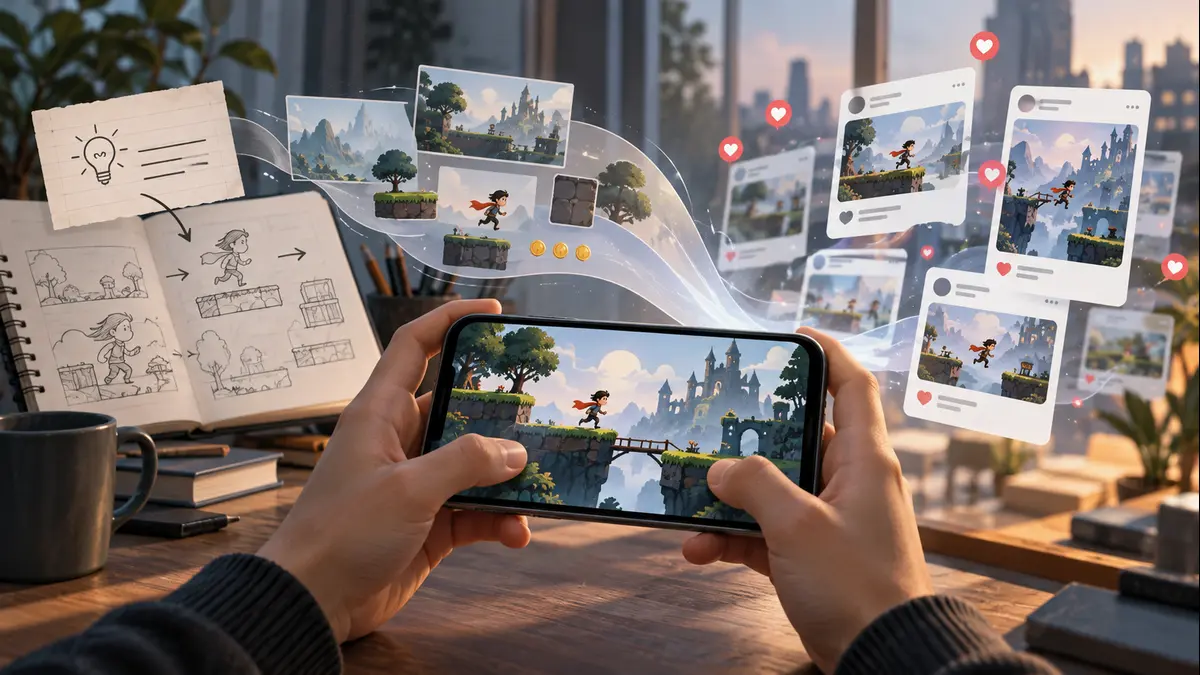
Imagine describing a game on your phone, playing an early version a little later, and changing its characters or difficulty by typing what you want. Meta wants to make that a normal way to build mobile games.
At Meta Connect on September 24, 2026, the company introduced Horizon Create, a mobile app, and Horizon Studio, a browser-based workspace. Both use what Meta calls the agentic creation capabilities of its Horizon Engine. The company says creators can generate and refine playable 2D or 3D games, including elements such as progression, art direction and multiplayer support. Published games may then be distributed across Horizon, Facebook and Instagram. The tools are currently being tested with creators, and Meta has opened an early-access waitlist.
That combination of creation and distribution is the story. Easier game-making tools are already emerging. Meta’s wager is that a game conceived on a phone can also reach players where they already watch, share and talk about content.
How Horizon Create turns a prompt into a game
Horizon Create is built around a short loop: describe an idea, try the result, then ask for changes. A creator can begin with a written prompt or a template and subsequently adjust the setting, characters, story or progression in ordinary language. Meta says a build can continue in the background while the user plays other games; the app sends a notification when it is ready to test. Several projects can be in progress at once.
The appeal is easy to see. Someone with a good idea for a small multiplayer challenge need not begin by installing a game engine or learning a scripting language. They can get something playable and discover what works through playtesting. But a playable first version is only a starting point. Whether a game is enjoyable, coherent and technically reliable still has to be judged through repeated testing with real players.
Meta describes the output as a complete game, with systems that can be refined rather than a collection of disconnected images and code. That is a product claim at this early stage; creators outside the current test group have yet to establish how consistently the tools handle ambitious ideas or complex mechanics.
What Horizon Studio adds on the web
Horizon Studio is for the point when a prompt is too imprecise. It runs in a browser, with no installation or dedicated gaming PC required, according to Meta. A creator can still request changes in natural language, but can also move elements within a scene, replace assets, adjust script parameters and shape the layout directly.
Projects move between Create and Studio in either direction. Meta says their assets, systems and revision history travel with them. That makes a plausible workflow: capture an idea on a phone, test the first build, then open the same project on a larger screen to make detailed changes. A creator can also start directly in Studio.
The handoff matters because generating a scene and designing a game are different jobs. A prompt may produce an appealing level, but the placement of an obstacle, the timing of a reward or the clarity of a control can decide whether anyone wants to play it twice. Visual editing gives creators another way to make those small, consequential decisions.
Why Facebook and Instagram distribution matters
Meta says a game published through either tool becomes eligible for native distribution across Facebook, Instagram and Horizon. Its example is a person who sees a game clip on Instagram, taps it and enters a multiplayer session within seconds, without an app download or an external redirect. Eligibility, however, does not mean that every game will appear widely in those feeds.
The company says its discovery systems will favor games that engage players, run reliably and bring people back. The company also points to in-game monetization and the Horizon Creator Fund, while saying that more information about monetization options is still to come. For creators weighing whether to invest serious time, those pending details matter as much as the speed of generation.
This distribution plan fits Meta’s wider shift toward mobile Horizon experiences. Earlier in 2026, the company said it was making mobile worlds a central focus after Horizon began as a VR experience. It reported more than 2,000 mobile-only worlds and a more than fourfold rise in mobile monthly active users during 2025. Those are Meta’s own platform figures, and they do not tell us whether the new prompt-built games will retain players. They do explain why the company sees Facebook and Instagram as a way to expand beyond Horizon’s existing audience.
Does this put Meta ahead of Roblox?
Roblox is working on the same broad problem. Its Build tool already lets eligible users create and publish games from prompts on mobile. Roblox says Build currently concentrates on 2D and 2.5D games, with support for more game types and 3D planned. Separately, Roblox Studio offers AI assistance for coding, models and other creation tasks.
Meta therefore cannot claim to have invented prompt-based mobile game creation. Its proposed advantage is the route from a newly made game into Facebook and Instagram, combined with the ability to move a project between a phone and a browser workspace. Roblox, meanwhile, has an established audience that already comes to its platform to play games. Which approach works better for an individual creator will depend on the quality of the tools, the audiences they can actually reach and the terms under which they can earn.
The questions early access still needs to answer
The announcement explains the intended workflow more clearly than it demonstrates performance at scale. We do not yet know how much editing a generated game will need, how well complex multiplayer ideas will hold up, or what reach and earnings a typical creator might see. A rush of easy-to-produce games could also make discovery more competitive. These are questions for the rollout, not conclusions that can be drawn from a product demonstration.
Safety is another practical test. Meta says generated content will pass through its safety systems, games will be reviewed before publication, and published titles will receive automated age ratings. It says existing youth protections, including parental supervision through Family Center, will apply. Those are the company’s stated safeguards; their effectiveness for games made and revised at this speed will become clearer with broader use.
Horizon Create and Horizon Studio make a compelling promise: a person can move from an idea to a playable game with far less technical preparation. Their success will be measured later, when creators have broad access and players can choose whether to come back. The prompt can start the game. The people playing it will decide whether it lasts.
Discover more from Poniak Times
Subscribe to get the latest posts sent to your email.