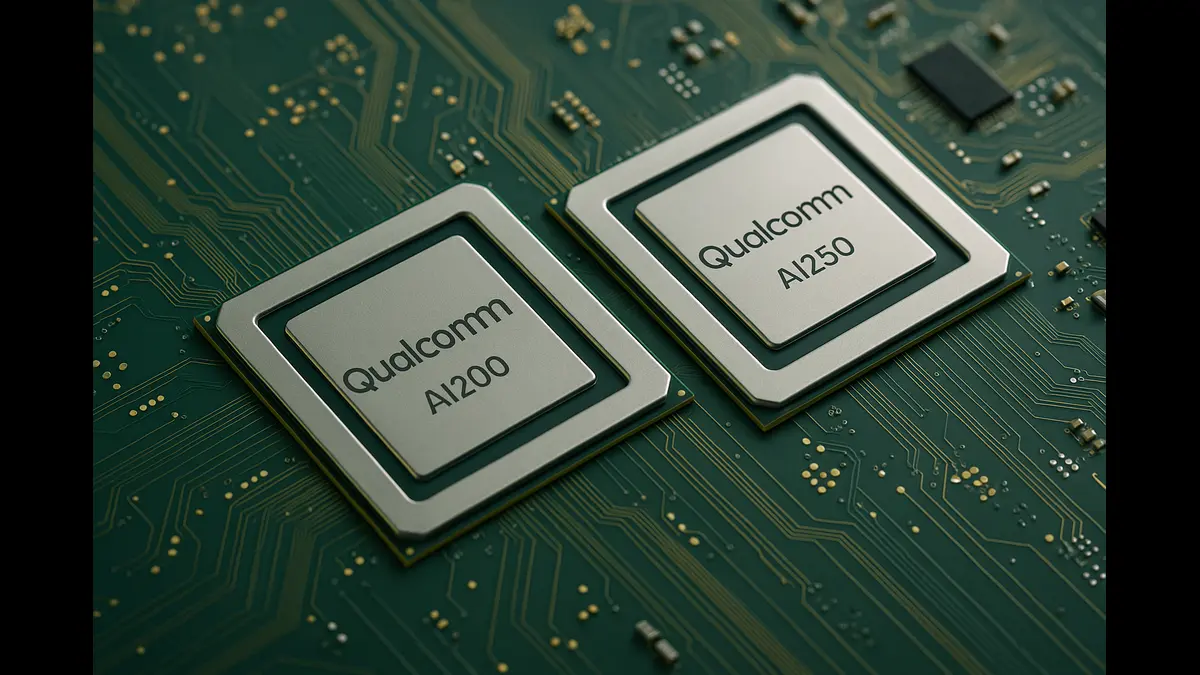
Qualcomm unveils the AI200 and AI250 accelerator chips, challenging Nvidia’s dominance with a bold push for efficient, scalable AI hardware.
In the fast-moving arena of semiconductor technology, where innovation never stops, a new competition has begun.On October 27, 2025, Qualcomm entered the competition by launching its new AI200 and AI250 accelerator chips. These advanced, energy-efficient chips are designed to compete with major industry players like Nvidia and AMD. They aim to meet the increasing demand for AI processing across everything from small edge devices to large data centers, highlighting a major shift toward greater efficiency in computing. Following the announcement, Qualcomm’s stock price rose sharply, showing that bold innovation can bring strong rewards in the technology market.
Qualcomm’s Efficiency Strategy: A Smarter Way to Power AI
Qualcomm has entered the AI chip race with a practical approach. Its new AI200 and AI250 chips are not copies of the large GPUs that currently dominate AI processing. Instead, they are designed specifically for running AI models efficiently, offering strong performance while using much less power.
Both chips draw from Qualcomm’s long experience in mobile technology, especially from its Snapdragon series, to bring the same kind of efficiency to data centers. Each chip supports up to 768 GB of memory, and the AI250 adds a new “near-memory” design that can make data transfer more than ten times faster than traditional systems.
These chips are made for real-world use. Think of factory robots powered by AI or self-driving vehicles analyzing data instantly without draining their batteries. That’s where Qualcomm’s strength lies—bringing efficient AI computing to the edge. In large data centers, where cooling costs are huge, the AI250 could help companies run AI systems in a more energy-saving way.
Industry reports suggest that Qualcomm’s chips are already being used in major projects, including a 200-megawatt AI installation in Saudi Arabia. While there are unconfirmed rumors about possible partnerships with AWS or Microsoft Azure, Qualcomm’s arrival adds valuable diversity to the AI hardware market.
This is not Qualcomm’s first move into AI. Although Nvidia has long dominated the space, Qualcomm has steadily developed its own mixed-computing systems that combine ARM-based cores with specialized AI processors. The AI200 series reflects that same design idea—efficient, scalable, and practical.
Nvidia’s Throne: $5 Trillion and Counting—but Cracks Are Appearing
Despite Qualcomm’s strong entry, Nvidia remains the clear leader in AI chips. Just days before Qualcomm’s launch, Nvidia made history by becoming the first semiconductor company worth over $5 trillion.
This success is driven by massive demand for its H100, H200, and Blackwell GPUs, which are used to train AI models like OpenAI’s GPT series and Meta’s Llama models. Nvidia’s data-center revenue keeps rising sharply, though the exact year-over-year growth figure—said by some analysts to be around 40%—has not been officially confirmed.
However, dominance comes with challenges. Nvidia’s GPUs are incredibly powerful but also consume huge amounts of electricity—up to 700 watts per chip in some setups. As data centers grow and power grids face pressure, many tech leaders are starting to question whether this energy use is sustainable. Qualcomm’s focus on efficiency may not defeat Nvidia, but it could push the entire industry to rethink how much power is too much.
Geopolitical Pressures: U.S. Tightens Export Rules
No story about global technology is complete without politics. The renewed Trump administration has announced plans to tighten export rules for advanced AI chips sent to China and certain other countries, citing national security risks.
Earlier restrictions already limited sales of Nvidia’s A100 and H100 chips to China. The new rules may extend those limits to include the Blackwell line. If approved, this could reduce Nvidia’s revenue from China, which is believed to be worth several billion dollars each year.For Qualcomm, the outcome is mixed. On one hand, its U.S.-based supply chain and focus on American manufacturing could be an advantage. On the other, the possibility of tariffs and global trade tensions creates new risks. The global chip industry is increasingly caught in the middle of a power struggle between nations.
Quantum Computing: The Next Leap Forward
While companies battle in the classical chip market, breakthroughs are happening in quantum computing. Google’s Quantum AI division recently announced the Willow chip, a 105-qubit processor that achieved new records in error-free quantum computation.
In tests, Willow completed complex data tasks in minutes that would challenge even the most powerful traditional supercomputers. These results were published in the scientific journal Nature.Although this doesn’t immediately threaten today’s encryption systems, it marks a big step toward practical, fault-tolerant quantum computers. For AI, that means faster simulations, smarter optimization, and much lower energy costs for training.Competitors like IBM (with its Condor chip), IonQ (Aria), and China’s Jiuzhang 3.0 are also advancing, but Google currently leads with its progress in reducing quantum computing errors.
The events of 2025 reveal a clear truth: the future of AI hardware is not just about producing more power—it’s about using power more wisely.
Efficiency, sustainability, and control over supply chains have become the new priorities. Qualcomm’s energy-efficient chips could push Nvidia to innovate in new directions. Trade tensions could lead countries to build their own manufacturing bases. And advances in quantum computing might one day change the limits of what machines can do.
For companies and innovators, the message is clear: diversify. Don’t rely on a single chipmaker or technology. Explore modular hardware, stay updated on quantum breakthroughs, and stay flexible as global policies shift.
The battle for AI hardware leadership is far from over—it’s just entering a new and exciting stage. In this race, the winners will be those who combine intelligence with efficiency to shape the next generation of computing.
Discover more from Poniak Times
Subscribe to get the latest posts sent to your email.