Elon Musk plans to rename SpaceXAI to SpaceXSI after a government terminology shift. Explore why the move is voluntary, what superintelligence means in research, and how Grok, Colossus and orbital computing fit into SpaceX’s ambitions. A new name signals intent, but capabilities still need evidence.
A single letter can change the promise a company appears to make. “AI” describes a broad field of technology. “SI”, short for “super intelligence”, suggests something more ambitious: machines capable of exceeding human intelligence. Elon Musk’s proposed switch from SpaceXAI to SpaceXSI brings that difference into focus.
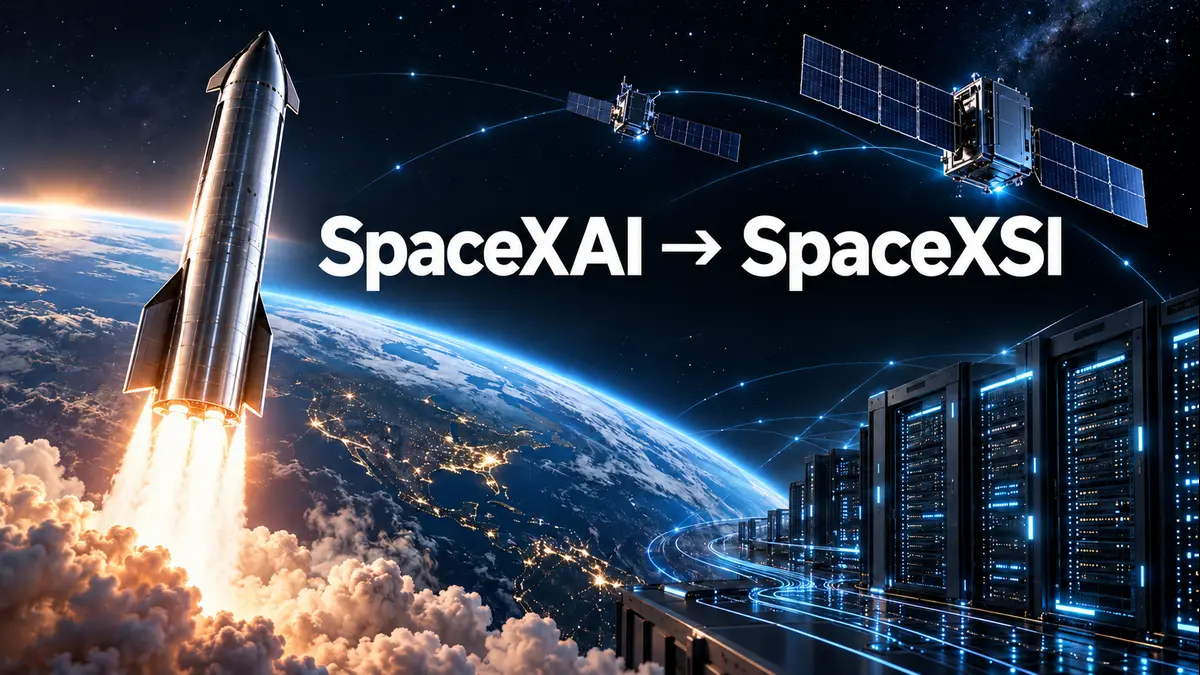
On October 4, 2026, Musk confirmed the planned rename in a reply on X. Asked whether SpaceXAI would become SpaceXSI, he answered: “Yes, we will make that change.” No implementation timeline accompanied the confirmation. The exchange was brief, but the surrounding story deserves a closer look. It connects a government terminology directive, SpaceX’s expanding AI business and a question that branding alone cannot answer: what would justify calling a system superintelligent?
The Government Order Behind the Terminology Shift
Musk’s announcement followed President Donald Trump’s September 29 executive order, Inaugurating the Era of Super Intelligence. Executive Order 14434 directs US executive-branch agencies to use “Super Intelligence” and “SI” instead of “Artificial Intelligence” and “AI” in official communications, websites, reports and other non-statutory documents, to the extent permitted by law. Previously issued regulations, contracts and historical documents do not have to be rewritten.
The administration argues that the new language better captures the potential and advancing capabilities of the technology. However, the order does not require private companies to rename themselves. SpaceXSI is Musk’s voluntary adoption of the preferred terminology.
There is also an important detail in the order’s definition section. Initially, SI covers the technologies already encompassed by the existing statutory definition of AI. The order requests proposed legislative language within 60 days to consider a federal definition. In other words, the terminology changes without establishing that the systems it describes have crossed a new technical threshold.
From xAI to SpaceXAI: A Fast-Moving Identity
The proposed rename comes shortly after the business acquired its current identity.
SpaceX acquired xAI in February 2026, bringing Grok and the AI business into the aerospace company. In May, Musk said xAI would be dissolved as a separate company and its products would be branded SpaceXAI. On July 6, the public rebrand appeared through a new logo and an updated X handle. Only three months later, Musk confirmed plans for SpaceXSI. That sequence helps explain the attention around the announcement. The business is still establishing its identity within SpaceX, and its proposed name now carries an even stronger claim.
What Superintelligence Actually Means
In AI research, superintelligence generally describes an intellect that substantially exceeds the best human capabilities across practically every important cognitive field. Scientific creativity, strategic judgement and social understanding are among the abilities traditionally included.
A system can outperform humans at a specialised task without meeting that standard. Consider an assistant that writes excellent code but struggles to identify an incorrect assumption in an unfamiliar engineering problem. Its coding ability may be valuable, yet that achievement alone does not establish broadly superior intelligence.
This distinction is easy to lose when the same phrase appears in research, policy and marketing. In the executive order, “Super Intelligence” initially serves as a replacement label for AI. In research, it describes a much more demanding capability. Musk has also suggested that fewer humans will be involved as systems improve their ability to improve themselves. That expresses his view of their trajectory. The rename provides no technical evidence that Grok has achieved autonomous recursive self-improvement. The useful question is how such progress would be demonstrated, tested and independently assessed.
Why an Aerospace Company Is Building an AI Business
The more substantial story lies beneath the branding. SpaceX brings launch and satellite capabilities together with the AI operations acquired through xAI. A plausible reading of that combination is that Musk wants greater control over the infrastructure supporting intelligence development, alongside the models themselves.
There is an existing terrestrial business behind this ambition. In its May 6 announcement of a compute partnership with Anthropic, SpaceXAI said it would provide access to Colossus 1 for workloads including training, fine-tuning and inference. Training develops a model’s capabilities; inference is the computation used when it responds to a request. Both require physical infrastructure. That makes the partnership relevant beyond Grok. Computing capacity can support another developer’s models as well as SpaceX’s own products. The business therefore extends beyond a chatbot interface to the machinery that enables AI services to operate.
Orbital Computing: An Ambition with Engineering Attached
SpaceX’s launch capabilities add a distinctive possibility: placing computing infrastructure in orbit. Its Anthropic partnership announcement included interest in developing orbital AI computing capacity. The company also acknowledged that engineering challenges would need to be overcome.
The prospect is compelling, but operating a data center in space introduces constraints that a new name cannot solve. In a 2024 study with IBM and KP Labs, the European Space Agency highlighted challenges involving satellite size, radiation, heat dissipation and power. The distinction between operating terrestrial capacity and proposed orbital infrastructure matters. Colossus provides an existing foundation; space-based computing requires further engineering and implementation.
For readers, the evidence to watch is concrete: what hardware is deployed, which workloads it supports, how reliably it operates and whether its economics justify expansion. The connection between rockets and AI becomes meaningful when those capabilities deliver a workable service.
A Bigger Name Brings Bigger Expectations
“Super intelligence” invites audiences to expect more from a system. For an ordinary user, that could mean an assistant that handles difficult questions reliably. For a business, it could mean software trusted with increasingly consequential decisions. Those expectations make clear communication essential. A model’s strengths, limitations and dependence on human oversight remain relevant regardless of its label.
The distinction is especially important for customers evaluating AI products. An impressive demonstration is a starting point. Consistent performance on unfamiliar tasks, transparent evaluation and dependable operation provide a stronger basis for adoption. SpaceX’s branding may help communicate ambition. Customers will still need evidence that the products meet their requirements.
What the SpaceXSI Rebrand Ultimately Signals
Musk’s proposed rename places SpaceX’s AI business within a more ambitious public narrative. It also shows how quickly government language can influence corporate branding, even when private companies are under no obligation to follow it. For now, the announcement confirms an intended name change. It does not settle the technical meaning of superintelligence or demonstrate its arrival.
The story will become more consequential as SpaceX delivers models, computing services and orbital infrastructure that can be evaluated on their merits. The new initials introduce the ambition; the engineering must give it substance.
Discover more from Poniak Times
Subscribe to get the latest posts sent to your email.