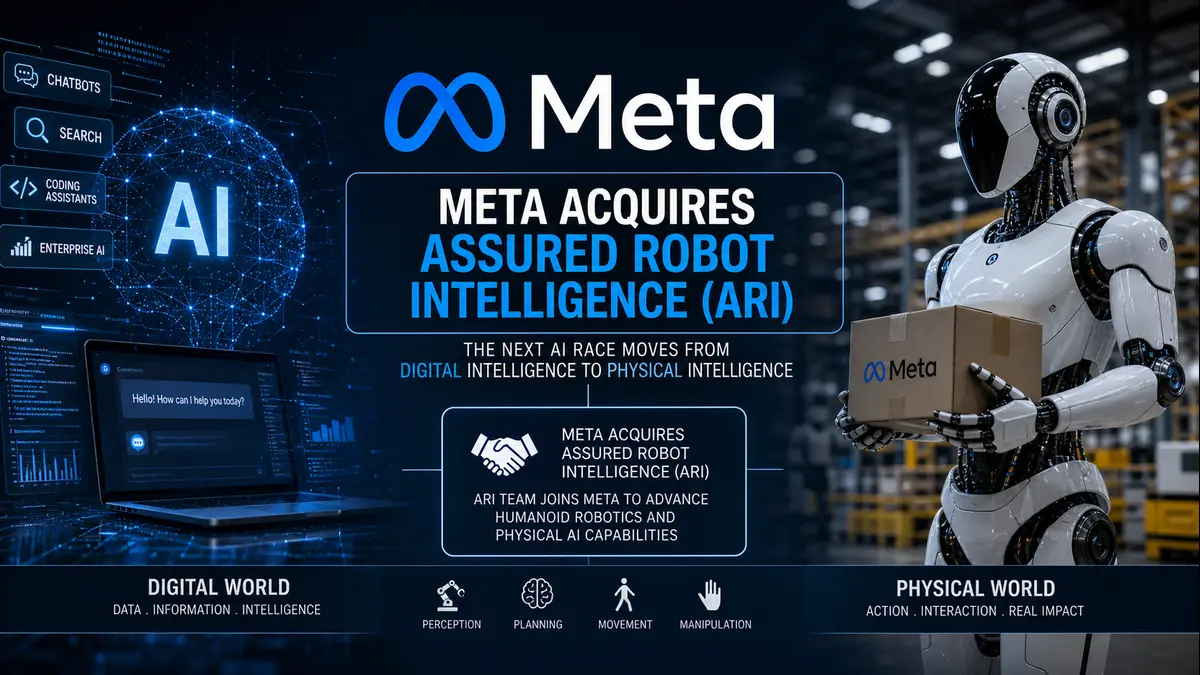
Meta’s acquisition of Assured Robot Intelligence shows how the AI race is expanding beyond chatbots, search, and coding tools into humanoid robotics and physical intelligence.
The first phase of the AI competition largely boiled down to one question: who could build the most capable intelligence system for the digital world?
That race is still far from over. Chatbots, search engines, coding assistants, image generators, office copilots, research agents, and enterprise automation tools continue to define the visible face of artificial intelligence. Companies are still competing to build larger models, faster inference systems, stronger reasoning layers, better retrieval pipelines, and more useful AI products for knowledge work.
But a second race is now beginning to form alongside it.
This new race is not only about generating text, answering questions, writing code, or summarizing documents.
It is about building AI systems that can understand the physical world, move through it, interact with humans, manipulate objects, and perform useful work in real environments. In other words, AI is no longer only being trained to think and respond. It is being trained to perceive, move, and act.
Meta’s acquisition of Assured Robot Intelligence, or ARI, fits directly into this shift.
Meta has acquired ARI, a San Diego-based startup focused on artificial intelligence for humanoid robots. The deal value has not been disclosed. Reports say ARI was founded in 2025 by robotics researchers Xiaolong Wang and Lerrel Pinto, and that its work focuses on models that allow robots to understand, predict, and adapt to human behaviour in complex environments. The company’s team is joining Meta’s broader AI and robotics efforts.
That may sound like another AI talent acqui-hiring. But it is more than that.
For a robot to understand and adapt around humans is one of the hardest problems in artificial intelligence. A chatbot can make an error and rewrite an answer. A robot moving inside a home, factory, warehouse, or hospital does not have that luxury. It has to deal with physics, safety, timing, fragile objects, unpredictable humans, and environments that are never perfectly structured.
That is why Meta’s ARI acquisition matters. It is not just a robotics deal. It is a signal that the next AI platform war may be about physical intelligence.
From Digital AI to Physical AI
Digital AI works mainly with information. It processes words, images, code, numbers, documents, emails, dashboards, and enterprise workflows. Its world is made of tokens, databases, APIs, files, and user interfaces.
Physical AI is different. It must operate in the real world. It must see, hear, move, touch, balance, grip, avoid obstacles, follow instructions, learn from humans, and make decisions under uncertainty. A humanoid robot is not just a chatbot with arms and legs. It is a system that combines perception, control, planning, memory, dexterity, safety, and real-time adaptation.
This is a major technical jump.
A large language model predicts useful outputs from patterns in data. A humanoid robot must convert intelligence into action. It must not only understand the instruction “pick up the cup,” but also identify the cup, estimate its position, plan a path, move the arm, grip the object without crushing it, avoid nearby obstacles, and place it safely somewhere else.
This is why the term “physical AI” is becoming important. It refers to AI systems that do not merely generate content, but act in the physical environment.
In digital AI, the output is often a sentence, a code block, an image, or a decision recommendation. In physical AI, the output is movement. And movement introduces consequences.
Why Meta Is Interested in Robots
At first glance, robotics may look like a strange direction for Meta. The company is best known for social platforms, advertising, AI research, virtual reality, augmented reality, and consumer devices. But robotics may fit Meta’s long-term direction more naturally than it appears.
Meta has already been reported to be working on humanoid robots through its Reality Labs division. Earlier reports said the company was exploring both hardware and software for humanoid robots, with a focus on household tasks and broader robotics capabilities.
The key point is that Meta may not need to become a traditional robot manufacturer first. Its bigger opportunity may be to build the intelligence layer that future robots use.
That would fit Meta’s historical strength. Meta’s largest businesses were not built by selling heavy physical products. They were built by owning platforms, software layers, user behaviour systems, developer ecosystems, and massive distribution networks.
In robotics, the equivalent opportunity could be the operating layer for humanoid machines.
If humanoid robots become an important computing platform, someone will need to provide the models that allow them to understand human commands, interpret messy environments, perform useful tasks, and learn from feedback. That software layer may become as strategically important as Android was for smartphones or cloud infrastructure was for internet companies.
Meta may be entering robotics not because it wants to build every motor, joint, battery, and actuator itself. It may be entering because it does not want to miss the next platform shift.
Why Humanoid Robots Are Harder Than LLMs
The hype around humanoid robots often hides the difficulty of the engineering problem.
A language model can appear intelligent even when it does not truly understand the physical world. A robot cannot fake physical competence for long. It either performs the task or it does not. It either moves safely or it becomes a risk.
A factory may be relatively controlled, but even there, robots need precision, repeatability, safety, and reliability. A home is far harder. Homes are messy and unpredictable. A chair may be in a different place every day. A child may leave toys on the floor. A dog may run across the room. A glass may be full, empty, hot, cold, fragile, or placed near the edge of a table.
A robot must understand context, not just commands.
This makes robotics fundamentally different from software-only AI. The cost of failure is higher. The data problem is harder. The hardware constraints are real. Battery life matters. Heat matters. Weight matters. Maintenance matters. Motors and sensors matter. So do regulations, liability, and user trust.
Industrial robots have existed for decades, but they mostly work in structured environments with repetitive tasks. General-purpose humanoid robots are different. They are expected to move through spaces designed for humans and perform many kinds of work.
That requires intelligence at a deeper level.
Digital AI Is Still the Larger Market Today
It would be easy to say that humanoid robots will immediately become the biggest AI market. That would be premature.
Digital AI is already entering the enterprise at scale. Banks, law firms, software companies, customer support teams, media firms, manufacturing companies, and consulting firms are adopting AI for coding, automation, research, document processing, search, analytics, and decision support.
Citi recently raised its forecast for the global AI market to more than $4.2 trillion by 2030, with around $1.9 trillion tied to enterprise AI. The forecast was driven by faster adoption of AI tools for coding and automation.
Humanoid robotics is still much earlier. Goldman Sachs Research projected that the global market for humanoid robots could reach $38 billion by 2035, with estimated shipments of 1.4 million units. That is a meaningful opportunity, but still far smaller than the near-term forecasts for digital and enterprise AI.
So the better argument is not that physical AI is already bigger than digital AI.
The better argument is that physical AI may become the next deeper layer of AI transformation.
Digital AI automates parts of knowledge work. Physical AI could automate parts of labour, logistics, manufacturing, elder care, household assistance, inspection, warehousing, and industrial operations. Digital AI changes how people work with information. Physical AI changes how machines participate in the physical economy.
That is a harder market to enter. But if solved, it could be structurally powerful.
The Race Is Already Crowded
Meta is not entering an empty field.
Tesla is developing Optimus, betting that its work in batteries, motors, manufacturing, computer vision, and autonomous systems can transfer into humanoid robotics. Figure AI has been testing humanoid robots in industrial environments, including work connected to BMW’s Spartanburg plant. BMW has said Figure 02 was being tested in a real production environment at the plant.
Agility Robotics is another important player, especially in logistics and warehouse automation. The company says its Digit humanoid robot is designed for manufacturing, distribution, and logistics environments, and Agility has reported commercial deployment milestones such as moving more than 100,000 totes at a GXO facility.
Nvidia is also becoming central to the robotics stack. Its Isaac GR00T platform is designed for robot foundation models and data pipelines, with a focus on accelerating humanoid robotics development. Nvidia describes GR00T as a research initiative and development platform for general-purpose robot foundation models.
This shows that the humanoid robotics race is not only about hardware. It is about the full stack: chips, simulation, robot foundation models, vision-language-action systems, synthetic data, control models, safety systems, and deployment platforms.
The robot body will matter. But the robot brain may matter even more.
The Intelligence Layer May Become the Real Prize
The most important question is not whether Meta will launch a humanoid robot tomorrow. The more important question is whether Meta can build a reusable intelligence layer for robots.
Hardware is visible, but intelligence creates differentiation.
Many companies may eventually build capable humanoid bodies. Some will specialize in home robots. Some will focus on factories. Some will target warehouses. Some may build low-cost robots for mass deployment. But if robot hardware becomes more standardized over time, the major competitive advantage may shift to software.
The winning robot will not simply be the one that walks beautifully on stage. It will be the one that can perform economically useful work again and again, safely and reliably.
That requires models that can learn from demonstration, improve through simulation, generalize across tasks, and adapt to different bodies and environments. It also requires systems that can follow safety constraints, handle exceptions, and recover when something goes wrong.
This is where Meta’s AI research depth could matter. Meta has experience in large-scale AI training, computer vision, open-source models, social behaviour systems, infrastructure, and consumer-scale deployment. If that expertise can be translated into robot control and real-world learning, Meta could become an important player in physical AI.
But that remains a major challenge. Robotics is not a pure software race. The real world has friction, gravity, uncertainty, and liability.
The Risks Are Bigger Than Chatbots
Humanoid robots bring opportunity, but they also raise serious risks.
The first risk is safety. A robot operating near humans must be predictable, controllable, and physically safe. A software bug can cause inconvenience. A robotics failure can damage property or injure people.
The second risk is surveillance. A humanoid robot in a home, hospital, office, school, or factory may carry cameras, microphones, sensors, and behavioural models. If such systems are controlled by companies that already operate massive digital platforms, the privacy questions become serious.
The third risk is labour disruption. Robots may first take over dangerous, repetitive, or labour-shortage tasks. That can be useful. But if humanoid robots become cheap and capable, they could reshape employment in logistics, manufacturing, retail, caregiving, and facility operations.
The fourth risk is power concentration. If only a few large technology companies control both digital AI and physical AI, they may gain enormous influence over the future of work, production, mobility, defence, and daily life.
The fifth risk is misuse. Any technology that combines autonomy, perception, movement, and physical action can be dual-use. Robotics can help in disaster response, healthcare, and industrial safety. It can also be used for surveillance, coercion, or military applications.
This is not an argument against robotics. It is an argument for serious governance before the technology becomes deeply embedded in society.
The Bigger Picture
Meta’s acquisition of ARI should not be read as proof that humanoid robots will become mainstream immediately. Robotics has seen waves of excitement before, and the real world is unforgiving. Hardware is expensive. Reliability takes time. Useful deployment requires more than impressive demonstrations.
But the direction is clear.
AI is expanding from text to action. From screens to sensors. From documents to factories. From chat windows to physical environments.
The first phase of the AI competition was defined by models that could understand and generate digital information. That phase is still alive and accelerating. But the next phase is beginning to ask a harder question: can AI understand the physical world well enough to act inside it?
Meta’s ARI acquisition is one move in that larger race. It places Meta closer to companies trying to build the brains of future humanoid robots. Whether Meta becomes a robot manufacturer, a robotics platform provider, or a supplier of intelligence systems remains unclear.
But the strategic intent is visible.
Meta does not want to be a spectator if humanoid robots become the next major computing platform.
For now, digital AI remains the larger and more immediate commercial opportunity. Enterprises are already adopting AI for coding, search, automation, and knowledge work. Physical AI is still early, expensive, and technically difficult.
But if humanoid robots eventually become useful at scale, the impact may go beyond software. It could reshape labour, logistics, manufacturing, care work, and the physical economy itself.
The chatbot era proved that intelligence could be delivered through software.
The robotics era will test whether intelligence can safely enter the physical world.
That is why Meta’s acquisition of Assured Robot Intelligence matters. It is not just another AI deal. It is a signal that the next great AI race may not only be about who answers better on a screen, but who builds machines that can understand, move, and work in the real world.
Discover more from Poniak Times
Subscribe to get the latest posts sent to your email.