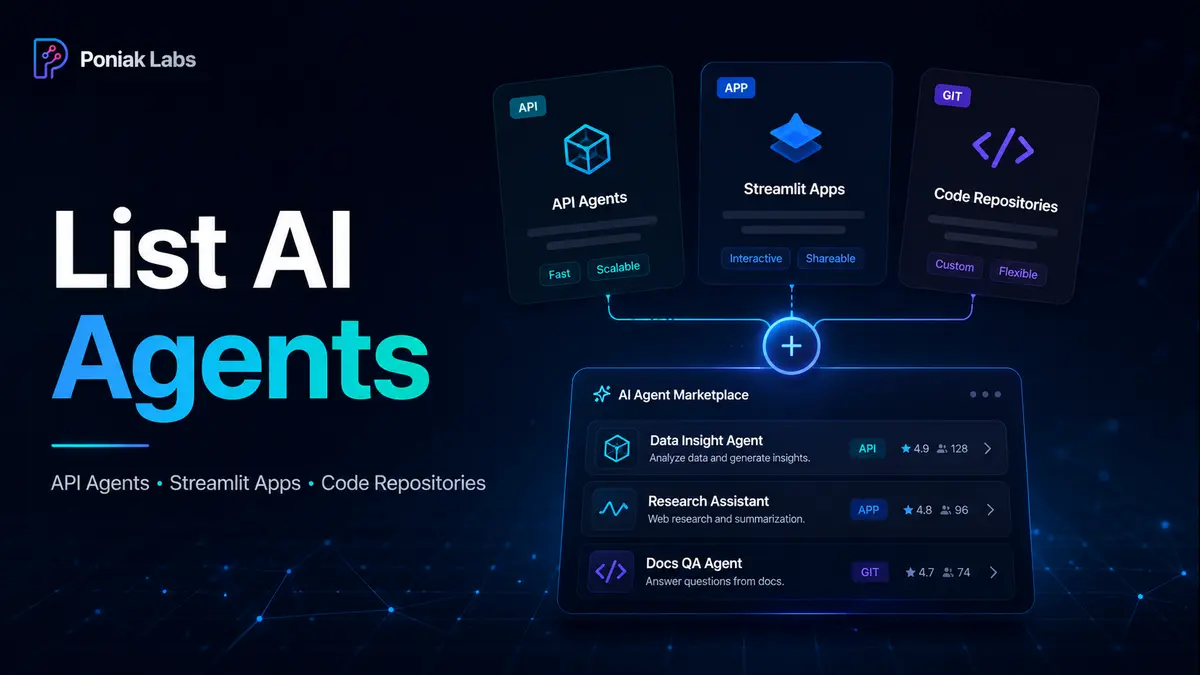
Poniak Labs supports three major agent listing formats: API Agents, Streamlit Apps, and Code Repository Agents. This article explains how developers can package, present, and monetize AI agents as the market moves toward structured commercial adoption.
The AI agent market is moving from scattered experimentation toward structured commercial adoption.
Over the last few years, developers have built thousands of AI-powered tools, automation scripts, research assistants, workflow agents, and internal copilots. Many of these agents are useful. Some can extract information from documents. Some can automate research. Some can generate reports. Others can interact with APIs, process business data, or support operations teams.
But one important question remains unresolved.
How should these agents be packaged, presented, and sold?
This question matters because an AI agent is not always a single type of software product. Some agents are backend APIs. Some are visual applications. Some are complete code repositories that other developers can clone, modify, and deploy.
A serious marketplace for AI agents must support this diversity instead of forcing every creator into one rigid format.
Poniak Labs is being built with this practical reality in mind.
The platform supports multiple listing formats so developers can bring different kinds of agentic software into a marketplace environment.
The first version focuses on three core listing types: API Agents, Streamlit Agents, and Code Repository Agents.
Each format serves a different kind of buyer, use case, and technical requirement.
Why Agent Packaging Matters
A traditional software product is usually easy to categorize. It may be a mobile app, a SaaS tool, a plugin, a template, or a downloadable file.
AI agents are more complex.
An agent may work silently in the background. It may receive a request, call an external tool, process a document, retrieve information, and return a structured output. Another agent may come with a dashboard where users upload files, enter inputs, and view results. A third agent may be a full codebase that a technical buyer wants to deploy inside their own infrastructure.
All three may be valid AI agents, but they should not be packaged in the same way.
This is why agent packaging matters.
A buyer needs to understand what they are purchasing. A seller needs to explain how the agent works.
The marketplace needs to support access, pricing, testing, and delivery in a format that matches the agent’s actual structure.
Without clear packaging, even a useful agent can look confusing.
A logistics delay prediction agent, for example, may be best offered as an API because another software system can call it automatically. A finance document analysis agent may work better as a Streamlit app because a user may want to upload reports and view results visually. A developer-focused LangGraph workflow may be more valuable as a code repository because the buyer may want to inspect and customize the logic.
The product format must match the use case.
That is the principle behind agent listing on Poniak Labs.
The Three Agent Listing Formats on Poniak Labs
Poniak Labs currently supports three major types of agent listings: API Agents, Streamlit Agents, and Code Repository Agents.
These categories are designed to make the marketplace more practical for both sellers and buyers. Sellers can choose the format that best represents their agent. Buyers can understand what kind of access they are getting before they make a decision.
API Agents
API Agents are agents exposed through REST API endpoints.
This is one of the most important listing formats for serious automation use cases. An API Agent does not necessarily need a user interface. It is designed to be called by another system, application, dashboard, or workflow.
For example, a buyer may want an agent that accepts an invoice PDF and returns structured JSON. Another buyer may want an agent that receives a company name and produces a research summary. A third buyer may want an agent that checks shipment data and predicts delay risk.
In all these cases, the agent can be deployed as a backend service and accessed through an API.
This format is suitable for agents built using frameworks such as FastAPI, LangGraph, LangChain, CrewAI, or custom Python services. The creator can deploy the agent on platforms such as Render, Railway, Fly.io, or similar hosting environments.
Once deployed, the agent can be listed on Poniak Labs with its endpoint details, usage description, pricing model, and sample input-output structure.
API Agents are especially useful for business workflows because they can be integrated into existing systems.
A company does not always need a new interface. Sometimes, it needs a reliable intelligence layer that can be called from its current software stack. API Agents make that possible.
Common Use Cases for API Agents
API Agents can be used for document extraction, lead enrichment, customer support classification, logistics risk analysis, financial research, automated report generation, email triage, compliance checks, and internal workflow automation.
They are also useful when the buyer wants the agent to run behind the scenes.
For sellers, API Agents are attractive because they allow usage-based access. A creator can define how the agent is used, what it returns, and how it should be priced. The marketplace can then help structure discovery, access, and monetization around that endpoint.
For buyers, the value is simple: they get access to a working agent without having to build it from scratch.
Streamlit Agents
Streamlit Agents are interactive AI applications with a visual interface.
This format is useful when the buyer needs to interact with the agent directly. Instead of calling an API manually, the user can open a web app, enter inputs, upload files, configure options, and view results inside a simple interface.
Streamlit has become popular among AI builders because it allows developers to create functional data and AI applications quickly. For many agentic workflows, this is enough to demonstrate real value.
A Streamlit Agent may allow a user to upload a spreadsheet and generate insights. It may let a business owner upload invoices and extract structured data. It may help a researcher analyze documents. It may give an operations team a dashboard for decision support.
In these cases, the interface matters.
The buyer does not only want an endpoint. They want a usable tool.
This is where Streamlit Agents become valuable on Poniak Labs. They allow developers to list visual, interactive agent applications that buyers can test and understand more easily.
When Streamlit Agents Make Sense
Streamlit Agents are suitable when the agent benefits from direct human interaction.
For example, a document analysis agent may need a file uploader. A financial research assistant may need input fields and output sections. A data cleaning agent may need preview tables. A logistics monitoring agent may need charts or status summaries.
These workflows are easier to understand when they are presented visually.
Streamlit Agents also work well for early-stage products and demos. A creator may not yet have a full SaaS platform, but they may already have a useful agentic tool. Listing it as a Streamlit Agent gives them a way to show the product’s value without building a complex front-end system.
For buyers, the benefit is clarity. They can see what the agent does, test the interface, and understand the output before committing to deeper usage.
Code Repository Agents
Code Repository Agents are packaged agent codebases that buyers can inspect, clone, customize, license, or deploy.
This format is especially important for technical buyers.
Not every buyer wants to use an agent through an external endpoint. Some teams may prefer to deploy the code inside their own environment. Others may want to study the architecture, modify the prompts, connect their own APIs, or extend the workflow for internal use.
A Code Repository Agent gives them that flexibility.
This type of listing may include a GitHub repository, documentation, setup instructions, dependency details, environment variable guidance, and deployment steps. The repository may contain a LangGraph workflow, a CrewAI project, a FastAPI backend, a RAG pipeline, or a complete agent template.
This is useful for developers, startups, agencies, and enterprise engineering teams that want more control.
Why Code Repository Agents Matter
Code Repository Agents turn agentic software into reusable technical assets.
A developer may build a strong research agent architecture. Another team may want to buy or license that structure rather than create it from the beginning. A seller may package a working agent with clean documentation and offer it as a repository-based product.
This creates a different kind of value compared to API access.
With an API Agent, the buyer uses the creator’s hosted service.
With a Code Repository Agent, the buyer gets access to the underlying implementation.
This format is useful for buyers who care about customization, security, internal deployment, or technical learning. It also allows sellers to monetize reusable engineering work, not just hosted endpoints.
For Poniak Labs, this category is important because the AI agent economy will not be limited to finished applications. It will also include templates, frameworks, workflows, and deployable code structures.
What Buyers Should Check Before Using an Agent
As the AI agent market matures, buyers will become more selective.
They will not only ask whether an agent looks impressive. They will ask whether it is reliable, understandable, secure, and useful for a real workflow.
Before using an agent on Poniak Labs, buyers should check a few important details.
First, they should understand the agent’s core use case. A good listing should clearly explain what problem the agent solves and who it is built for.
Second, they should review the input and output format. If the agent accepts PDFs, CSV files, text prompts, API payloads, or structured data, that should be clearly described. The expected output should also be visible through examples.
Third, buyers should check the pricing model. Some agents may be priced by usage, some by access, and some as a repository license. The pricing should match the value and complexity of the agent.
Fourth, buyers should look for documentation. Even a simple agent becomes more trustworthy when it includes clear instructions, limitations, setup details, and sample use cases.
Finally, buyers should evaluate whether the agent fits their workflow. A strong AI agent is not just technically impressive. It must solve a problem that matters enough to be used repeatedly.
What Sellers Should Prepare Before Listing
For sellers, listing an agent is not only about uploading a link.
A good listing should make the agent easy to understand, test, and trust.
Before listing an agent on Poniak Labs, sellers should prepare a clear title, a concise description, a defined use case, sample input-output examples, pricing logic, and basic documentation.
For API Agents, sellers should make sure the endpoint is working, stable, and properly documented. They should explain the request format, response format, authentication method if applicable, and expected usage limits.
For Streamlit Agents, sellers should ensure that the application loads properly, the interface is understandable, and the workflow is simple enough for a buyer to test.
For Code Repository Agents, sellers should provide setup instructions, environment variable guidance, dependency details, and a clear README file. A repository without documentation is difficult to evaluate, even if the code is strong.
The goal is to reduce buyer uncertainty.
A buyer should be able to understand what the agent does, how it works, what it costs, and what result they can expect.
The better the listing, the higher the chance of trust.
Why This Helps the Agent Marketplace Mature
The AI agent market is moving from scattered prototypes toward structured commercial products.
That shift requires better standards.
Developers need to think not only like builders, but also like product owners. They need to package their agents clearly, document them properly, define pricing, and explain business value.
Buyers also need better evaluation tools. They need to compare agents based on use case, format, output quality, pricing, and implementation model.
A marketplace can help both sides.
Poniak Labs is designed to create this structured layer. By supporting API Agents, Streamlit Agents, and Code Repository Agents, the platform gives creators more flexibility and buyers more clarity.
This is important because the future of AI agents will not be shaped only by model quality. It will also depend on packaging, distribution, trust, and usability.
In traditional software, the market matured when products became easier to discover, buy, install, and integrate. AI agents will follow a similar path.
The builders who understand this early will have an advantage.
The Road Ahead
AI agents are becoming a serious category of software.
Some will automate narrow tasks. Some will support research and analysis. Some will integrate with enterprise systems. Some will become internal productivity tools. Others will be sold as reusable code, hosted APIs, or interactive applications.
This diversity is healthy.
But it also means the market needs better structure.
Poniak Labs is building a listing layer that recognizes the different ways agents are created and consumed. Instead of treating every agent as the same kind of product, the platform supports multiple formats that match real developer workflows. We are beginning with a focused set of initial agent listings, and the marketplace will continue to expand as more developers bring their agents onto the platform. The objective is not to create volume for the sake of volume, but to build a structured environment where useful agents can be listed, reviewed, discovered, and gradually scaled.
As part of this early creator program, developers are invited to list their agents on Poniak Labs with free onboarding for the first six months.
As the platform grows, the focus will remain on practical utility, clear packaging, and reliable agent experiences for buyers.
For creators, this means a clearer path to distribution and monetization. For buyers, it means a better way to discover and evaluate agentic tools. For the broader ecosystem, it represents one step toward turning AI agents from isolated demos into commercial software products.
As the market matures, the winners will not only be the agents with the most impressive prompts. They will be the agents that are well packaged, clearly explained, reliable, and useful in real workflows. That is the standard Poniak Labs is being built around.
Discover more from Poniak Times
Subscribe to get the latest posts sent to your email.